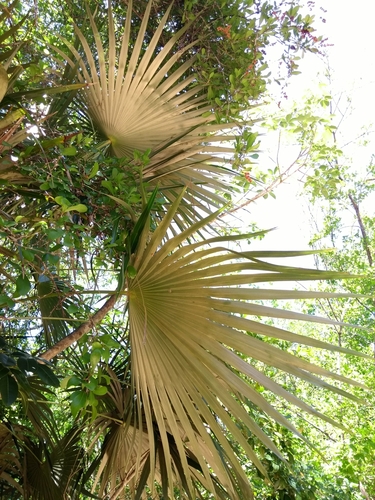
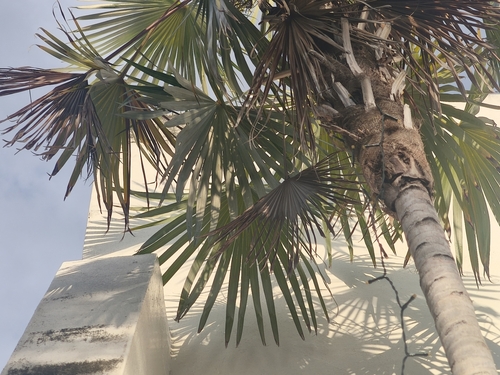
Coccothrinax readii H.J.Quero, the Mexican silver palm (knacás or nak'as in the Yucatán Peninsula), is a small single-stemmed fan palm from the coasts of south-eastern Mexico and northern Belize, and the only Coccothrinax of the Yucatán Peninsula. A remarkably thin trunk, rarely more than a few centimetres thick, carries a loose head of rounded leaves that are deep green above and bright silver beneath. Its most characteristic feature is a hastula that is usually split into two points, which was the basis on which it was described as a species. It is one of the dominant plants of the coastal dune scrub of Yucatán and Quintana Roo, where its stems have long been cut for rustic buildings and fences, and it is grown in tropical and subtropical gardens for its silvery foliage.
Also known asMexican silver palm; knacás; nak'as (Maya, Yucatán Peninsula); náaj k'aax (Maya, Yucatán Peninsula)
Distribution and habitat

Kew records the species as native to south-eastern Mexico and Belize. In Mexico it is confined to the Yucatán Peninsula, in the states of Quintana Roo and Yucatán: Quero traced it from the south of Quintana Roo north and west along the coast to the area of Sisal on the north-western shore of Yucatán. Of the three islands off the north-eastern tip of the peninsula, Quero found scattered plants on Cozumel only, and none on Isla Mujeres or Contoy. In Belize it was first confirmed in 2013 in the Shipstern Nature Reserve near Sarteneja (Corozal District), where nine plants were located at about 2 m elevation in deciduous forest with Beaucarnea pliabilis, Bursera simaruba, Thrinax radiata, Vitex gaumeri and Manilkara zapota; it also grows in Bacalar Chico National Park on northern Ambergris Caye. Henderson (2023) gives coastal elevations of 7 (4–10) m on karst limestone.
Quero recognised three habitats:
- Medium-stature forest near the coast of Quintana Roo, from the south of the state to around Cancún, under a canopy of Manilkara zapota, Metopium brownei and Caesalpinia gaumeri. Here the palm is very common in the middle layer of the forest and shapes its appearance, growing best in humid conditions on thin, humus-rich soils only 10–15 cm deep. It penetrates up to 30 km inland in the south but stays within 2 km of the shore near Cancún. Ecologists recognise a Manilkara zapota–Coccothrinax readii forest association in this region, and in a survey of palm communities across the peninsula the species turned up only in semi-evergreen forest.
- Low forest between the medium forest and the dunes in central Quintana Roo, around Tulum, on poorer, very stony ground with outcrops of coralline limestone, alongside Pseudophoenix sargentii, Beaucarnea pliabilis, Acacia gaumeri, Metopium brownei, Pithecellobium platylobum and Thevetia thevetioides.
- Coastal dunes from Tulum north to Sisal, in full sun and sea wind. At Tulum, where rain is frequent, the palm grows with Coccoloba uvifera, Thrinax radiata, Metopium brownei, Chrysobalanus icaco and a Cordia; at Punta Sam with Sophora tomentosa, Thrinax radiata, Chrysobalanus icaco, Pithecellobium keyense and Coccoloba uvifera; at El Cuyo, beside a coastal lagoon, with Metopium brownei, Pseudophoenix sargentii, Thrinax radiata, cacti and an Agave; and around Chelem, near Sisal, in one of the driest parts of the peninsula, with Gossypium hirsutum, Malvaviscus arboreus, Metopium brownei, Thrinax radiata and various cacti. The Ría Lagartos Biosphere Reserve on the north coast of Yucatán holds dune stands with Pseudophoenix sargentii.
A survey of ten dune-scrub sites along the Yucatán coast found the palm to be the most important species at six of them, all from the centre to the east of the state, and absent from the Sisal community. It characterises the central dunes together with Bravaisia berlandieriana and Metopium brownei, and the eastern dunes together with Thrinax radiata and Pseudophoenix sargentii. At San Benito, a dune site with a hot semi-arid climate, a mean annual temperature of 26 °C and about 450 mm of rain a year, it made up 28% of the vegetation. Away from the coast it has also been recorded in semi-deciduous forest of southern Quintana Roo near Caobas and among the most frequent plants regenerating in abandoned agroforestry plots in southern Yucatán.
Description

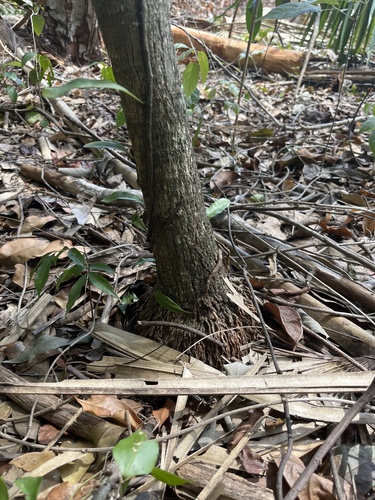
- Habit and stem: a solitary palm 1–4 m tall with a very thin trunk 3–5(–5.5) cm in diameter, brownish in forest and greyish on the dunes, topped by a sparse, open head of 9–16 leaves.
- Leaves: blades 40–110 cm across, dark green on the upper side and silvery underneath because of a dense covering of hairs, divided into 39–54 segments that are joined for 13–30 cm at the centre (the palman). The free part of each segment is triangular and usually narrows to a two-pointed tip notched for up to 3 cm; occasionally a segment is abruptly pinched halfway along. Middle segments measure 40–65(–71) cm from hastula to tip and 2–3.8 cm across, always widest just above the sinus. Petioles measure 25–110 cm in length and 6–11 mm across at the narrowest point and 8–15 mm where it meets the sheath, biconvex to narrowly diamond-shaped in section and flat on the upper side towards the base. The sheath ends in a tongue-shaped free part measuring 3–6.8(–9.5) cm, woven from fine fibres that become a looser mesh with age. The upper hastula is narrowly triangular, sometimes merely notched but usually split deeply into two (up to 7.5 mm), its free part 9–25 mm long and sometimes rolled into a tube as the blade expands; the lower hastula is 1.7–4 mm long.
- Inflorescence: borne among the leaves and arching once fruits form, (37–)40–84 cm long, with 4–7(–9), most often 5, primary branches; the lowest branch is 9–25 cm long and carries 6–20(–25) rachillae of (3–)4.5–11 cm.
- Flowers: scented and creamy white, on stalks 1.5–4 mm long. The perianth forms a single whorl of (4–)5–6 unequal, awl-shaped lobes. There are (8–)9–11(–13) stamens, longer than the pistil, their filaments fused at the base into a ring around the ovary; the anthers are longer than the filaments, notched to two-lobed at the tip and arrow-shaped at the base, with unequal thecae 2–3.7 mm long.
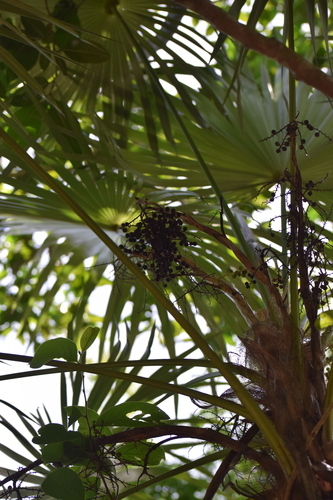
- Fruit and seed: fruit almost round, 5–12.5 mm in diameter, juicy and purple-black when ripe, with the perianth and filaments persisting at the base, on stalks 2–6.5 mm long. The seed is brownish, nearly globose and deeply furrowed like a brain (cerebriform), 3.5–10 mm across.
- Roots: like other members of the genus, the roots carry a velamen, a layered, thickened epidermis.
Variation between habitats
Quero documented how strongly the palm's stature changes with conditions. In the medium forest the trunks are brownish, commonly about 4 m tall but no more than about 4 cm thick, with leaves 80–110 cm across on petioles 70–110 cm long, and hastulas only slightly two-pointed and often tubular. In the low forest plants are similar but shorter, averaging 2.5 m. On the dunes the palm is most variable: shorter overall but with thicker, greyish trunks, deeply split hastulas and shorter inflorescences whose end branches are often poorly formed.
- Tulum dunes: vigorous plants over 2 m tall with trunks 5 cm thick, leaves up to 110 cm across, segments as broad as 3.8 cm, and petioles about 1 m long.
- Punta Sam: to 2 m but usually shorter, trunks up to 5.5 cm thick, leaves 40–70 cm across on petioles of 25–50 cm, and a hastula up to 2.5 cm in length, split to 7 mm, inflorescence 30–50 cm.
- El Cuyo: plants 2 m tall with leaves up to 90 cm across, petioles to 60 cm and inflorescences to 50 cm.
- Chelem: stunted plants 1–1.5 m tall, trunks to 4 cm thick, leaves 40–50 cm across on petioles to 40 cm, and very short inflorescences with poorly developed branches.
A dune survey recorded maximum heights from 2.25 m at San Benito in central Yucatán to 4.44 m at Alegrías in the east, and adults 5–6 m tall have been seen in semi-deciduous forest of Quintana Roo near Caobas.
How to tell it from similar species
In cultivation and in the wild the Mexican silver palm is easily confused with Thrinax radiata, which shares its range and habitats. Two field characters separate them: Thrinax leaf bases are split where the petiole joins the stem, whereas those of Coccothrinax readii are not; and ripe Thrinax fruits are white, while those of Coccothrinax are purple-black. Within Coccothrinax, Quero separated Coccothrinax readii from Coccothrinax argentata by its two-pointed hastula; see Name history for the debate over this character.
Ecology

Flowering and fruiting take place from August to October, and the fruits are dispersed mainly by birds and beetles. In the dune scrub the palm acts as a windbreak against storms and hurricanes, traps sand among its roots, adds organic matter to the soil and shelters insects, reptiles, birds and small mammals. Its roots form arbuscular mycorrhizas despite the velamen layer: in a year-long study of young plants about 50 cm tall at San Benito, colonisation was highest in the dry season, when light, heat and low humidity were most stressful, and lower in the windy season of winter northerly storms (nortes).
A demographic study in the Sian Ka'an Biosphere Reserve (Quintana Roo) found up to 760 plants per hectare. Flowering, fruiting and leaf production varied with rainfall and site. Growth is extremely slow: plants there took about 63 years to reach 3 m, started reproducing only at about 4 m, and were estimated to live more than 145 years; the population growth rate was 1.05 a year. The species is one of the palms of the Yucatán Peninsula in which a lethal yellowing phytoplasma has been detected.
Uses
The stems are cut to build rustic houses and fences. The palm was already used by the Maya in the past, and harvesting of adult stems in Sian Ka'an has been heavy enough to require a management plan. A review of palm uses in the Yucatán Peninsula lists it for construction and medicine, under the Maya names nak'as and náaj k'aax. It is also sold as an ornamental for gardens and indoor use.
Cultivation
The Mexican silver palm is grown for the contrast between its green upper leaf surface and silver underside. It is grown in southern Florida and in southern California, where a plant at Palm Springs has been grown on from a seedling for 15 years. Growth is very slow. Propagation is by seed. No reliable minimum temperature has been published.
Conservation
Conservation status: Near Threatened.
The palm is on Mexico's official list of species at risk (NOM-059-SEMARNAT-2010). Its coastal dune and forest habitats are being lost to development and land-use change along the Yucatán coast. In Sian Ka'an, models suggested that no adults could be removed each year without the population declining, that rotational cutting every 2–4 years could take at most 8 adults per hectare, and that a harvested population would need more than 100 years to recover. Populations in Mexico lie partly in the Sian Ka'an and Ría Lagartos biosphere reserves, and in Belize in the Shipstern Nature Reserve and Bacalar Chico National Park.
Name history
Quero described Coccothrinax readii in Principes 24: 118 (1980). The type is Quero 2755, collected on 26 May 1979 half a kilometre north of Xel-Há, Quintana Roo, at 10 m elevation (holotype MEXU; isotypes BH, F, GH, NY, US). The epithet commemorates the Smithsonian Institution botanist Robert W. Read, a specialist in Caribbean palms. Pronunciation: Coccothrinax koh-koh-TRIH-naks; readii REED-ee-eye.
Quero based the species chiefly on its two-pointed hastula and discussed its variation in detail. Henderson (2023), in a revision of Coccothrinax using phylogenetic species, merged it into a broad Coccothrinax argentata together with Coccothrinax inaguensis, Coccothrinax jamaicensis, Coccothrinax litoralis, Coccothrinax proctorii and Coccothrinax victorinii. Henderson pointed out that some specimens from Puerto Juárez in Quintana Roo have pointed rather than split hastulas, that Cayman Islands plants can have split ones, and, following Nauman and Sanders (1991), that hastula shape varies too much to separate species. Kew continues to accept Coccothrinax readii, and this page follows Kew.