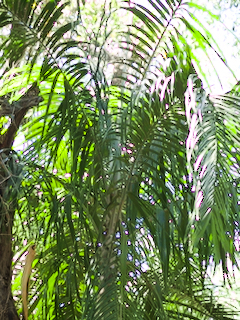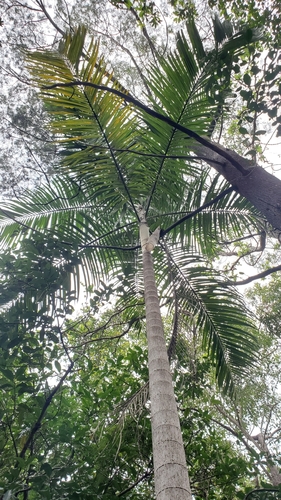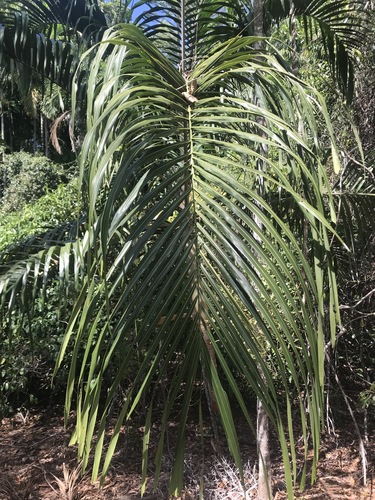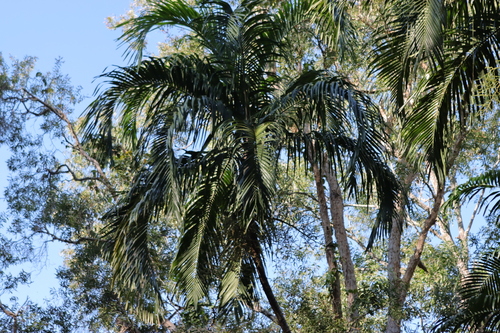
Carpentaria acuminata (H.Wendl. & Drude) Becc., known to growers as the Carpentaria Palm, is a tall, single-trunked feather palm with a smooth green crownshaft, endemic to the monsoon forests of the Top End of the Northern Territory, Australia. It is the only species in its genus. In the wild it can reach 30 m, its slim grey trunk carrying a sparse crown of arching leaves whose leaflets broaden toward the leaf tip, and below the crownshaft hang large sprays of white flowers that ripen into masses of scarlet fruits. First described as Kentia acuminata, it was brought into horticulture in the 1960s and is now a fast-growing, widely planted feather palm of the humid tropics and warm subtropics, grown for its self-cleaning habit and bright fruit. It is also known as the North Australian feather palm and the Darwin palm.
Also known asCarpentaria palm; North Australian feather palm; Darwin palm; Carpie (Australian growers' nickname)
Distribution and habitat

Kew records the species as native only to the Northern Territory of Australia (the northern part of the Territory); it has no recorded introduced range, although it is now grown throughout the tropics (see Cultivation).
The Flora of Australia account places it on Melville, Bathurst and Croker Islands and across the mainland Top End from the Fitzmaurice and Daly Rivers east to eastern Arnhem Land, reaching south to about Pine Creek. Representative collections come from Elcho Island, the Fitzmaurice and Liverpool Rivers and Gubara Pools in Kakadu National Park. The type locality is the Escape Cliffs north-east of Darwin.
The palm is a plant of the scattered patches of monsoon rainforest that lie within the savanna-dominated landscape of the Top End. It grows from close to sea level up to about 200 m, as a canopy or subcanopy tree in four forest types (wet rainforest, swamp forest, vine forest and forest dominated by Allosyncarpia), on soils ranging from sand to heavy clay loam. It favours permanently moist sites: forest streams, springs and the margins of brackish lowland estuaries. In the spring-fed wet monsoon forest of Wangi Creek on the Litchfield Plateau it is one of the dominant canopy trees, together with Calophyllum soulattri, Carallia brachiata, Elaeocarpus arnhemicus and Xanthostemon eucalyptoides, above an understorey that includes Pandanus spiralis, Pandanus aquaticus and the palm Hydriastele wendlandiana (Larsen et al. 2016). Shapcott (2000) found it common throughout moist rainforest in the Territory.
Description

The account below follows the Flora of Australia (Dowe & Jones) and the Australian Tropical Rainforest Plants key (CSIRO), with notes from cultivated plants.
- Habit and stem: a solitary, unarmed, monoecious palm 9–30 m tall. The trunk is 15–20 cm thick at breast height (up to 25 cm), a little broader at the base, smooth, grey to light tan, and marked with leaf-scar rings set well apart, up to 25 cm in cultivated palms.
- Crownshaft: smooth, green to greyish white, up to about 1 m long and slightly swollen at the base; the elongate leaf sheaths are grey-green.
- Leaves: 10–12 in the crown, pinnate, 2–4 m long and arching, with a recurved tip. Each side of the rachis carries 55–70 narrow, arching pinnae up to 40–60 cm long and 1.2–1.5 cm wide, deep green above and paler, slightly bluish green beneath, with tiny brown scales scattered on the lower surface and only the midrib prominent. Leaflet tips are cut off squarely or jagged (praemorse), and the leaflets near the leaf apex are much broader than the rest and look as if fused. In mature palms the leaflets are held upward in a V; in young plants they lie flat.
- Inflorescence: borne below the crownshaft, the first from the uppermost leaf scars and later ones progressively lower on the trunk; 1–2 m long (to about 1.5 m in the Flora), much branched and pendent, with cream-green axes and semi-pendulous, somewhat zigzag rachillae; the flowering branches may hang 90–120 cm.
- Flowers: cream to white or greenish white, about 10 mm across, in triads of a female flower between two males, each with three sepals and three petals. Male flowers are bullet-shaped in bud, to 10 mm long, with 30–40 stamens and an elongate, bottle-shaped pistillode; female flowers are up to 6 mm high.
- Fruit and seed: fruits globose to slightly ovoid, up to 20 mm across (10–15 mm long in cultivated material), scarlet when ripe. The fleshy mesocarp has fibres pressed against the endocarp and contains irritant calcium oxalate crystals; the juice is caustic to skin. Each fruit usually holds one smooth, globose seed up to 15 mm across, although up to three seeds have been recorded.
- Seedlings and juveniles: the first leaves are bifid; in deep shade they may stay undivided at the tip, broad and dark green on reddish stalks, for 18 months before the first pinnate leaf appears. Until a trunk forms the leaves remain spaced along the stem rather than clustered in a crown.
Similar species
- Archontophoenix cunninghamiana (bangalow palm) bears lilac or pinkish flowers and its leaflets are uniformly linear, whereas Carpentaria acuminata has whitish flowers and noticeably widened leaflets at the leaf tip.
- Veitchia species have drooping leaflets rather than leaflets raised in a V.
- Ptychosperma macarthurii, often planted alongside it, is a clustering palm with much thinner stems.
Ecology

- Phenology: an evergreen palm that flowers and fruits in every month (Flora of Australia). Franklin & Bach (2006) followed eight wild palms monthly for 30 months in monsoon forest about 40 km north-east of Darwin: flowering was markedly out of step between individuals, and the authors suggested the palm may be able to flower almost continuously.
- Pollination and flower visitors: the black flying fox (Pteropus alecto) feeds on both the flowers and the fruit, one of only two rainforest plants on which it was seen doing both near Darwin (Palmer et al. 2000).
- Dispersal: the fruit is a favourite food of mobile frugivores, notably the Torresian imperial pigeon (Torres Strait pigeon, Ducula spilorrhoa) and flying foxes, which carry the seeds between rainforest patches (Shapcott 1998). In that radio-tracking study, the palm was among the fruiting trees at the foraging sites of the black flying fox, with flowering and fruiting resources overlapping from October to December (Palmer et al. 2000).
- Population genetics: isozyme surveys across the whole range found genetic diversity typical of rainforest trees (expected heterozygosity 0.143) but strong differences between populations (FST 0.379) and little effective gene flow (Nm 0.39). Diversity fell with increasing isolation of populations and rose with mean annual rainfall, but did not depend on patch size; populations were strongly inbred (F 0.641), suggesting pollen moves little. Rare alleles are distributed as expected if the palm retreated to refugia when rainforest contracted in the Pleistocene, while stands on young Holocene landforms were not necessarily poor in diversity, showing that frugivore dispersal has kept populations connected (Shapcott 1998, 2000).
- Fungi: the leaf-spot fungus Pseudocercospora carpentariae, recorded from Australia, is known only from this palm.
Uses
- Ornament: a very widely planted garden, avenue and street palm in tropical and subtropical regions, used as a specimen, in groups, in containers and on patios. Grown triple-planted in a single container, it is popular with indoor plant-hire businesses.
- Traditional uses: Wightman & Andrews (1989) record several uses of the palm by Aboriginal people of the Northern Territory.
Cultivation
- Climate and hardiness: a palm for warm, frost-free climates. In Florida it is rated for USDA zones 10b–11 (average annual minimum +1.7 to +10 °C). The freeze of 20 January 1977 killed many mature specimens in South Florida, though palms in sheltered spots, including some in Tampa, survived and recovered slowly; it does not withstand deep freezes. The trunk tends to crack in cool weather, letting in decay organisms. It is grown at up to about 1500 m (5000 ft) in Medellín, Colombia.
- Light: full sun for mature palms. Young plants tolerate heavy shade, under which they develop elongated reddish leaf stalks and big, deep green bifid leaves.
- Soil, water and feeding: needs rich, moist but well-drained, fertile soil and abundant water, fertiliser and mulch to look its best; in Florida it grows on sandy soils of Palm Beach County as well as on the alkaline, rocky soils of Broward and Miami-Dade counties, but many ordinary landscape soils are too poor for it. Drought tolerance is moderate and tolerance of salt spray low.
- Wind: the soft leaflets shred easily, so it should not be planted where strong winds are frequent (Broschat).
- Growth: very fast at all stages and easy to establish; in a mixed planting it soon overtops its neighbours, adding height to a garden quickly. Juveniles are attractive because they keep most of their leaves; with age a crownshaft forms, the leaves arch and the leaflets rise into a V. Palms spaced out in sun as an avenue grow evenly, and the old leaves drop cleanly. Older specimens usually transplant well.
- Propagation: by seed, which germinates readily when fresh, warm and moist; germination within 78 days has been reported in Florida. Removing the flesh before sowing is advisable but not essential; wear gloves, as the pulp can burn sensitive skin. Seeds sown in trays produce bifid leaves within 3–4 months and are then potted on. By the time they fill a 200 mm pot, at about two years old, the young palms are about 2 m tall, carry some pinnate leaves and are ready to plant out. In laboratory tests germination was best at alternating temperatures of about 31/33 °C (day/night), with a calculated minimum of 9.13 °C, optimum of 28.53 °C and maximum of 36.33 °C (Batista et al. 2023). The seeds survived drying to 5% moisture content, and salt in the germination medium did not reduce germination (Batista et al. 2016).
- Pests and diseases: thrips are the main pest listed in Florida; no disease is considered serious there. It appeared resistant to lethal yellowing in heavily infested parts of Miami-Dade County and was once promoted as a replacement for Adonidia merrillii (Christmas palm), but its soil demands limited that role.
- Where grown: throughout northern and eastern Australia (Darwin, the Adelaide River area, Queensland including the Gold Coast and its hinterland), southern Florida (Miami, Davie, Palm Beach County, Key West), Sri Lanka, Sarawak (Kuching), Thailand, New Caledonia, Réunion (Le Tampon) and Colombia.
Conservation
Conservation status: Least Concern.
The palm is common within its range, but that range consists of small, isolated patches of monsoon rainforest, and the genetic distinctness of individual populations means that each patch holds part of the species' diversity (Shapcott 1998, 2000). Its spring-fed wet monsoon-forest stands can shrink locally where creek beds cut back upstream and the peaty forest floor is disturbed and burnt (Larsen et al. 2016).
Name history
- Publication: the accepted combination was published by Beccari in Ann. Jard. Bot. Buitenzorg 2: 128 (1885), when the genus Carpentaria was erected for this species.
- Basionym and type: Kentia acuminata H.Wendl. & Drude, Linnaea 39: 207 (1875), described by Wendland and Drude from a few fruits and a small leaf collected before 1875 by Hulls at the Escape Cliffs north-east of Darwin, Northern Territory (type locality). Beccari, who also knew the palm only from that description, transferred it to a new genus ten years later.
- Rediscovery and introduction: the palm was later found again near Darwin. Moore collected fresh seed there in January 1964 (Moore 9228) for the Fairchild Tropical Garden in Florida; plants from that collection began to fruit in 1973, and seedlings were distributed in 1968 (from another introduction) and again in 1974. A Florida garden palm from the 1968 distribution first fruited in 1975 (Hull 1978).
- Etymology: the genus is named after the Gulf of Carpentaria, the great gulf on the northern Australian coast bordering Arnhem Land; acuminata is Latin for tapering to a long point.
- Pronunciation: kahr-pen-tahr-EE-ah ah-koo-mih-NAHT-ah; in Florida usually kar-pen-TAIR-ee-uh ack-yoo-min-NAY-tuh.
- Classification: subfamily Arecoideae, tribe Areceae; Carpentaria is a monotypic genus.