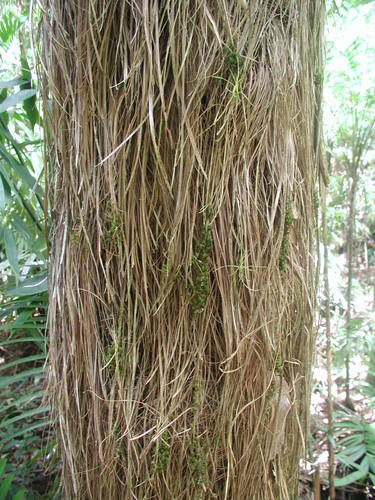
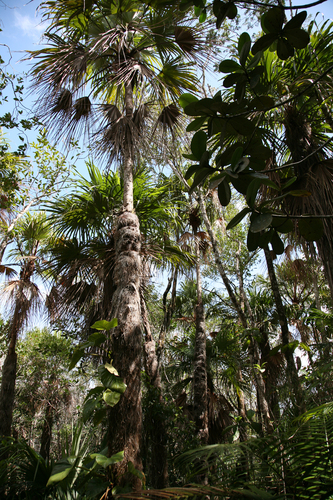
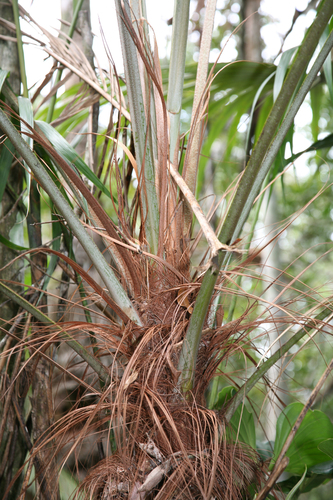
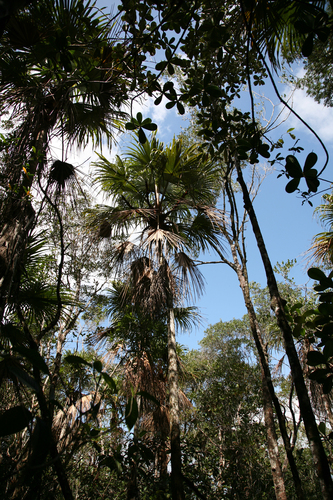
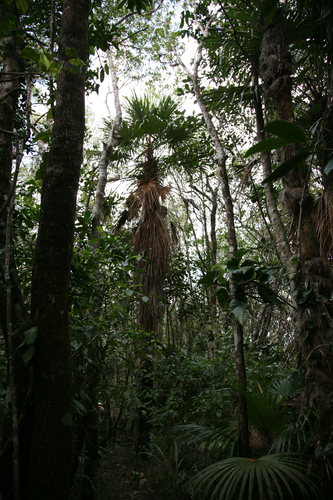
Colpothrinax cookii Read is a tall, single-stemmed fan palm of the wet hill and mountain forests of northern Central America, native to Belize, Guatemala and Honduras and, since a discovery made in 2022, to the Chimalapas forests of southern Mexico. Its straight, columnar trunk often rises above the surrounding canopy and, in young and many adult plants, is hidden under a thick, shaggy coat of fine fibres left by the disintegrating leaf sheaths. The crown carries large costapalmate leaves, green above and glaucous beneath, and the woolly-bracted inflorescences bear creamy yellow, strongly scented flowers. It is one of only three living species of Colpothrinax, a genus otherwise represented by the Cuban belly palm (Colpothrinax wrightii) and the southern Central American Colpothrinax aphanopetala. It is rare in cultivation, grows very slowly and is seldom offered; one grower report indicates it tolerates brief light frost.
Also known asguanu (Belize); xan (Q'eqchi' Maya, Guatemala); shan (Guatemala); suyate; suyate colorado; caral; guano (Honduras)
Distribution and habitat

Kew lists the species as native to Belize, Guatemala, Honduras and south-western Mexico; it has no introduced range.
- Belize, Guatemala and Honduras: a palm of premontane and, less often, lower montane wet forest on the Caribbean-facing slopes, mostly at 700–1200 m and occasionally up to 1600 m (Evans 2001). It is confined to ridge tops and the highest parts of the slopes above them, typically growing alongside Euterpe precatoria, a habit it shares with Colpothrinax aphanopetala. In the Maya Mountains of Belize it is common in the higher-elevation forest of the Chiquibul Forest, at around 1000 m, together with Euterpe precatoria and Synechanthus fibrosus (Bridgewater et al. 2006). On Little Quartz Ridge in the Columbia River Forest Reserve, Toledo District, it is common and evenly spread along the ridgetop with Euterpe macrospadix; that survey regarded it as part of a once more extensive lower montane forest type that now persists only in scattered, shrinking patches along the Caribbean slope of Middle America (Parker et al. 1993). The type locality lies in Alta Verapaz, Guatemala.
- Mexico: first recorded for the country by Pérez-Farrera et al. (2025), from the Selva Zoque on the border of Oaxaca and Chiapas, where it grows at 500–1100 m in lowland evergreen rainforest, both in intact forest and on cleared slopes. The collections come from Santa María Chimalapa (Ejido San Juan, 1080 m) and San Juan del Río (850 m) in Oaxaca. The ground there is formed of granite and metamorphic rocks with reddish clay soils (luvisols and vertisols). Its palm companions include Astrocaryum mexicanum, Attalea butyracea, Calyptrogyne ghiesbreghtiana, Reinhardtia elegans, Synechanthus fibrosus and several Chamaedorea species, and the tree layer includes mahogany (Swietenia macrophylla), Cedrela odorata and Brosimum alicastrum. The find added Colpothrinax as the 22nd native palm genus of Mexico.
Description

Measurements follow the monograph of Evans (2001); figures from the Mexican population (Pérez-Farrera et al. 2025) are added where they extend the range.
- Habit and stem: solitary and unarmed, with an erect, cylindrical trunk (5–)10–20 m tall and 15–25 cm thick at breast height; Mexican plants reach 8–25 m and 15–35 cm. Unlike Colpothrinax wrightii the trunk never swells. Adults standing in the open usually have a bare trunk, but in closed forest the upper part may be partly or wholly sheathed in a mat of persistent fibres, normally 20–30 cm thick. Juveniles below about 6–8 m are typically covered completely by this mat.
- Leaves: 15–30 in the crown (8–25 in Mexico), costapalmate. The sheath is densely hairy, with two mixed kinds of hairs: soft, star-shaped ones about 0.5 mm long, rusty at the base with free white tips, and coarser, wavy, twisted, flattened ones that become longer, denser and darker towards the top of the sheath, from about 1.5 mm and tan near the base to 9 mm and reddish brown distally. The sheath breaks down into hanging, loosely woven, thread-like and more or less round fibres 0.3–0.5 mm thick. Petiole (1–)1.5–2.5(–3) m long and 2.3–3.4 cm wide where it meets the blade. The hastula on the upper side lies flat against or slightly above the blade, 2.3–3.4 × 2.4–3.9 cm, its width 0.7–1.4 times its length, broadly triangular and usually with a short point. The costa measures 16.5–38.5 cm. The blade is 131–170 cm long at the centre and 62–136 cm at the sides, green and hairless above, glaucous below, split into single-fold segments except the outermost segment on each side, which has 2(–4) folds. The central splits reach to within 46–67 cm of the base (one-half to two-thirds of the blade length) and the outermost to within 11.5–19.0 cm (about four-fifths). There are 25–35 folds on each half of the blade, and the broadest single-fold segment is 4.3–5.0 cm wide.
- Inflorescence: up to about 5(–8) flowering or fruiting inflorescences at a time, plus about 5(–7) old dead ones retained in the crown. Main axis 1.2–2.1 m long, peduncle 0.2–0.8 m, rachis 0.9–1.4 m. The bracts are woolly, with hairs 2–8 mm long: prophyll about 25 × 8.0–10.0 cm, 6–7 peduncular bracts 27.0–45.0 cm long, bracts on the rachis 14.0–47.0 cm. There are 9–12 first-order branches (6–9 in Mexico), all axes creamy yellow; each branch has a main axis 12.0–58.5 cm long, of which 2.5–37.0 cm is unbranched and 6.0–32.0 cm branched, and its own prophyll 10.5–40.5 cm long. Basal branches carry typically 40–50 rachillae and apical ones 10–20; the rachillae are 3.0–15.5 cm long and covered in tan to rust-coloured hairs 0.2–0.3 mm long. Flowers sit on short spurs 0.2–0.8(–1.2) mm long, each subtended by a bracteole 0.7–2.0 mm long and 0.4–1.0 mm wide at the base.
- Flowers: bisexual, creamy yellow and strong-smelling. The floral receptacle measures 0.7–1.7 mm. The calyx, 3.5–5.4 mm, is free from the corolla for one-half to two-thirds of its length, and its lobes are 0.5–0.8 mm. The corolla, 4.0–6.0 mm, is joined at the base for one-fifth to one-third of its length; the petals are valvate, fleshy, parallel-sided with a tiny point, grooved on the inner face with inrolled or thickened edges, hooded at the tip, and remain on the flower. Filaments cream, 2.1–4.0 mm long, united for 1.1–2.0 mm (two-fifths to three-fifths of their length) into a stamen cup 1.5–2.2 mm across that is no longer than the calyx cup; anthers 2.3–3.5 × 0.9–1.3 mm. Pollen grains 25–30 × 20–30 µm, with a coarsely perforate to reticulate surface away from the aperture. Gynoecium cream, 2.5–3.4 × 1.1–1.6 mm; carpels 1.1–1.6 × 0.7–1.3 mm; styles 1.5–2.2 mm long.
- Fruit and seed: fruit globose, 1.6–2.1 cm in diameter (1.5–2.0 cm in Mexico); seed 1.0–1.2 × 1.3–1.5 cm.
How to tell it from related species
- Colpothrinax wrightii (Cuba) has a strongly swollen, belly-shaped trunk, smaller fruits and seeds, and petals that drop off along a line at their base; Colpothrinax cookii has a straight trunk, bigger fruits and seeds, and petals that stay attached (Evans 2001).
- Colpothrinax aphanopetala (Nicaragua to Panama) differs in flower and inflorescence colour: in Colpothrinax cookii the petals are big, fleshy and yellow, and the finer inflorescence branches are yellow too. Without flowers the two cannot be separated. Colpothrinax cookii frequently has bigger leaf blades and petioles, but the overlap is too great for this to be a reliable character (Evans 2001).
Ecology

- Pollination: both the male and the female phase of each flower seem to take place while the sexual parts are still shut inside the unopened corolla. Together with the strong scent this points to pollination by beetles (Evans 2001).
- Forest structure: an emergent palm whose crowns often stand clear above the canopy, conspicuous on forested ridges and slopes (Pérez-Farrera et al. 2025). It persists on cleared slopes in Mexico, and old dead inflorescences and the fibre mat remain on the trunk for a long time.
- Fire: the fibre coat on the trunk is highly flammable (see Uses).
- History of the genus: fossil flowers preserved in amber from Chiapas, of Late Oligocene to Early Miocene age, were described as Colpothrinax chiapensis and are thought to belong near the base of the genus, showing that Colpothrinax has been part of the southern Mexican flora since the mid-Tertiary (Chambers et al. 2012, cited by Pérez-Farrera et al. 2025). The Mexican population lies in Los Chimalapas, an area considered a Pleistocene forest refuge.
Uses
- Fibre: the leaves are used locally for thatching roofs and for making brooms.
- Local names: in Belize the palm is called guanu. Guatemalan names are xan, in the Q'eqchi' Maya language, and shan. Hondurans know it as suyate or suyate colorado, and also as caral or guano.
- Fibre mat: local people in Belize and Honduras have acknowledged setting light to the inflammable mat of sheath fibres around some trunks purely to watch it blaze.
Cultivation
- Position: best in shade or part shade, in soil that is kept moist but drains freely.
- Growth rate: very slow, and the palm remains hard to obtain.
- Cold: more cold-tolerant than its origin suggests. A plant growing near Sarasota in western Florida since 1999 came through the hard winter of 2009–2010 at about −3.3 °C (26 °F) at the nearby airport, perhaps −2 to −1.7 °C (28–29 °F) beneath the tree canopy, without any damage. This is a single report and needs confirming.
- Where grown: besides Florida, it is grown in Hawaii and in the hinterland of the Gold Coast in Queensland, Australia (garden photographs).
Conservation
Conservation status: Least Concern.
Its forests on the Caribbean slope of Middle America survive as scattered, shrinking patches (Parker et al. 1993), and the Selva Zoque in Mexico, although partly protected, faces various human pressures (Pérez-Farrera et al. 2025). Burning of the trunk fibre mat for display is a local, deliberate source of damage.
Name history
- Original publication: described by Read in Principes 13: 13 (1969), in the article "Colpothrinax cookii – a new species from Central America" (Principes 13: 13–22). Read's concept also included a widely separated population in eastern Panama (Parker et al. 1993), which is now treated as Colpothrinax aphanopetala, so that Colpothrinax cookii in the modern sense, as revised by Evans (2001), is restricted to Belize, Guatemala, Honduras and southern Mexico.
- Type: Guatemala, Alta Verapaz, coffee estate of Sepacuite north of Panzós, on the northern slope of the main mountain range crossed when leaving the Polochic valley, 1200 m, 22 March 1902, Cook & Griggs 116 (holotype US; isotype BH) (Pérez-Farrera et al. 2025).
- Etymology: the epithet honours the American botanist Orator Fuller Cook, who gathered the first specimens with Griggs and was the first to see that they belonged to an undescribed species.
- Classification: subfamily Coryphoideae, tribe Trachycarpeae. Colpothrinax is monophyletic, and plastid phylogenomics places it with Copernicia and Pritchardia in a clade sister to the rest of the tribe (Yao et al. 2023, cited by Pérez-Farrera et al. 2025).
- Pronunciation: genus kol-poh-TRIH-naks; epithet COOK-ee-eye.