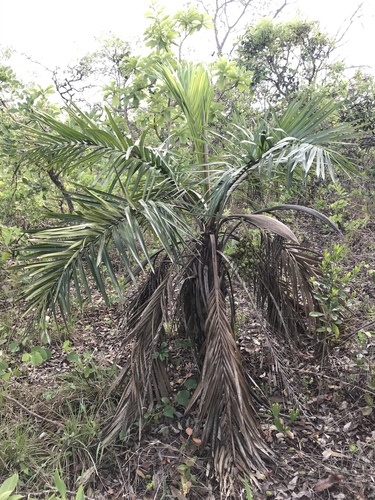
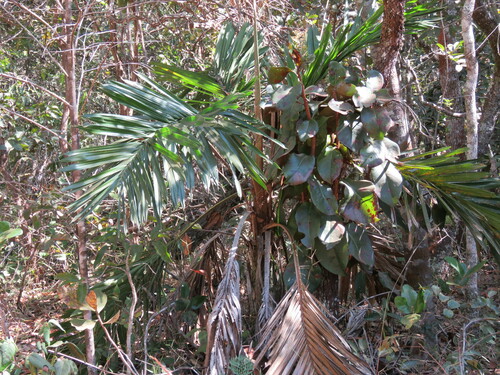
Syagrus comosa (Mart.) Mart. is a small to medium-sized, single-stemmed feather palm of the Cerrado, the great savanna of central Brazil, reaching into eastern Bolivia. Its slim trunk is normally clad in the stubs of old leaf stalks and carries a modest tuft of stiff, leathery, dark green leaves whose leaflets are set in small clusters at different angles, giving the crown a lightly plumed look; in some places plants stay stemless. Thick, woody, deeply grooved flower bracts, rounded white female flowers and smooth, pale green, egg-shaped fruits up to about 3 cm long help to recognise it. Stemless plants were once separated as Syagrus acaulis (also Cocos acaulis), a name still met in older literature. In Brazil the palm is widely known as catolé or coco-babão: its fruits are eaten, its bitter palm heart is used in regional cooking and folk medicine, and it has been suggested as an ornamental, though it grows slowly and is still seldom cultivated.
Also known ascatolé; coco-babão; babão; gariroba-catolé (gabiroba-catolé); guariroba-do-campo; palmito-amargoso; pati; indaiá; jerivá; acumã-rasteiro (stemless forms); coquinho-do-cerrado; gairobinha-do-cerrado; camargo; bacuri (Araguaia, Mato Grosso); bitter palm
Distribution and habitat

Kew gives the native range as Bolivia and Brazil (North, Northeast, Southeast and West-Central regions). It is spread over most of the Brazilian Cerrado: the Distrito Federal, Goiás, Mato Grosso, Mato Grosso do Sul, Minas Gerais, São Paulo, Tocantins, Pará, Piauí, southern Maranhão and the far west of Bahia, where it is rare and known only from a few municipalities such as São Desidério, Barreiras and Formosa do Rio Preto. In Bolivia it grows in eastern Santa Cruz, for instance in the Noel Kempff Mercado National Park at about 700 m. In Maranhão it is confined to the south of the state, around Balsas, Loreto, Tasso Fragoso and the Mirador State Park. Well-known Brazilian localities include the Chapada dos Veadeiros (Alto Paraíso de Goiás), the Serra dos Cristais near Cristalina, the area around Brasília, the Chapada dos Guimarães and Serra do Roncador in Mato Grosso, Emas National Park and the Jalapão.
It is a palm of open cerrado vegetation: low, scrubby savanna on flat or broken stony ground, and especially rocky ridges and slopes with quartzitic soils on the high plateaux of central Brazil. Most populations lie between about 700 and 1200 m, but herbarium collections range from roughly 140 m on the Araguaia plains to about 1300 m near Brasília. Near Brasília it occurs in typical cerrado (cerrado sensu stricto), and specimens have also come from a vereda (palm swamp margin) and a river floodplain; parts of its habitat have a seasonally high water table and can be briefly waterlogged in the rains. The climate is seasonally dry tropical, with a wet summer and a long dry winter.
Description

- Habit and stem: usually a solitary palm with an above-ground trunk (0–)1–4 m tall and 6–15 cm thick, rarely reaching 7–8 m; trunks are erect and dark grey but mostly concealed by persistent petiole bases, with leaf-scar intervals of about 1.5–3 cm. Some plants have a short subterranean stem and grow so densely that they look clustered. In a Brasília cerrado survey adults were 0.9–3.8 m tall, with basal diameters of 6.5–17.5 cm.
- Leaves: 5–12 in the crown, spirally arranged and spreading, each up to about 1.5 m long. Sheathing base about 10–11 × 8 cm with fibrous margins; pseudopetiole 25–56 cm; petiole 10–44 × 1.3–3.7 cm, about 1.2 cm thick, brown-felted; rachis (49–)80–134(–140) cm. Leaflets medium to dark green on both faces, coriaceous, with veins raised on the upper side (most obvious when dry), 38–82 (rarely to 164) per side, in clusters of 2–4 held in diverging planes; scales or felt occur where the leaflets join the rachis and along the lower midrib. Basal leaflets 14–46 × 0.2–0.8(–2.2) cm, middle leaflets (25–)30–55(–67) × (1.4–)2.0–3.8 cm, apical leaflets (9–)13–39(–45) × 0.5–2.6 cm, mostly with sharp, lopsided tips.
- Inflorescence: erect, either unbranched (spicate) or with branches arranged spirally. Prophyll (14–)20–46 × 1.5–8 cm. Peduncular bract about (39–)52–90(–100) cm long, the expanded part 17–35 × (3–)4.5–8(–13) cm with a beak 0.7–5 cm long, 2.5–4(–7) mm thick, woody, deeply grooved, light brown to orange-brown and felted at first. Peduncle (15–)27–75 × 0.5–1.5 cm; inflorescence axis 13–32 cm; rachis very short or absent (0–17 cm); rachillae 3–21, (8–)12–23(–27) cm long.
- Flowers: staminate flowers white to cream, 10–13 × 4–6.5 mm near the base of the rachillae and 6–10 mm long towards the tip; sepals 1–3 mm; petals 7–12 × 2.5–5 mm; stamens 4–6 mm, anthers 2–5(–6) mm. Pistillate flowers white and almost globose, (5–)6–10 × (4–)5–8.5 mm; sepals (5–)6–10 × 3–7 mm; petals 5–6 × 4–5 mm with short valvate tips; pistil (3–)4–5(–7) × 3–4(–5) mm, hairless; staminodal ring 1.5–3 mm high, entire.
- Fruit and seed: fruit ellipsoid, 20–32 × 14–21 mm, smooth, light green to greenish yellow when ripe (yellowish at the base), with a beige to brown persistent perianth cup 9–10 mm wide. Skin under 1 mm thick; flesh 0.5–2 mm thick, fibrous and mucilaginous. Endocarp bony, caramel-coloured, 23–25 × 15 mm, 1–2 mm thick on the sides and 3–5 mm at the ends, smooth and shiny inside. Seed 17–19 × 9–10 mm with homogeneous endosperm. Germination is remote-tubular.
How to tell it apart
Among trunk-forming Syagrus of the Cerrado, Syagrus comosa is recognised by its stem sheathed in old petiole bases, closely spaced leathery leaflets, thick woody and deeply grooved peduncular bract, very short inflorescence rachis, whitish flowers with rounded female flowers, and smooth pale green fruits less than 3 cm long. Stemless forms frequently bear unbranched inflorescences, but spicate inflorescences also occur on plants with trunks, so these forms are not treated as a separate species. In southern Maranhão the stemless Syagrus glazioviana differs in its underground stem and fewer (15–31 per side), much narrower leaflets.
Ecology

A four-year study at three cerrado sites found flowering and fruiting spread through the year, with little seasonality and no clear link to monthly rainfall; flowering was synchronised among individuals and with the related Syagrus flexuosa and Syagrus glazioviana, while fruiting was not. Fruit production peaked in June and July. Across its range flowering runs mainly from February to October, most strongly from March to May, and fruits ripen from August to February; in Maranhão flowers were recorded in March, May and September and fruits from June to December. Because it bears fruit almost all year and in abundance, the palm is considered an important food source for fruit-eating animals, and its seeds are animal-dispersed. Many fruits are damaged by insects.
Populations are typically aggregated. In a cerrado on the Fazenda Água Limpa near Brasília it formed about 11% of all palms, alongside Syagrus flexuosa and Syagrus petraea; densities of 177 plants per hectare were reported in the nearby Brasília Botanic Garden, and in Mato Grosso from about 700 per hectare on rocky cerrado to 53 per hectare on tall cerrado of the interfluves. Two fungi have been described from wild plants: Passalora eitenii, and the rust Cerradoa palmaea, whose host was confirmed by DNA work and herbarium comparison to be this palm.
Uses
The fruits are gathered from the wild and eaten locally, although the thin pulp is slimy. The palm heart (apical bud) is bitter; it is used in regional cooking, and the Kalunga Quilombola community of Engenho II (Cavalcante, Goiás), who call the palm gariroba-catolé, prefer it, together with Syagrus oleracea, precisely for that bitterness. As the palm is single-stemmed, cutting the heart kills the plant, and few individuals were left near that community.
In Brazilian folk medicine the bitter bud is taken as a stomachic to help digestion, while the mucilaginous fruit flesh is considered diuretic, and roasted seeds are used against diarrhoea. In the northern Araguaia region of Mato Grosso, where the palm is called bacuri, the fruit is used to treat conjunctivitis and as eye drops. The species has also been suggested as an ornamental, particularly in its younger stemless forms.
Cultivation
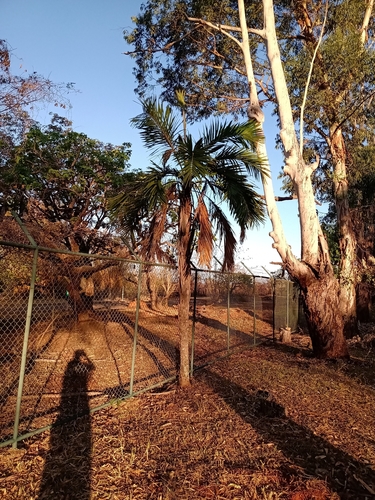
The palm is still very rare in gardens, mainly because seed is hard to obtain. It is grown in its home region, for example in Brasília and Recife, and outside Brazil it has been photographed in collections in Townsville (Queensland, Australia) and San Marino (California, USA). It needs full sun and a moist but freely draining soil, and established plants cope well with drought. Plants are expected to survive at least light frosts. Growth is slow, especially in young plants, though it is said to speed up as the palm matures under good conditions. With its slender trunk wrapped in old leaf bases and its compact crown of broad, leathery leaflets, it has been suggested for urban landscaping, outdoors and possibly indoors. Propagation is by seed, which germinates by the remote-tubular method.
Conservation
Conservation status: Least Concern.
The species is widespread, produces many fruits and occurs in several national parks and reserves. Locally, however, its cerrado habitat is being converted to farmland: in southern Maranhão much of the area around Balsas has been cleared for soybean, only one of nine known sites there lies in a protected area, and stands on the central Brazilian plateaux are declining where land is developed. Harvesting the palm heart kills the plant.
Name history
Martius described the palm in 1826 as Cocos comosa in the Historia Naturalis Palmarum (vol. 2), and in 1847 transferred it to Syagrus in d'Orbigny's Voyage dans l'Amérique Méridionale (Voy. Amér. Mér. 7(3): 134), giving the accepted name Syagrus comosa (Mart.) Mart. Kuntze moved it to Calappa in 1891 (Calappa comosa). The lectotype, designated by Dahlgren in 1959, is a Martius collection from Goiás without precise locality, kept at Munich (M).
Drude described stemless plants with unbranched inflorescences as Cocos acaulis in Flora Brasiliensis (1881), together with a variety glabra; the type is Gardner 3495 from the Serra Douro, Piauí (holotype M, isotype K). Kuntze transferred it to Calappa (Calappa acaulis) and Beccari to Syagrus in 1916 (Syagrus acaulis). Because both spicate and branched inflorescences occur on stemmed and stemless plants alike, these names are now treated as synonyms of Syagrus comosa. The genus belongs to subfamily Arecoideae, tribe Cocoseae, subtribe Attaleinae.
The epithet comosa means "bearing a tuft", after the tufted crown of leaves. Pronunciation: Syagrus see-AHG-ruhs, comosa koh-MOH-sah.