Difference between revisions of "Leopoldinia piassaba"
| (15 intermediate revisions by one user not shown) | |||
| Line 1: | Line 1: | ||
__noeditsection__ | __noeditsection__ | ||
{{Palmbox | {{Palmbox | ||
| − | |image= | + | |image=lp007844312.JPG |
| − | |image_caption= | + | |image_caption=Rio de Janeiro Botanical Garden in Brazil. Photo by Paul Craft. |
|genus=Leopoldinia <br>(leh-oh-poll-dihn-EE-ah) | |genus=Leopoldinia <br>(leh-oh-poll-dihn-EE-ah) | ||
|species=<br>piassaba (pee-ahs-SAH-bah) | |species=<br>piassaba (pee-ahs-SAH-bah) | ||
| Line 19: | Line 19: | ||
}} | }} | ||
==Habitat and Distribution== | ==Habitat and Distribution== | ||
| − | Brazil North, Colombia, and Venezuela. From 0°08'S-3°44'N and 64°04'-67°53'W in the northern Amazon region of Brazil (Amazonas), Colombia (Guainía, Vichada), and Venezuela (Amazonas) at (72-) 163 (-275) m elevation in non or seldom flooded forests adjacent to black water rivers. Although only one specimen has been seen from Brazil, L. piassaba occurs along several tributaries of the Rio Negro - the Rio Padauari, Rio Daraá [Daraha], Rio Marié, and Rio Xié | + | Brazil North, Colombia, and Venezuela. From 0°08'S-3°44'N and 64°04'-67°53'W in the [[File:eb7bc1b4a6215f980b95fdf47a8504fda7284e5c.jpg|thumb|left|400px|Palm trees of the Amazon. Piassaba tree before the stem fibres are harvested. Photo by Gerrit Davidse.]]northern Amazon region of Brazil (Amazonas), Colombia (Guainía, Vichada), and Venezuela (Amazonas) at (72-) 163 (-275) m elevation in non or seldom flooded forests adjacent to black water rivers. Although only one specimen has been seen from Brazil, L. piassaba occurs along several tributaries of the Rio Negro - the Rio Padauari, Rio Daraá [Daraha], Rio Marié, and Rio Xié |
| − | + | ||
==Description== | ==Description== | ||
Plants (4.0) -6.2 (-9.0) m tall; stems (4.0-) 5.8 (-10.0) m tall, 15.0 cm in diameter, solitary. | Plants (4.0) -6.2 (-9.0) m tall; stems (4.0-) 5.8 (-10.0) m tall, 15.0 cm in diameter, solitary. | ||
| Line 28: | Line 27: | ||
Taxonomic notes: Leopoldinia piassaba differs from its congeners in its elongate, pendulous leaf sheath fibers and non-flattened, globose to ellipsoid fruits. Subspecific variation: There are too few specimens to describe subspecific variation. (Henderson, A.J., A revision of Leopoldinia (Arecaceae) in Phytotaxa 32. 2011)/Palmweb. | Taxonomic notes: Leopoldinia piassaba differs from its congeners in its elongate, pendulous leaf sheath fibers and non-flattened, globose to ellipsoid fruits. Subspecific variation: There are too few specimens to describe subspecific variation. (Henderson, A.J., A revision of Leopoldinia (Arecaceae) in Phytotaxa 32. 2011)/Palmweb. | ||
==Culture== | ==Culture== | ||
| − | + | Cold Hardiness Zone: 10b | |
==Comments and Curiosities== | ==Comments and Curiosities== | ||
Uses: A belief linking palms with forest spirits existis among the Kuripako Indians of the Guainía River, an area representing the northern limit of the curious Leopoldinia piassaba, it is the source of an inusual coarse brown fiber formed by the frayed and rotting petioles, an article of commerce exported from the area and useful for manufacturing ropes, cables and brooms, the natives, belief that the evil spirit, the curupira, inhabit piassaba groves and wanders around the night. | Uses: A belief linking palms with forest spirits existis among the Kuripako Indians of the Guainía River, an area representing the northern limit of the curious Leopoldinia piassaba, it is the source of an inusual coarse brown fiber formed by the frayed and rotting petioles, an article of commerce exported from the area and useful for manufacturing ropes, cables and brooms, the natives, belief that the evil spirit, the curupira, inhabit piassaba groves and wanders around the night. | ||
| Line 46: | Line 45: | ||
File:eb7bc1b4a6215f980b95fdf47a8504fda7284e5c.jpg|Palm trees of the Amazon. Piassaba tree before the stem fibres are harvested. Photo by Gerrit Davidse. | File:eb7bc1b4a6215f980b95fdf47a8504fda7284e5c.jpg|Palm trees of the Amazon. Piassaba tree before the stem fibres are harvested. Photo by Gerrit Davidse. | ||
File:162e3eb6090c4167a795221ab09174748441c1bc.jpg|Palm trees of the Amazon. Piassaba plant after the fibres have been harvested from the stem. Photo by Gerrit Davidse. | File:162e3eb6090c4167a795221ab09174748441c1bc.jpg|Palm trees of the Amazon. Piassaba plant after the fibres have been harvested from the stem. Photo by Gerrit Davidse. | ||
| − | |||
File:Leopoldinia_piassaba_specimen.jpg|Rio de Janeiro Botanical Garden in Brazil. Photo by Paul Craft. | File:Leopoldinia_piassaba_specimen.jpg|Rio de Janeiro Botanical Garden in Brazil. Photo by Paul Craft. | ||
File:lp007844312.JPG|Rio de Janeiro Botanical Garden in Brazil. Photo by Paul Craft. | File:lp007844312.JPG|Rio de Janeiro Botanical Garden in Brazil. Photo by Paul Craft. | ||
File:piaçaa.jpg|Photo by Luis Mendonca de Carvalho. | File:piaçaa.jpg|Photo by Luis Mendonca de Carvalho. | ||
| + | File:f962dcc55f71ad5b1c4b31cd9f9e6657748aa74a.jpg|Palm trees of the Amazon. The harvested fibre, waiting to be made into brooms etc. Photo by Gerrit Davidse. | ||
File:aam-aaes114136.jpg|Piacava (Leopoldinia piassaba) fiber bundles (feixa) at river port awaiting shipment to Manaus. Sao Gabriel da Cachoeira, Rio Negro, Amazonas, Brazil. | File:aam-aaes114136.jpg|Piacava (Leopoldinia piassaba) fiber bundles (feixa) at river port awaiting shipment to Manaus. Sao Gabriel da Cachoeira, Rio Negro, Amazonas, Brazil. | ||
File:lp007745321.JPG|Piassaba after exploitation. Young leaves are kept to ensure the regeneration of the fiber, which may be cut again, six or seven years later. The leaf sheaths of piaçaba palm Leopoldinia piassaba, provide a fiber used to make brooms and was once used to make ropes for boats, before the advent of nylon. Once the staple fibers, they are packed in bundles and bound by the cipo Ambé (Philodendron sp., Araceae). These piraibas will be shipped to Manaus. It is a still active extractivism in this region of the Amazon. Rio Negro, Amazon, Brazil. | File:lp007745321.JPG|Piassaba after exploitation. Young leaves are kept to ensure the regeneration of the fiber, which may be cut again, six or seven years later. The leaf sheaths of piaçaba palm Leopoldinia piassaba, provide a fiber used to make brooms and was once used to make ropes for boats, before the advent of nylon. Once the staple fibers, they are packed in bundles and bound by the cipo Ambé (Philodendron sp., Araceae). These piraibas will be shipped to Manaus. It is a still active extractivism in this region of the Amazon. Rio Negro, Amazon, Brazil. | ||
| Line 55: | Line 54: | ||
File:lp0098972367.JPG|The adult leaves are cut in order to access the leaf sheaths. | File:lp0098972367.JPG|The adult leaves are cut in order to access the leaf sheaths. | ||
File:lp00653229.JPG|Cup piassaba fiber. The trunk of the palm tree, surrounded by a sleeve of fibers, is beaten with a stick to scare spiders, scorpions or snakes. The older leaves are cut to free access to the fiber. | File:lp00653229.JPG|Cup piassaba fiber. The trunk of the palm tree, surrounded by a sleeve of fibers, is beaten with a stick to scare spiders, scorpions or snakes. The older leaves are cut to free access to the fiber. | ||
| + | File:lp06632514.JPG|Cup piassaba fiber. The trunk of the palm tree, surrounded by a sleeve of fibers, is beaten with a stick to scare spiders, scorpions or snakes. The older leaves are cut to free access to the fiber. | ||
| + | File:lp007562133.JPG|Leopoldinia piassaba after exploitation. | ||
| + | File:lp006732216.JPG|Boots or piraibas of piassaba bound by the Ambé cipo. | ||
| + | File:lp005631277.JPG|Boots or piraibas of piassaba linked. | ||
| + | File:lp0073456119.JPG|Loading extractive products at the front of a boat on the Rio Negro trader. | ||
| + | File:lp07553125.JPG|Boots or piraibas of piassaba in a warehouse. | ||
| + | File:lp007745312.JPG|Boots or piraibas of piassaba. | ||
| + | File:lp089974563.JPG|Piles of palm fiber piassaba stored for sale at the edge of the Rio Negro in São Gabriel da Cachoeira. | ||
| + | File:EBC_35766.jpg|Royal Botanic Gardens, Kew. | ||
File:Piassavabesen_5_fcm.jpg|Old Piassava broom | File:Piassavabesen_5_fcm.jpg|Old Piassava broom | ||
| + | File:lp006732245.JPG | ||
File:lp0056442317.JPG|Leopoldinia piassaba: A few biological and economic data from the Rio Negro. by Dr. Jean-Paul Lescure, Dr. Laure Emperaire and Dr. Carlos Franciscon - Region (Brazil). | File:lp0056442317.JPG|Leopoldinia piassaba: A few biological and economic data from the Rio Negro. by Dr. Jean-Paul Lescure, Dr. Laure Emperaire and Dr. Carlos Franciscon - Region (Brazil). | ||
File:lp005632167.JPG|Leopoldinia piassaba: A few biological and economic data from the Rio Negro. by Dr. Jean-Paul Lescure, Dr. Laure Emperaire and Dr. Carlos Franciscon - Region (Brazil). | File:lp005632167.JPG|Leopoldinia piassaba: A few biological and economic data from the Rio Negro. by Dr. Jean-Paul Lescure, Dr. Laure Emperaire and Dr. Carlos Franciscon - Region (Brazil). | ||
File:lp00622316.JPG|Leopoldinia piassaba: A few biological and economic data from the Rio Negro. by Dr. Jean-Paul Lescure, Dr. Laure Emperaire and Dr. Carlos Franciscon - Region (Brazil). | File:lp00622316.JPG|Leopoldinia piassaba: A few biological and economic data from the Rio Negro. by Dr. Jean-Paul Lescure, Dr. Laure Emperaire and Dr. Carlos Franciscon - Region (Brazil). | ||
File:lp0055782267.JPG|Leopoldinia piassaba: A few biological and economic data from the Rio Negro. by Dr. Jean-Paul Lescure, Dr. Laure Emperaire and Dr. Carlos Franciscon - Region (Brazil). | File:lp0055782267.JPG|Leopoldinia piassaba: A few biological and economic data from the Rio Negro. by Dr. Jean-Paul Lescure, Dr. Laure Emperaire and Dr. Carlos Franciscon - Region (Brazil). | ||
| + | File:lp0988675412.JPG | ||
</gallery></center> | </gallery></center> | ||
==External Links== | ==External Links== | ||
Latest revision as of 17:38, 14 January 2016
| Leopoldinia (leh-oh-poll-dihn-EE-ah) piassaba (pee-ahs-SAH-bah) | |||||||
|---|---|---|---|---|---|---|---|
 Rio de Janeiro Botanical Garden in Brazil. Photo by Paul Craft. | |||||||
| Scientific Classification | |||||||
| |||||||
| Synonyms | |||||||
|
| |||||||
| Native Continent | |||||||
 | |||||||
| Morphology | |||||||
| |||||||
| Culture | |||||||
|
| |||||||
| Survivability index | |||||||
|
| |||||||
| Common names | |||||||
|
| |||||||
Contents
Habitat and Distribution
Brazil North, Colombia, and Venezuela. From 0°08'S-3°44'N and 64°04'-67°53'W in the
Description
Plants (4.0) -6.2 (-9.0) m tall; stems (4.0-) 5.8 (-10.0) m tall, 15.0 cm in diameter, solitary. Leaves (14-) 18 (-21) per stem; sheaths 45 cm long, fibers from apices elongate, loose, pendulous; petioles 118.8 (75.0) (150.0) cm long; rachises (270.0-) 290.0 (-330.0) cm long, (10.6-) 18.4 (-23.7) mm diameter; pinnae (53-) 59 (-65) per side of rachis, spreading horizontally, the bases narrowed with abaxial, distal and proximal swellings adjacent to rachis, midveins prominent and raised in cross-section adaxially; basal pinna 41.0 cm long, (0.3-) 0.7 (-1.0) cm wide, forming an angle of 45° with the rachis; apical pinna 37.0 cm long, (0.7-) 0.9 (-1.0) cm wide, forming an angle of (3-) 6 (-10)° with the rachis. Inflorescences dimorphic; prophylls no data; peduncular bracts no data; peduncles (32.0-) 56.0 (-80.0) cm long, 49.8 mm in diameter; staminate rachillae (1.3-) 1.6 (-1.9) cm long; pistillate rachillae (9.5-) 14.1 (-16.0) cm long; fruits (35.5-) 41.0 (-44.2) mm long, (31.3-) 34.6 (-36.8) mm in diameter, not flattened, globose to ellipsoid, the surfaces with raised, reticulate ridges from mesocarp fibers, giving a wrinkled appearance. (Henderson, A.J., A revision of Leopoldinia (Arecaceae) in Phytotaxa 32. 2011)/Palmweb. Editing by edric.
Taxonomic notes: Leopoldinia piassaba differs from its congeners in its elongate, pendulous leaf sheath fibers and non-flattened, globose to ellipsoid fruits. Subspecific variation: There are too few specimens to describe subspecific variation. (Henderson, A.J., A revision of Leopoldinia (Arecaceae) in Phytotaxa 32. 2011)/Palmweb.
Culture
Cold Hardiness Zone: 10b
Comments and Curiosities
Uses: A belief linking palms with forest spirits existis among the Kuripako Indians of the Guainía River, an area representing the northern limit of the curious Leopoldinia piassaba, it is the source of an inusual coarse brown fiber formed by the frayed and rotting petioles, an article of commerce exported from the area and useful for manufacturing ropes, cables and brooms, the natives, belief that the evil spirit, the curupira, inhabit piassaba groves and wanders around the night.
The well known Pará piassaba fiber, used for brooms and brushes and also for ropes, hats and baskets, is de product of the chiquichique (Leopoldinia piassaba). The long, tough yet flexible, brown fibers are produced abundantly on the margins of the old, frayed leafstalks which hang down covering the trunk to the very base in a dense, beard-like mass. A similar beverage ("wine") is also made from the fruits of the chiquichique (Leopoldinia piassaba), the moriche or canangucha (Mauritia minor) the bacaba (Oenocarpus bacaba), and the bacabiña or milpesillo (Oenocarpus minor). The "wine" of the moriche is usually allowed to ferment before using. Construction - The leaves are used for thatch.
The piaçabeira (Leopoldinia piassaba Wallace) is an endemic palm species of the Rio Negro basin, whose biology and ecology are poorly documented. Exploited for the fiber (piaçaba), the species is important for rural populations as a source of economic income through extractive activity. Two journeys in the middle Rio Negro region permit us to document more fully the biological and economic aspects of the species. Three populations were observed in the Rio Preto-Rio Negro interfluve (64° 15′ −64° 28′ W; 0° 5′ −0° 15′S).
- IMAGE GALLERY

Regiao, Amazonica. Photo by Tico da Pisa.

Regiao, Amazonica. Photo by Tico da Pisa.

Regiao, Amazonica. Photo by Tico da Pisa.

Regiao, Amazonica. Photo by Tico da Pisa.

Regiao, Amazonica. Photo by Tico da Pisa.

Palm trees of the Amazon. Piassaba tree before the stem fibres are harvested. Photo by Gerrit Davidse.

Palm trees of the Amazon. Piassaba plant after the fibres have been harvested from the stem. Photo by Gerrit Davidse.

Rio de Janeiro Botanical Garden in Brazil. Photo by Paul Craft.

Rio de Janeiro Botanical Garden in Brazil. Photo by Paul Craft.

Photo by Luis Mendonca de Carvalho.
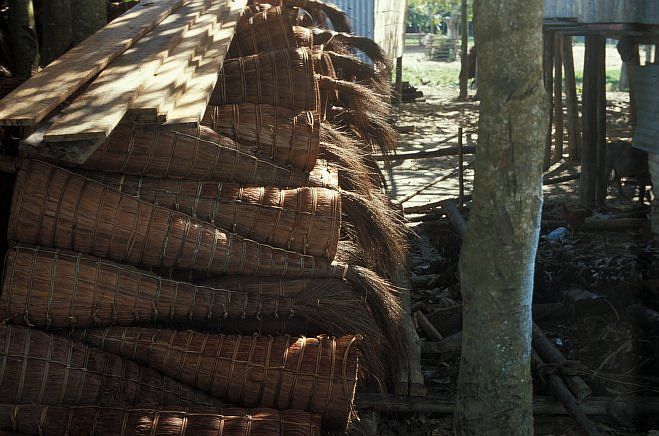
Palm trees of the Amazon. The harvested fibre, waiting to be made into brooms etc. Photo by Gerrit Davidse.

Piacava (Leopoldinia piassaba) fiber bundles (feixa) at river port awaiting shipment to Manaus. Sao Gabriel da Cachoeira, Rio Negro, Amazonas, Brazil.

Piassaba after exploitation. Young leaves are kept to ensure the regeneration of the fiber, which may be cut again, six or seven years later. The leaf sheaths of piaçaba palm Leopoldinia piassaba, provide a fiber used to make brooms and was once used to make ropes for boats, before the advent of nylon. Once the staple fibers, they are packed in bundles and bound by the cipo Ambé (Philodendron sp., Araceae). These piraibas will be shipped to Manaus. It is a still active extractivism in this region of the Amazon. Rio Negro, Amazon, Brazil.

Preparing piraibas (boots) of piassaba. The leaf of the Piassaba palm is spread on the ground to receive the freshly cut fiber.

The adult leaves are cut in order to access the leaf sheaths.

Cup piassaba fiber. The trunk of the palm tree, surrounded by a sleeve of fibers, is beaten with a stick to scare spiders, scorpions or snakes. The older leaves are cut to free access to the fiber.

Cup piassaba fiber. The trunk of the palm tree, surrounded by a sleeve of fibers, is beaten with a stick to scare spiders, scorpions or snakes. The older leaves are cut to free access to the fiber.

Leopoldinia piassaba after exploitation.

Boots or piraibas of piassaba bound by the Ambé cipo.

Boots or piraibas of piassaba linked.

Loading extractive products at the front of a boat on the Rio Negro trader.

Boots or piraibas of piassaba in a warehouse.

Boots or piraibas of piassaba.
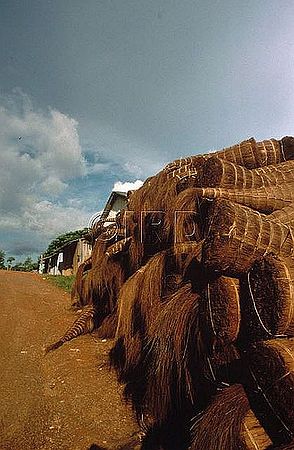
Piles of palm fiber piassaba stored for sale at the edge of the Rio Negro in São Gabriel da Cachoeira.

Royal Botanic Gardens, Kew.

Old Piassava broom


Leopoldinia piassaba: A few biological and economic data from the Rio Negro. by Dr. Jean-Paul Lescure, Dr. Laure Emperaire and Dr. Carlos Franciscon - Region (Brazil).

Leopoldinia piassaba: A few biological and economic data from the Rio Negro. by Dr. Jean-Paul Lescure, Dr. Laure Emperaire and Dr. Carlos Franciscon - Region (Brazil).

Leopoldinia piassaba: A few biological and economic data from the Rio Negro. by Dr. Jean-Paul Lescure, Dr. Laure Emperaire and Dr. Carlos Franciscon - Region (Brazil).
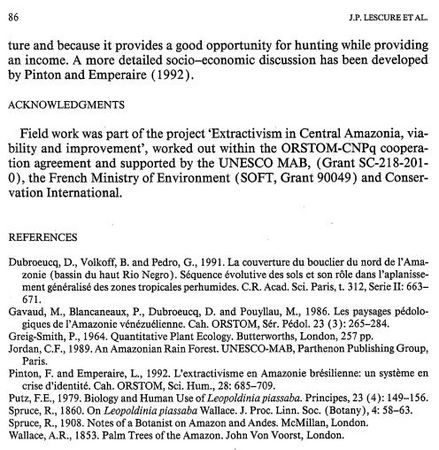
Leopoldinia piassaba: A few biological and economic data from the Rio Negro. by Dr. Jean-Paul Lescure, Dr. Laure Emperaire and Dr. Carlos Franciscon - Region (Brazil).


External Links
- Glossary of Palm Terms
- MODERN BOTANICAL LATIN
- "Just To Be Clear"
- http://horizon.documentation.ird.fr/exl-doc/pleins_textes/pleins_textes_6/b_fdi_43-44/010005130.pdf
- http://ambienteacreano.blogspot.com/2005/11/explorao-da-palmeira-piaava-no-vale-do.html
- https://youtu.be/hbS2P0YyKTk
References
Phonetic spelling of Latin names by edric.
Special thanks to Geoff Stein, (Palmbob) for his hundreds of photos.
Special thanks to Palmweb.org, Dr. John Dransfield, Dr. Bill Baker & team, for their volumes of information and photos.
Glossary of Palm Terms; Based on the glossary in Dransfield, J., N.W. Uhl, C.B. Asmussen-Lange, W.J. Baker, M.M. Harley & C.E. Lewis. 2008. Genera Palmarum - Evolution and Classification of the Palms. Royal Botanic Gardens, Kew. All images copyright of the artists and photographers (see images for credits).
Henderson, A.J., A revision of Leopoldinia (Arecaceae) in Phytotaxa 32. 2011
Many Special Thanks to Ed Vaile for his long hours of tireless editing and numerous contributions.