Bactris elegans
| Bactris (BAHK-triss) elegans (EHL-eh-ganz) | |||||||
|---|---|---|---|---|---|---|---|
 French Guiana. Photo-ti palms.fr | |||||||
| Scientific Classification | |||||||
| |||||||
| Synonyms | |||||||
|
| |||||||
| Native Continent | |||||||
 | |||||||
| Morphology | |||||||
| |||||||
| Culture | |||||||
|
| |||||||
| Survivability index | |||||||
|
| |||||||
| Common names | |||||||
|
| |||||||
Contents
Habitat and Distribution
Amazon region of Colombia (Amazonas), the Guianas, Brazil (Amazonas, Pará, Rondonia), and Bolivia (Pando).
Description
Stems cespitose, forming loose to dense clumps of up to 8 stems, 1.5-3.5 m tall, 0.8-1.5 cm in diam., spiny or not spiny on internodes. Leaves 6-13 in the crown; leaf spines scattered, terete, black or dark brown, rarely yellowish, to 4 cm long, on sheath and proximal part of petiole, usually absent from rachis; sheath 9-30 cm long; ocrea to 4 cm long; petiole 11-40 cm long; rachis 47-75 cm long, densely covered with soft, fine, brown spinules to 1 mm long; pinnae 17-32 per side, regularly arranged except for gaps, spreading in the same plane, linear-Ianceolate to almost sigmoid, asymmetrically and briefly bifid and pendulous apically, glossy green adaxially, with small spines on margins; middle pinnae 9-22 x 1-2.5 cm. Inflorescences interfoliar; peduncle 18-25 cm long, recurved, spiny; prophyll 10-15 cm long; peduncular bract 30-42 cm long, densely brown-tomentose with few to many black spines to 1.5 cm long; rachis absent; rachillae (1-)2, 8-15 cm long, at anthesis densely covered with reddish brown tomentum and brown, moniliform trichomes; triads irregularly arranged among paired or solitary staminate flowers; staminate flowers 4-5.5 mm long, deciduous; sepal lobes 1-2 mm long; petals 4-5 mm long; stamens 6; pistillode small; pistillate flowers 3-4 mm long; calyx tubular, 2.5-3 mm long; corolla tubular, 3-3.5 mm long; staminodes absent; fruits 1.2-1.7 cm in diam., globose, rostrate, purple-black; mesocarp juicy; endocarp depressed-oblong, the sterile pores displaced longitudinally; endocarp fibers free, numerous, with juice sacs attached; fruiting perianth with deeply 3-lobed calyx almost as long as the 3-lobed corolla, without staminodial ring. (Henderson, A.J., Bactris (Palmae) in Flora Neotropica Monographs 79. 2000)/Palmweb. Editing by edric.
Bactris elegans is diagnosed by its small, regularly arranged (but with gaps), asymmetrically and briefly bifid, glossy green pinnae, inflorescence with (1-)2 rachillae, and purple-black, globose fruits. (Henderson, A.J., Bactris (Palmae) in Flora Neotropica Monographs 79. 2000)/Palmweb.
Culture
| read more |
|---|
|
Cultivation and Propagation: This is an excellent understory palm very highly sought after by palm collectors, but scarcely known in cultivation. It is adapt to warm temperate to tropical climates in humid regions, especially along with rainforests and, once established, will grow quite fast and does well in cultivation. In general it does not like hot, drying suns, winds, salt or bad water. Soil requirements: It has a fibrous root system and benefits from deep organic, acidic, sandy loam soils that are fertile and well drained but thrives on wide range of tropical soils, like coastal marine alluvial clays, soils of volcanic origin, acid sands and other coastal alluviums. Waterlogged, highly lateritic, extremely sandy, stony or peaty soils should be avoided. Watering: In cultivation it hates low humidity. During the summer or warmer months, water frequently to keep the soil from drying out. Light: Will grow better in full shade, but tolerates morning sun. Seedlings like a more sheltered area. Fertilization: Need a perfect fertilizer diet including all micro nutrients and trace elements. Aerosol salt tolerance: It is moderately salt tolerant, but does a lot better inland then it does on the coast. Hardiness: It is suited for tropical or subtropical climate (USDA Zones 10a-12) Wind hardiness: It needs wind protection. Garden uses: It is rarely cultivated, but is an excellent understory palm if you can water it regularly. It is ideal where garden space is limited and a small clumping plant is required. It is also an excellent potted palm. Propagation: Seeds or division of larger cluster. Germination can be erratic and slow, taking from 8 to 20 weeks and benefit from soaking. (llifle.com) |
Comments and Curiosities
Uses: The fruit and the palm heart are edible.
- IMAGE GALLERY

Lago Vara, Brazil. Photo by Dr. Andrew J. Henderson/Palmweb.

French Guiana. Photo-ti palms.fr

French Guiana. Photo-ti palms.fr

French Guiana. Photo-ti palms.fr
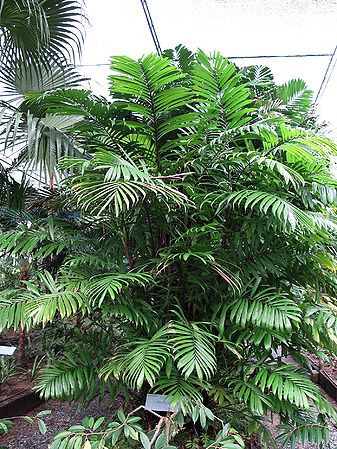
Nong Nooch Tropical Garden, Pattaya, Thailand. Photo by Dr. Scott Zona.

French Guiana. Photo by Dr. Herve Galliffet.


External Links
References
Phonetic spelling of Latin names by edric.
Special thanks to Geoff Stein, (Palmbob) for his hundreds of photos.
Special thanks to Palmweb.org, Dr. John Dransfield, Dr. Bill Baker & team, for their volumes of information and photos.
Glossary of Palm Terms; Based on the glossary in Dransfield, J., N.W. Uhl, C.B. Asmussen-Lange, W.J. Baker, M.M. Harley & C.E. Lewis. 2008. Genera Palmarum - Evolution and Classification of the Palms. Royal Botanic Gardens, Kew. All images copyright of the artists and photographers (see images for credits).
Henderson, AJ, Bactris (Palmae) in Flora Neotropica Monographs 79. 2000
Many Special Thanks to Ed Vaile for his long hours of tireless editing and numerous contributions.