Vonitra utilis
<google>CH02</google>

| Dypsis utilis | |||||||
|---|---|---|---|---|---|---|---|
 Hawaii, photo by Bill Austin, edric. | |||||||
| Scientific Classification | |||||||
| |||||||
| Synonyms | |||||||
|
| |||||||
| Native Continent | |||||||
 | |||||||
| Morphology | |||||||
| |||||||
| Culture | |||||||
|
| |||||||
| Survivability index | |||||||
|
| |||||||
| Common names | |||||||
|
| |||||||
Contents
Habitat and Distribution
Endemic to East Madagascar. Streamsides in swamp forest or moist forest, gregarious; alt. 950- 1000 m.
Description
Robust palm, solitary, but often several specimens in a clump. TRUNK 6-17 m high, branching dichotomously 2-3 times at 9-11 m above the ground, the branches closely parallel, 25-37 cm. in diam., near crown about 18 cm. in diam.; internodes 7-9 cm; bark light brown; wood soft, pinkish-white, moist; crown untidy with pale brown pendulous fibre. LEAVES 13-14 per crown, with the dead leaves marcescent, 4-5 m, erect to porrect, often held on edge; sheath fibrous, about 80 cm long, brown-grey tomentose, with fibrous wings about 4.3 cm wide each, with opposite the petiole a light brown fibrous tongue about 50 cm long; petiole 45-100 cm (to 185 cm in young trees), proximally about 5 x 2.5 cm, distally 2-4.2 x 1.1-1.5 cm, flat adaxially or slightly convex, convex abaxially, with sharp edges, with scattered scales, glabrescent; rachis 2.8-3.8 m, 1.5-1.9 x 1-1.3 cm in mid-leaf, keeled, straw-brown, with scattered pale or dark red scales; leaflets 65-73 on each side of the rachis, in one plane, regular, bright green, stiff, attenuate, the proximal ones 64-82 x 1.2-2 cm, median 77-92 x 3.1-4.8 cm (interval 4-4.5 cm), distal 18-47 x 1-1.8 cm, ramenta few, redbrown, quite large, abaxial on the midrib, main veins 2 on each side of the midrib and main veins, prominent abaxially, young leaves reddish. INFLORESCENCE interfoliar to infrafoliar, up to 20 per tree (in two crowns) in all stages from closed and erect to x old fruiting stage (pendent); branching to 3 orders (rarely to 2 orders?); peduncle 125-135 cm, proximally 3.3 x 2.5 cm, distally x 2 cm, green, glabrous, curved; prophyll dark brown, 25-70 cm long, 6.5 x 2.5 cm. in diam., split at the apex; peduncular bract 154-191 x cm, green turning mid-brown, adaxially redbrown and smooth, densely scaly but soon glabrescent abaxially, glabrous adaxially, beaked for about 7 cm, abscising and carried upwards by the lengthening inflorescence; rachis about 62 cm long, somewhat angled, the branches bulbous at their bases; first order branches (number unclear) proximally 1.4-1.5 x 0.5-0.7 cm; rachillae pendulous, coral-pink in bud but turning pale green, 69-91 cm long, 2.5-5 mm in diam., glabrous or nearly so; triads distant, spirally arranged, slightly sunken in pits; buds yellowgreen to reddish brown, slightly trigonous. STAMINATE FLOWERS purplish or reddish at anthesis, with sepals 2-2.2 x 3.5-5 mm, unequal, the outermost smallest, fleshy, hooded; petals 2.7-2.8 x mm, fleshy, ovate, acute; stamens 6, biseriate, didymous, the outermost inserted slightly lower than the inner, filaments 0.8-1 mm, anthers dorsifix, 0.6-0.8 mm; pistillode about 1.5 x 0.8 mm, bottle-shaped, showing stamen indentations. PISTILLATE FLOWERS with sepals 3- x 3.5-8.5 mm, unequal, hooded, the innermost largest and enveloping the bud for some 270°; petals 3.5-4.5 x 5-7 mm, orbicular, imbricate, unequal, the innermost largest; ovary 3.5-3.8 x 2.5-3 mm, slightly asymmetric with an indistinct trigonous apex; staminodes 0.6- 0.8 mm, flat, tooth-shaped. FRUIT dull green turning purplish brown or black, globose-ellipsoid or obovoid, 17-28 x 14 -20 mm, with persistent petals about 6 mm long; endocarp fibrous. SEED about 23 mm x 16 mm, pointed at the base, rounded at the apex, with ruminate endosperm, the ruminations many, slightly irregular, and almost reaching the middle of the seed. (J. Dransfield and H. Beentje. 1995) Editing by edric.
This is the most robust member of the "Vonitra" group. (J. Dransfield and H. Beentje. 1995).
Culture
Sunny, very moist position.
Comments and Curiosities
This is an upland palm, closely related to D. crinita, but even larger in all its parts, and with inflorescences branched to three rather than two orders. It has been seen near Analamazaotra (in fact there is a much photographed specimen opposite the station hotel at Andasibe; see photo below) and at Ranomafana. Sometimes cited as being critically endangered, this may not be so rare as was originally thought. The Latin name means 'useful', a reference to the piassava produced by the leaves and formerly exported for rope production.
Conservation: Vulnerable. Restricted to only a few sites; numbers thought to be low. (J. Dransfield and H. Beentje. 1995).
Uses: The palmheart is eaten, and the fruit pulp is sugary and also consumed.
External Links
- Glossary of Palm Terms
- Pronunciation Key
- http://www.palmbeachpalmcycadsociety.com/palms/documents/DypsisUtilis.pdf
References
Special thanks to Geoff Stein, (Palmbob) for his hundreds of photos, edric.
Special thanks to Dr. John Dransfield, Dr. Bill Baker & team, for their volumes of information and photos, edric.
- IMAGE GALLERY
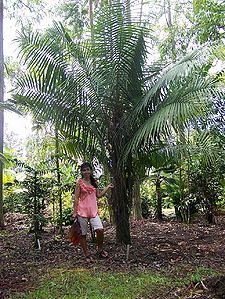
Hawaii, photo by Bill Austin, edric.
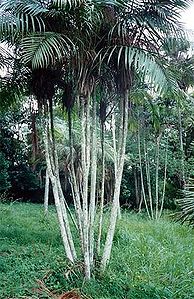
Sri Lanka Botanical Gardens. Notice the branching trunk. Photo by Rolf Kyburz, edric.

Madagascar. Photo by Dr. John Dransfield, edric.

Madagascar, Photo by Rolf Kyburz, edric.

Madagascar, Photo by Rolf Kyburz, edric.

Madagascar, Photo by Rolf Kyburz, edric.

San Diego Zoo, CA.


Jim Wright's garden in San Diego, photo by Kim, edric.
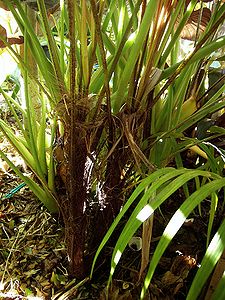
Brisbane Australia, photo by Brod, edric.

Brisbane Australia, photo by Brod, edric.

Hawaii, photo by BGL, edric.

Hawaii, photo by BGL, edric.

Hawaii, photo by BGL, edric.

Perth Western Australia, photo by Tyrone, edric.

Palm Bch. FL.

"Ho'omaluhia Botanical Gardens, Hawaii", edric.

Hawaii.

Hawaii.

Hawaii.
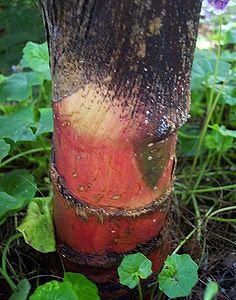
SoCal.

Cape Coral, FL. Photo by Margaret Price, edric.


.jpg)


Many Special Thanks to Ed Vaile for his long hours of tireless editing and numerous contributions.