Coccothrinax argentea
<google>CH02</google> [[Image:
| Coccothrinax argentea | |||||||
|---|---|---|---|---|---|---|---|
|
Help to make this reference box better by uploading a representative photo of this palm. | |||||||
| Scientific Classification | |||||||
| |||||||
| Synonyms | |||||||
|
| |||||||
| Native Continent | |||||||
 | |||||||
| Morphology | |||||||
| |||||||
| Culture | |||||||
|
| |||||||
| Survivability index | |||||||
|
| |||||||
| Common names | |||||||
|
| |||||||
Contents
Habitat and Distribution
Hispaniola, Dominican Republic, and Haiti.
Description
Solitary, or rarely clustered, slender, smooth trunk to 10 m (33 ft.) tall. Its circular fan-shaped leaves, are dark green above, and beautifully silvery below, with an 8" diameter trunk, covered in a woven thatch of fibers. Fan leaves are 5 feet wide, and form a beautiful circular shape, with the leaflet segments being divided almost all the way to the hastula. Leaflets are rigid when young, and only slightly pendent when older, the undersides showing a silver coating.
Culture
Requires full sun and a well drained soil. Does not mind drying out between waterings once established.
Curiosities
External Links
References
Special thanks to Geoff Stein, (Palmbob) for his hundreds of photos, edric.
- IMAGE GALLERY

Coccothrinax Argentea 15 yrs old from seedling Palm Springs, Ca.
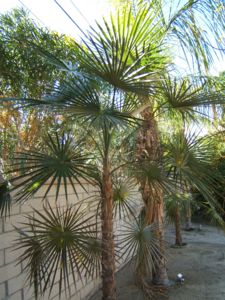
Coccothrinax Argentea 15 yrs old from seedling Palm Springs, Ca.


Many Special Thanks to Ed Vaile for his long hours of tireless editing and numerous contributions.