Carpentaria acuminata
<google>CH02</google>

| Carpentaria acuminata | |||||||
|---|---|---|---|---|---|---|---|
 AUSTRALIA: Darwin, 1964. | |||||||
| Scientific Classification | |||||||
| |||||||
| Synonyms | |||||||
|
| |||||||
| Native Continent | |||||||
 | |||||||
| Morphology | |||||||
| |||||||
| Culture | |||||||
|
| |||||||
| Survivability index | |||||||
|
| |||||||
| Common names | |||||||
|
| |||||||
Habitat and Distribution
Escape Cliffs, NE of Darwin, Northern Territory, Australia. Occurs in the top end of the NT. Altitudinal range from near sea level to 200 m. Grows in canopy or subcanopy of rainforest, Allosyncarpia forest, vine forest and swamp forest on sandy to heavy clay lom soils.
Description
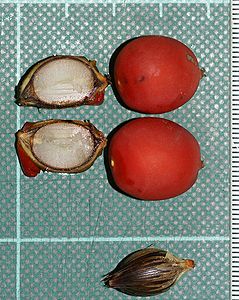
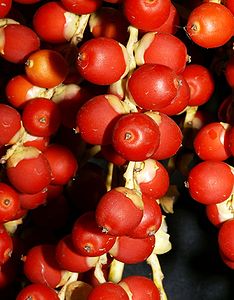
Solitary palm 9-30 m tall with a DBH of 15-20 cm, grey to light tan with widely spaced rings. Leaves 10-12 per plant. Leaves pinnate, 2-4 m long, arching; pinnae many, narrow, arching, 40-60 x 1.2-1.5 cm long, deep green. Crownshaft smooth, green. Inflorescence arise from the upper leaf bases, and then progressively down the trunk, 1-2 m long with flower clusters 90-120 cm long, pendant, much branched, beneath the crown shaft bearing white male and female flowers. Flowers ca. 10 mm across. Sepals 3, petals 3 and the flowers in groups of 3, with 1 female between 2 male flowers. Male flowers with 30-40 stamens. Fruit globular and up to 20 mm diameter, scarlet when ripe with up to 3 seeds within. Seeds smooth.
Culture
Curiosities
References
Special thanks to Geoff Stein, (Palmbob) for his hundreds of photos.
- IMAGE GALLERY

AUSTRALIA: Darwin, 1964.
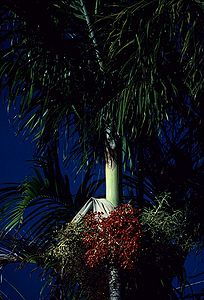
Fairchild Tropical Garden, Coconut Grove

In low lying monsoonal forest.

Male flowers.

Female flowers.


Many Special Thanks to Ed Vaile for his long hours of tireless editing and numerous contributions.