Raphia gentiliana
| Raphia (rahf-EE-ah) gentiliana (jehn-tihl-ee-AHN-ah) | |||||||
|---|---|---|---|---|---|---|---|
 Bas-Congo. Photo by Scamperdale. | |||||||
| Scientific Classification | |||||||
| |||||||
| Synonyms | |||||||
|
| |||||||
| Native Continent | |||||||
 | |||||||
| Morphology | |||||||
| |||||||
| Culture | |||||||
|
| |||||||
| Survivability index | |||||||
|
| |||||||
| Common names | |||||||
|
| |||||||
Contents
Habitat and Distribution
Central African Republic, and Zaire. Congo, Democratic
Description
Moderate, apparently solitary palm; stem 6 m long with leaves up to 10 m long, arching away from the axis; leaflets to 120 on each side of rachis; inflorescences pendant, 2 m long; fruits variable in shape, ranging from tapering club shaped to more globose or ellipsoid-ovoid, 4-6.5 cm long and 3-3.5 cm in diameter, covered by yellowish-brown brown scales which become darker at maturity. (Palms of Africa)
Culture
Cold Hardiness Zone: 10a
Comments and Curiosities
Uses: The leaf stems are used for making hammocks, beds and various items of furniture. Traditionally fibres from the young leaves were used to weave Mbari, a loin cloth worn for dances. The palm is tapped for palm wine. Honeybees collect nectar from some species and may be responsible for pollination.
- IMAGE GALLERY

Bas-Congo. Photo by Scamperdale.

Bas-Congo. Photo by Scamperdale.

Bas-Congo. Photo by Scamperdale.
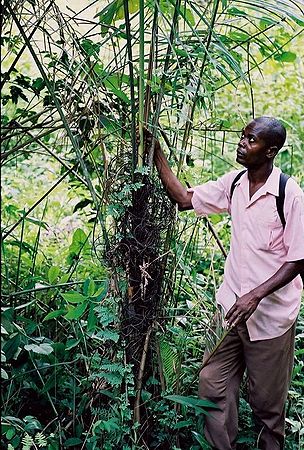
Congo. Photo by Paul Latham.


External Links
References
Phonetic spelling of Latin names by edric.
Special thanks to Geoff Stein, (Palmbob) for his hundreds of photos.
Special thanks to Palmweb.org, Dr. John Dransfield, Dr. Bill Baker & team, for their volumes of information and photos.
Glossary of Palm Terms; Based on the glossary in Dransfield, J., N.W. Uhl, C.B. Asmussen-Lange, W.J. Baker, M.M. Harley & C.E. Lewis. 2008. Genera Palmarum - Evolution and Classification of the Palms. Royal Botanic Gardens, Kew. All images copyright of the artists and photographers (see images for credits).
Many Special Thanks to Ed Vaile for his long hours of tireless editing and numerous contributions.