Calamus rotang
| Calamus (KAL-ah-muhs) rotang (roh'-tahng} | |||||||
|---|---|---|---|---|---|---|---|
|
Help to make this reference box better by uploading a representative photo of this palm. | |||||||
| Scientific Classification | |||||||
| |||||||
| Synonyms | |||||||
|
| |||||||
| Native Continent | |||||||
 | |||||||
| Morphology | |||||||
| |||||||
| Culture | |||||||
|
| |||||||
| Survivability index | |||||||
|
| |||||||
| Common names | |||||||
|
| |||||||
Contents
Habitat and Distribution
INDIA (Andhra Pradesh, Tamil Nadu, Kerala), SRI LANKA. Common in coastal fresh water swamp forests, frequent along fresh water streams of lower hill valleys. [[]]
Description
Clustering palm exhibiting a slender stem ranging from a few millimeters to some centimeters in diameter, flexible, sometimes more or less armed with spines. Its leaves are pinnate, alternately arranged at regular intervals along the stem, 60-80 cm long, consisting of linear-lanceolate segments, 15-30 cm long, armed with two ranks of spines on upper face. Its sheath and thin petiole are armed with whitish spines, whose function is that of support and climbing organs. Flowers, unisexual on dioecious plants, are clustered in showy unbranched inflorescences, enveloped by spiny spathes.
A slender thicket forming climber; stem with leafsheath 8-16 mm in diameter; internodes to 40 cm or more long. Leaves ecirrate, to 80 cm long; leafsheath with distinct knee, armed with more or less scattered, broad-based 1 cm long yellowish spines; each pointing down-wards; flagellum slender, about 2 m long; petiole absent; leaflets numerous, equidistant or sub-equidisitant, linear to lanceolate, 1-nerved, 10 -15 cm long, 1.5 cm broad at middle; midnerve with 2 hooks on upper side and uniformly spinulose below; uppermost leaflets smallest. Male inflorescence flagelliform; axial part strongly aculeate; rachillae scorpioid, 12 - 35 cm long, with 5-12 approximate male flowers on each side of the rachilla; in male flowers corolla deeply divided into 3 segments. Female inflorescence flagelliform; partial inflorescences 15 - 20 cm long with 5-8 rachillae on each side; each arch-like with divaricate neuter flower. Fruit globose, apiculate, 1.3 -1.5 cm long, 1.2 cm broad at middle; fruit scales in 21 longitudinal series, faintly channelled at middle; seed flattened, 8 mm in diameter. (Dransfield J., Rattans (canes) in India. A Monographic Revision. 1992)/Palmweb. Editing by edric.
Culture
Cultivated in the Indian Botanic Garden, Howrah. It is also cultivated in trial plots of the Kerala Forest Research Institute, Peechi, Kerala.
Comments and Curiosities
| read more |
|---|
|
Etymology: Its generic name derives from Greek calamos = reed, with reference to its slender stem much like bamboo canes. Its specific name refers to the native name for the material obtained from the stem (rattan). Uses: Calamus rotang cane is used for making rough baskets, for plucking tea leaves, and for carrying building materials. Split canes are largely used for making bags, 'jhapi', a kind of small bucket used in villages for measuring grain, and for making chair bottoms. The young leaves are also eaten as a vegetable by tribal people. Its slender and cylindrical stem, properly worked, is the source of the well known rattan, a valuable and expensive material, much appreciated for the making of furniture, walking-sticks, umbrellas and wickerwork. NOTE: Calamus godefroyi is considered to be synonymous with C. rotang, so I will list it here as a form, but at this time not a sub-species, the newly collected Lao material did not reach Kew in time for this to be confirmed by detailed direct comparisons. Most previously published locality records are inaccurate and so, since Magalon's (1930) report from Cochinchina appears to be unsupported by specimens (it may simply be a repeat of Beccari's [1908, 1913] error) there remains no evidence that the species occurs in Vietnam. A reported specimen from Siam (Gagnepain & Conrard 1937) is apparently in error (see above). The specimen from Phnom Penh cited by Gagnepain & Conrard (1937) could not be located; it may be Unknown s.n. E140. The one Lao record is from a marshy valley on the Mekong floodplain. This area is used for dry season rice but floods too deeply to be used in the rainy season, at which time the paddies are rapidly re-occupied by sedges. Much of the marsh was probably once wooded but only scattered trees now remain, as well as degraded forest and bamboo scrub on the surrounding higher ground. Calamus rotang-godefroyi 'Laos form' was reportedly once very abundant at the site, the local name of which translates as 'rattan lake', but it is now reduced to scattered clumps along banks and ditches in the marsh, with more plants in the surrounding scrub. In 2000 seedlings were common but few adult plants were found. One local man was so concerned by this decline that he has transplanted several clumps to his small-holding; these are thriving and were the source of the recently collected material. Indochinese endemic, Thailand (North-east), Laos (Central) and Cambodia. Marshy, forested areas below 200 m. (J. Dransfield, A Synopsis of the Rattans (Arecaceae: Calamoideae) of Laos and Neighbouring Parts of Indochina. 2002)/Palmweb. Calamus rotang-godefroyi 'Laos form' conservation: Unknown, but locally poor (see above) because the species occupies a habitat especially vulnerable to clearance. Similar habitats are widespread in the Mekong plain and it is likely that C. godefroyi will be found at other sites, but as agriculture intensifies many of those in Laos may be under threat. Likely to be secure if strong populations occur around the Great Lake in Cambodia; otherwise of moderate concern. Calamus rotang-godefroyi 'Laos form' Common Name: wai nong (Lao Loum). Calamus rotang-godefroyi 'Laos form' Uses: Stem used for handicrafts, shoot edible. |
- IMAGE GALLERY

Prachin Buri, Thailand. Photo by Dr. John Dransfield, Royal Botanic Gardens, Kew/Palmweb.

Prachin Buri, Thailand. Photo by Dr. John Dransfield, Royal Botanic Gardens, Kew/Palmweb.

Laos. Calamus rotang-godefroyi 'Laos form' Photo by Dr. John Dransfield, Royal Botanic Gardens, Kew/Palmweb.

Laos. Calamus rotang-godefroyi 'Laos form' Photo by Dr. John Dransfield, Royal Botanic Gardens, Kew/Palmweb.
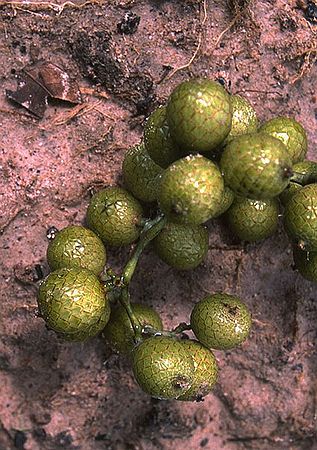
Laos. Calamus rotang-godefroyi 'Laos form' Photo by Dr. John Dransfield, Royal Botanic Gardens, Kew/Palmweb.


External Links
References
Phonetic spelling of Latin names by edric.
Special thanks to Geoff Stein, (Palmbob) for his hundreds of photos.
Special thanks to Palmweb.org, Dr. John Dransfield, Dr. Bill Baker & team, for their volumes of information and photos.
Glossary of Palm Terms; Based on the glossary in Dransfield, J., N.W. Uhl, C.B. Asmussen-Lange, W.J. Baker, M.M. Harley & C.E. Lewis. 2008. Genera Palmarum - Evolution and Classification of the Palms. Royal Botanic Gardens, Kew. All images copyright of the artists and photographers (see images for credits).
Dransfield J., Rattans (canes) in India. A Monographic Revision. 1992
J. Dransfield, A Synopsis of the Rattans (Arecaceae: Calamoideae) of Laos and Neighbouring Parts of Indochina. 2002
Many Special Thanks to Ed Vaile for his long hours of tireless editing and numerous contributions.