Bactris hirta
| Bactris (BAHK-triss) hirta (HEER-tah) | |||||||
|---|---|---|---|---|---|---|---|
 Habitat. Photo by André Cardoso. | |||||||
| Scientific Classification | |||||||
| |||||||
| Synonyms | |||||||
|
| |||||||
| Native Continent | |||||||
 | |||||||
| Morphology | |||||||
| |||||||
| Culture | |||||||
|
| |||||||
| Survivability index | |||||||
|
| |||||||
| Common names | |||||||
|
| |||||||
Contents
Habitat and Distribution
Common and widespread throughout the Amazon region and Atlantic coastal forest of Brazil; lowland or upland rain foreston terra firme, usually below 350 m elevation but occasionally to 1500 m.

Description
Stems solitary or cespitose and forming small clumps, 0.5-3 m tall, 0.5-2 cm in diam., commonly covered with persistent, decaying leaf bases, spiny or not spiny on internodes. Leaves 3-8 per crown; leaf spines somewhat clustered, black, terete or sometimes flattened, 0.5-3 (-5) cm long, dense on sheath, fewer on petiole, usually absent from rachis, or spines absent; sheath 8-26 cm long, sheath, petiole, and rachis spinulose or brown-tomentose; ocrea to 1 cm long; petiole 6-89 cm long; rachis 15-80 cm long; blade simple or pinnate, pinnate leaves with 7-30 pinnae per side, regularly or irregularly arranged, spreading in the same plane, linear, linear-lanceolate or sigmoid, aristate, with fine spinules along the margins, usually with soft hairs to 3 mm long abaxially, and occasionally adaxially; simple leaves 23-80 cm long, 9-20 cm wide at rachis apex, sometimes lighter green abaxially, sometimes with prominent cross-veins, middle pinnae of pinnate leaves 10-37 x 1-3 cm. Inflorescences inter- or infrafoliar, usually borne among persistent leaf sheaths; peduncle 3-21 cm long, straight or curved, spinulose or not; prophyll 3-6 (-9) cm long; peduncular bract 9- 12 cm long, sparsely to densely covered with black or brown spines to 5 mm long; rachis 0-0.7 cm long; rachillae 1-4 (-6), 2.5- 7 cm long, usually forming a 45° angle with the stem, at anthesis densely whitish brown-tomentose, covered with brown; moniliform trichomes; triads regularly arranged almost throughout rachillae, paired or solitary staminate distally; staminate flowers 3-4 mm long, semipersistent or deciduous; sepal lobes 0.5-1 mm long; petals 3-4 mm long; stamens 6-7; pistillode absent; pistillate flowers 2-3.5 mm long; calyx annular, 0.5-1 mm long; corolla tubular, 2-3.5 mm long, tomentose, densely covered with long, flexuous, appressed, brown hairs, these exceeding the corolla; staminodes minute or absent; fruits 5-8 mm in diam., rarely to 1 cm long, globose to broadly obovoid, orange-red or red, afterwards becoming black, covered with fine, brown, deciduous spinules, rarely glabrous; mesocarp starchy; endocarp turbinate, the sterile pores slightly displaced longitudinally or equally spaced; endocarp fibers few, free; fruiting perianth with small, 3-lobed calyx and much longer, hairy, broadly 3-lobed corolla, without staminodial ring. (Henderson, A.J., Bactris (Palmae) in Flora Neotropica Monographs 79. 2000)/Palmweb. Editing by edric.
| read more |
|---|
|
Bactris hirta is diagnosed by its 1-4(- 5) rachillae 5-7 cm long, tubular corolla 2-3.5 mm long densely covered with long, flexuous, appressed, brown hairs (these exceeding the corolla), and globose to broadly obovoid, orange-red or red fruits 5-8 mm diameter (rarely to 1 cm long). This species is widespread and extremely variable, particularly in leaf division, shape, and size. There are several more or less distinct local forms, and some of these are recognized here as varieties. The differences between them are not always clear, and the whole complex is poorly understood. Many more collections are needed to better understand this species. I expect that further collecting and study will lead to the recognition of even more taxa. In the following paragraphs I attempt to describe some of the variation among and within the four varieties here recognized. In the western and central Amazon region there are specimens without leaf spines (or rarely spiny), and with short petioles, and simple, narrowly to broadly obovate, deeply bifid blades, usually with prominent cross-veins. The peduncle is spinulose and usually becomes recurved after anthes is. Some of these were called B. hirta var. pulchra by Henderson (1995) and Henderson et al. (1995). They have also been identified as B. hirta and B. longipes. They area heterogeneous group of specimens, and are here called var. hirta. Specimens from Guyana at 300-700 m elevation have simple leaves that are spinulose and lighter green abaxially, and glabrous or spinulose fruits. The first collection of these was by Jenman, and Trail wrote the name B. vesiculifera on the label of this collection, although this name was never validly published. It is here called var. jenmanii. A group of distinctive specimens from the western Amazon region have densely spinulose leaves, with soft spines to 2 cm long. Leaves are pinnate with linear-lanceolate to sigmoid pinnae. These are herecalled var. lakoi, although they were referred to as var. mollis by Henderson (1995) and Henderson et al. (1995). The fourth variety, var. spruceana, is common and widespread and occurs throughout the Amazon region and in the Atlantic coastal forest of Brazil. Within this variety it is possible to recognize five local forms. In the first, plants have large, simple leaves and elongate petioles. The abaxial leaf surface is often pilose. Specimens of this form have been referred to as Bactris hirta, B. geonomoides, and B. integrifolia. More toward the center of the Amazon region (but also in the Atlantic coastal forest) the second, common form is found. This has large, pinnate leaves. Pinnae are 7-30 per side, linear, elongate, and are 22-37 cm long and 1-2 cm. This form has been called B. pectinata. The third local form also has pinnate leaves. It is found in the upper Río Negro region of Venezuela (Amazonas, Bolívar) and Colombia (Guainía), often on tepuí slopes from 400 to 1670 m elevation. Pinnaeare fewer and shorter, typically 7-10 per side, linear-lanceolate to sigmoid, 17- 25 cm long and 2-3 cm. This form was called B. turbinata by Spruce. The fourth form, also pinnate-leafed, is known from western Brazil (Amazonas, Río Jurua) and Peru (Loreto, Rio Ucayali). Specimens have much larger inflorescences than usual. The fifth form consists of a few specimens from the western Amazon region (e.g., Galeano 2032, Gentry 61973, Knapp 7928). These have 2-5, broad, sigmoid, irregularly arranged, densely pilose pinnae, with the apical pinna much wider than the others. Inflorescences are pendulous, like those of B. simplicifrons. All these five local forms grow together, and it is not uncommon to find two leaf forms, pinnate and simple, on the same plant. Because of this, and because there are few other differences in vegetative or reproductive characters, I have treated all these forms as var. spruceana. (Henderson, A.J., Bactris (Palmae) in Flora Neotropica Monographs 79. 2000)/Palmweb. |
Culture
Comments and Curiosities
There are five subspecies: 1.) Bactris hirta var. hirta; Colombia (Amazonas) and Peru (Loreto) and Brazil (Amazonas) lowland rain forest on terra firme at 122-140 m elevation. Sheath and petiole densely brown-spinulose or-tomentose, leaf spines absent (rarely present); petiole 4-12 (-29) cm long; rachis 12- 16 cm long; blade simple, narrow to broadly obovate, deeply bifid, 18-33 cm long, 9-17 cm wide at apex of rachis, often spinulose marginally, abaxially and sometimes adaxially,with prominent cross-veins, lighter green abaxially. Fruits spinulose. The holotype of Bactris hirta subsp. pulehra (J .Trail 876/XCVIII) is problematic, because it has the short petiole and bifid blade typical of var. hirta, but a spiny sheath and petiole, typical of var. spruceana. Although it is thus somewhat intermediate, I choose to place it here. (Henderson, A.J., Bactris (Palmae) in Flora Neotropica Monographs 79. 2000)/Palmweb.
2.) Bactris hirta var. jenmanii; Guyana; upland rain forest, at 300-1500 m elevation. Sheath and petiole with scattered, black, flattened spines to 5 mm long, few to moderate on sheath, fewer or absent on petiole; petiole 6-20 cm long; rachis 15-20 cm long; blade simple, broadly obovate, deeply bifid apically, 30-40 cm long, 12-23 cm wide at rachis apex, spinulose and lighter green abaxially. Fruits glabrous or slightly spinulose. (Henderson, A.J., Bactris (Palmae) in Flora Neotropica Monographs 79. 2000)/Palmweb.
3.) Bactris hirta var. lakoi; Brasil (Amazonas, Peru (Loreto) and E Ecuador. Leaf blade to 1 m long, divided into 19-30 pinnae on each side, usually with numerous, soft, black bristles on both sides. Inflorescence with 2-5, whitish tomentose branches, each to 5 cm long. (Borchsenius F., Borgtoft-Pedersen H. and Baslev H. 1998. Manual to the Palms of Ecuador. AAU Reports 37. Department of Systematic Botany, University of Aarhus, Denmark in collaboration with Pontificia Universidad Catalica del Ecuador)/Palmweb.
4.) Bactris hirta var. pectinata; Bolivia, Brazil North, Brazil Northeast, Brazil Southeast, Colombia, French Guiana, Guyana, Peru, Suriname, and Venezuela. Uses: the leaves are used for thatch, the fruit is edible.
5.) Bactris hirta var. spruceana; Widespread and common in Colombia (Amazonas, Guainía, Vaupés), Venezuela (Amazonas, Bolívar), the Guianas, Peru (Loreto, Madre de Dios, San Martín), Brazil (A mapa, Amazonas, Bahia, Espírito Santo, Maranhao, Para, Pernambuco, Rondonia), and Bolivia (Pando); usually in lowland rain forest on terra firme, at 106-1670 m elevation. Sheath spinulose or tomentose, sparsely to densely covered with black spines 1-3(-5) cm long; petiole 40-89 cm long; blade simple or pinnate; pinnate leaves with 7-30 pinnae per side, linear, regularly or irregularly arranged, spreading in the same plane; middle pinnae to 37 x 1-2 cm (rarely pinnate leaf with 2-5, broad, sigmoid, densely pilose pinnae, with the apical pinna much wider than the others); simple or partially divided blades to 80 cm long, to 20 cm wide at rachis apex. Fruits spinulose. Types were not designated for several of Drude?s names (Bactris geonomoides, Bactris geonomoides var. setosa, Bactris hylophila var. macrocarpa, Bactris hylophila var. glabreseens, Bactris hylophila var. nana). Although these were based on Trail's specimens, it is not clear from either Drude (1881) or from the specimens which are the types. (Henderson, A.J., Bactris (Palmae) in Flora Neotropica Monographs 79. 2000)/Palmweb.
Uses: The fruit is edible.
- IMAGE GALLERY

Habitat. Photo by Dr. Andrew J. Henderson, Royal Botanic Gardens, Kew/Palmweb.

Habitat. Photo by André Cardoso.

Habitat. Photo by André Cardoso.

Habitat. Photo by André Cardoso.

Habitat. Photo by André Cardoso.

Habitat. Photo by André Cardoso.

Habitat. Photo by André Cardoso.

Bahia, Brazil. Bactris hirta var. spruceana. Photo by Dr. Alex Popovkin.

Bahia, Brazil. Bactris hirta var. spruceana. Photo by Dr. Alex Popovkin.

Bahia, Brazil. Bactris hirta var. spruceana. Photo by Dr. Alex Popovkin.

Bahia, Brazil. Bactris hirta var. spruceana. Photo by Dr. Alex Popovkin.

Bahia, Brazil. Bactris hirta var. spruceana. Photo by Dr. Alex Popovkin.

Bahia, Brazil. Bactris hirta var. spruceana. Photo by Dr. Alex Popovkin.

Bahia, Brazil. Bactris hirta var. spruceana. Photo by Dr. Alex Popovkin.

Madre de Dios, Peru. Photo by Dr. Timothy Paine.
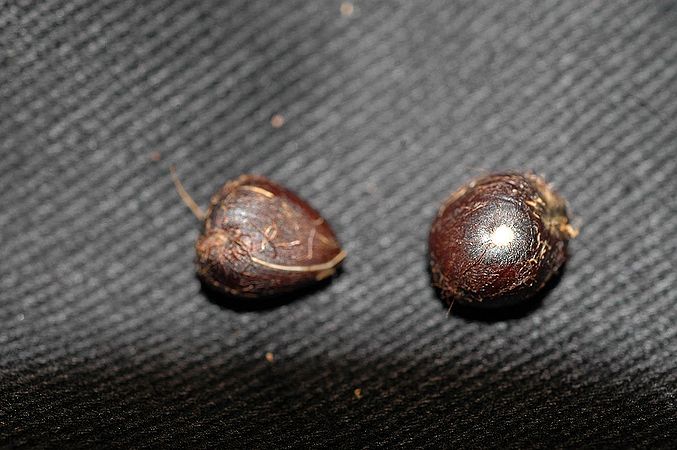
Madre de Dios, Peru. Photo by Dr. Timothy Paine.


External Links
- Glossary of Palm Terms
- MODERN BOTANICAL LATIN
- "Just To Be Clear"
- http://media.e-taxonomy.eu/palmae/protologe/palm_tc_18890_P.pdf
References
Phonetic spelling of Latin names by edric.
Special thanks to Geoff Stein, (Palmbob) for his hundreds of photos.
Special thanks to Palmweb.org, Dr. John Dransfield, Dr. Bill Baker & team, for their volumes of information and photos.
Glossary of Palm Terms; Based on the glossary in Dransfield, J., N.W. Uhl, C.B. Asmussen-Lange, W.J. Baker, M.M. Harley & C.E. Lewis. 2008. Genera Palmarum - Evolution and Classification of the Palms. Royal Botanic Gardens, Kew. All images copyright of the artists and photographers (see images for credits).
Henderson, A.J., Bactris (Palmae) in Flora Neotropica Monographs 79. 2000
Borchsenius F., Borgtoft-Pedersen H. and Baslev H. 1998. Manual to the Palms of Ecuador. AAU Reports 37. Department of Systematic Botany, University of Aarhus, Denmark in collaboration with Pontificia Universidad Catalica del Ecuador
Many Special Thanks to Ed Vaile for his long hours of tireless editing and numerous contributions.