Ammandra decasperma
| Ammandra (aham-MAHN-drah) decasperma (deh-kahs-PEHR-mah) | |||||||
|---|---|---|---|---|---|---|---|
|
Help to make this reference box better by uploading a representative photo of this palm. | |||||||
| Scientific Classification | |||||||
| |||||||
| Synonyms | |||||||
|
| |||||||
| Native Continent | |||||||
 | |||||||
| Morphology | |||||||
| |||||||
| Culture | |||||||
|
| |||||||
| Survivability index | |||||||
|
| |||||||
| Common names | |||||||
|
| |||||||
Contents
Habitat and Distribution
Colombia. [[]]
Description
Solitary or clustered dioecious palm, with stems short and subterranean, or prostrate, and up to 1.5 m long and 25-35 cm in diameter, usually decaying at the older portions. Leaves 8-20 erect or arching; sheath l-1.7 m long, strongly fibrous, most of it appearing like the petiole; petiole cylindrical, l-2.4 m long, 2-2.5 cm in diameter, green; rachis 3.3-4 m long, with 40-62 pinnae; middle pinnae opposite, to 85 cm long and 5 cm wide, glabrous, with a prominent submarginal vein on either side of the midvein. Inflorescences interfoliar, the staminate up to 1.4 m long; peduncle 30-75 cm; peduncular bract 35-50 cm long; rachis 3O-92 cm long; rachillae 45-90, each with 6-9 flowers 0.5-3 cm long, the proximal ones larger and with more stamens; perianth obscure, hidden by the enlarged receptacle, the latter making the most conspicuous part of the flower; receptacle prismatic, to 1.5 cm long, with a small, central pistillode; stamens 300-1321; filaments 0.1-0.9 mm long; anthers 0.5-1.7 mm long. Pistillate inflorescence with peduncle to 30 cm long; peduncular bt'act 15*30 cm long; pistillate flowers 6-10 densely arranged in a head on a short rachis 1-2.5 cm long, each flower up to 25 cm long, with 7-10 narrow tepals to 10 cm long; ovary with 6-10 locules; style to 7 cm long; stigmas to 5 cm long. Infructescence 2O-25 cm diameter, with 3-10 fruits. Fruit depressed-globose1, 0 -12 cm diameter, with woody spiny projections to L cm long; seeds 6-10, wedge-shaped, with two flat sides, the distal surface convex, 4.5-5 cm long, 3-4 cm wide,2.2-3 cm along the tangential face. (R. Bernal, Notes on the Genus Ammandra (Palmae). 2001)/Palmweb. Editing by edric.
According to Barfod, Ammandra dasyneura differs from A. decasperma mainly in the larger number of stamens (800-1200 vs. 300-500), with longer filaments (0.5 vs. 0.1-0.2 mm) and longer anthers (1-1.7 vs. 0.5 mm). These differences, faint as they might seem, were reinforced by the isolation of both species on either side of the Andes. Ammandra decasperma was known only from the Pacific lowlands of Colombia, west of the Andes, whereas A. dasyneura was known from the northwestern Amazon in Colombia and Ecuador, east of the Andes. No populations of this genus had been found in the inter-Andean valleys in between. During recent field work in central Colombia, we found a population of Ammandra in the wet middle valley of the Magdalena river. As this valley lies deep between the Central and Eastern Andean cordilleras, in an area intermediate between the ranges of A. dasyneura and A. decasperma, the finding was particularly interesting. Thus, we have reassessed the differences between the two species, under the light of the new discovery
Culture
Comments and Curiosities
Uses: The weaved pinnae of the leaves are used for thatch. Leaves are used to make temporary baskets. Fibres from the leaf base of juvenile plants are used to make brooms. The mesocarp, preferably mature, is edible. The endosperm is also edible when immature in a liquid or jelly-like state. The endosperm is eaten to cure diarrhea and stomach ache. (Macía, M.J., Multiplicity in palm uses by the Huaorani of Amazonian Ecuador. 2004 (as Ammandra dasyneura (Burret) Barfod)
- IMAGE GALLERY

Yasuni National Park, Orellana, Ecuador. Pistillate Inflorescence (Left) and Pistillate Flower in 2 Views. Photo by Dr. John Dransfield, Royal Botanic Gardens, Kew/Palmweb.
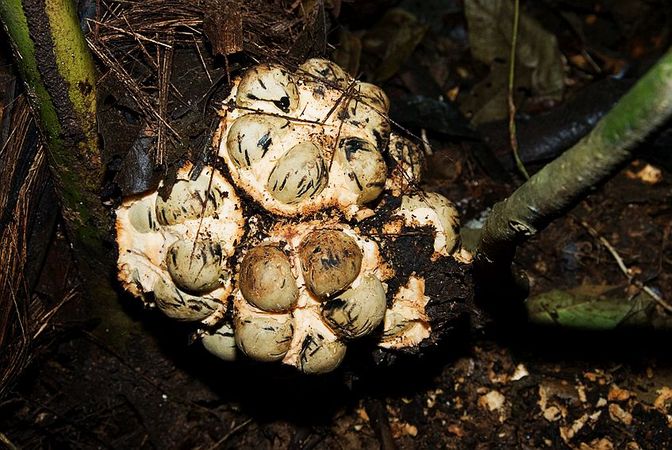
Yasuni National Park, Orellana, Ecuador. Photo by Dr. John Dransfield, Royal Botanic Gardens, Kew/Palmweb.
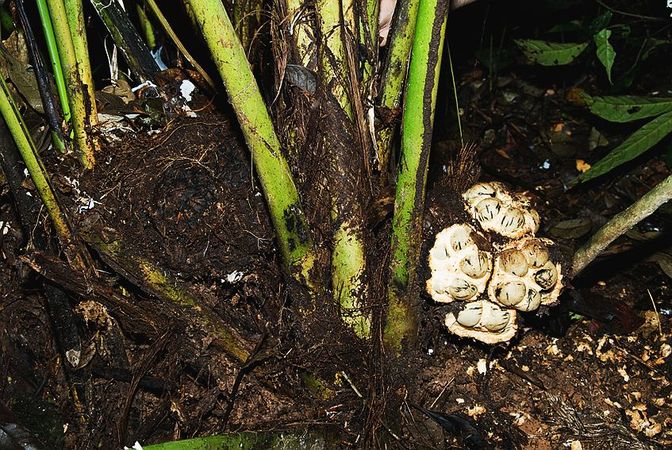
Yasuni National Park, Orellana, Ecuador. Photo by Dr. John Dransfield, Royal Botanic Gardens, Kew/Palmweb.

Buenaventura, Colombia. Photo by Dr. John Dransfield, Royal Botanic Gardens, Kew/Palmweb.

Yasuni National Park, Orellana, Ecuador. Portion of Staminate Inflorescence (Left), Staminate Rachilla (Middle) and Staminate Flower (Right). Photo by Dr. John Dransfield, Royal Botanic Gardens, Kew/Palmweb.

Yasuni National Park, Orellana, Ecuador. Photo by Dr. Natalie W. Uhl, Royal Botanic Gardens, Kew/Palmweb.
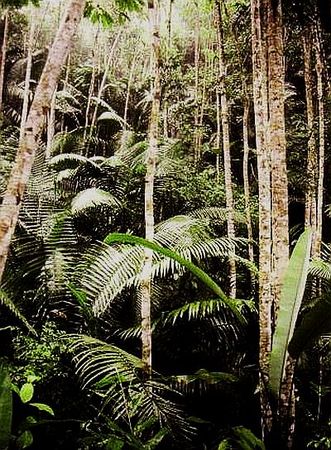
Magdalena River Valley, Columbia. Photo by Rodrigo Bernal, edric.

Magdalena River Valley, Columbia. Photo by Rodrigo Bernal, edric.

Magdalena River Valley, Columbia. Photo by Rodrigo Bernal, edric.


External Links
- Glossary of Palm Terms
- MODERN BOTANICAL LATIN
- "Just To Be Clear"
- http://www.palms.org/palmsjournal/2001/vol45n3p123-126.pdf
References
Phonetic spelling of Latin names by edric.
Special thanks to Geoff Stein, (Palmbob) for his hundreds of photos.
Special thanks to Palmweb.org, Dr. John Dransfield, Dr. Bill Baker & team, for their volumes of information and photos.
Glossary of Palm Terms; Based on the glossary in Dransfield, J., N.W. Uhl, C.B. Asmussen-Lange, W.J. Baker, M.M. Harley & C.E. Lewis. 2008. Genera Palmarum - Evolution and Classification of the Palms. Royal Botanic Gardens, Kew. All images copyright of the artists and photographers (see images for credits).
R. Bernal, Notes on the Genus Ammandra (Palmae). 2001
Many Special Thanks to Ed Vaile for his long hours of tireless editing and numerous contributions.