Difference between revisions of "Carpentaria acuminata"
| Line 30: | Line 30: | ||
The red fruit is planted in trays, defleshing is wise but not essential, as the flesh can burn sensitive skin. Bifid leaves will appear in 3 or 4 months, the seedlings are then tubed. Heavy shading results in long red petioles and large dark bifid leaves for 18 months before a pinnate leaf develops. Once they have filled a 200mm pot they will be about 2 years old, 2m tall, have some pinnate leaves and be ready to plant out. Heavy irrigation, fertilizer and mulch are required for best results. It establishes easily in gardens and is handsome in all stages of its rapid growth. Until the palm reaches maturity, the leaves are spaced evenly up the trunk, with the leaflets lying flat. As it ages, a crownshaft develops, the leaves arch and the pinnae rise to form a "V". Transplanting older specimens is usually successful. Carpentarias can be used indoors, being popular with plant hire companies triple planted. In a community of mixed species they will outgrow the others, adding height to the garden quickly. When spaced out in the sun as an avenue, the Carpie will grow uniformly, its self cleaning habit a bonus. | The red fruit is planted in trays, defleshing is wise but not essential, as the flesh can burn sensitive skin. Bifid leaves will appear in 3 or 4 months, the seedlings are then tubed. Heavy shading results in long red petioles and large dark bifid leaves for 18 months before a pinnate leaf develops. Once they have filled a 200mm pot they will be about 2 years old, 2m tall, have some pinnate leaves and be ready to plant out. Heavy irrigation, fertilizer and mulch are required for best results. It establishes easily in gardens and is handsome in all stages of its rapid growth. Until the palm reaches maturity, the leaves are spaced evenly up the trunk, with the leaflets lying flat. As it ages, a crownshaft develops, the leaves arch and the pinnae rise to form a "V". Transplanting older specimens is usually successful. Carpentarias can be used indoors, being popular with plant hire companies triple planted. In a community of mixed species they will outgrow the others, adding height to the garden quickly. When spaced out in the sun as an avenue, the Carpie will grow uniformly, its self cleaning habit a bonus. | ||
==Comments and Curiosities== | ==Comments and Curiosities== | ||
| + | This is a [[monotypic]] genus. | ||
May be confused with Archontophoenix cunninghamiana, which has pink to lavender flowers and all linear leaflets, rather than white to greenish-white flowers and broad apical leaflets in Carpentaria acuminata; Veitchia sp. which have leaflets that are drooping, rather than held in a V-shape. | May be confused with Archontophoenix cunninghamiana, which has pink to lavender flowers and all linear leaflets, rather than white to greenish-white flowers and broad apical leaflets in Carpentaria acuminata; Veitchia sp. which have leaflets that are drooping, rather than held in a V-shape. | ||
| Line 44: | Line 45: | ||
<center><gallery caption="IMAGE GALLERY" perrow="4" widths="200px" heights="200px"> | <center><gallery caption="IMAGE GALLERY" perrow="4" widths="200px" heights="200px"> | ||
| − | image: | + | image:7e24bb71-6461-47cd-8391-a5109156d4cb.jpg|Queensland, Australia. Photo by Dr. John Dransfield, edric. |
| − | + | ||
| − | + | ||
| − | + | ||
| − | + | ||
| − | + | ||
image:Carpenteria_acuminata1.jpg|AUSTRALIA: Darwin, 1964. | image:Carpenteria_acuminata1.jpg|AUSTRALIA: Darwin, 1964. | ||
| − | image:Carpentaria_acuminata.jpg|Fairchild Tropical Garden, Coconut Grove | + | image:Carpentaria_acuminata.jpg|Fairchild Tropical Garden, Coconut Grove. |
image:Carpac0001.jpg|In low lying monsoonal forest. | image:Carpac0001.jpg|In low lying monsoonal forest. | ||
image:Carpac0002.jpg|Male flowers. | image:Carpac0002.jpg|Male flowers. | ||
| Line 62: | Line 58: | ||
image:Carpac0009.jpg | image:Carpac0009.jpg | ||
image:94281c.jpg | image:94281c.jpg | ||
| − | image:Acuminata.jpg|On the Gold Coast, Queensland | + | image:Acuminata.jpg|On the Gold Coast, Queensland, Australia. Photo by Daryl O'Connor, edric. |
image:Acuminata02.jpg|Photo by Rolf Kyburz, edric. | image:Acuminata02.jpg|Photo by Rolf Kyburz, edric. | ||
image:Acuminata03.jpg|Adelaide River, Northern Territory, Aus. | image:Acuminata03.jpg|Adelaide River, Northern Territory, Aus. | ||
Revision as of 02:35, 8 November 2012
<google>CH02</google>

| Carpentaria acuminata | |||||||
|---|---|---|---|---|---|---|---|
 AUSTRALIA: Darwin, 1964. | |||||||
| Scientific Classification | |||||||
| |||||||
| Synonyms | |||||||
|
| |||||||
| Native Continent | |||||||
 | |||||||
| Morphology | |||||||
| |||||||
| Culture | |||||||
|
| |||||||
| Survivability index | |||||||
|
| |||||||
| Common names | |||||||
|
| |||||||
Contents
Habitat and Distribution
Escape Cliffs, NE of Darwin, Northern Territory, Australia. Occurs in the top end of the NT. Altitudinal range, from near sea level to 200 m. Grows in canopy or subcanopy of rainforest, Allosyncarpia forest, vine forest and swamp forest on sandy to heavy clay loam soils.
Description
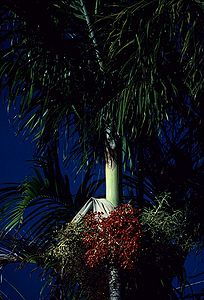
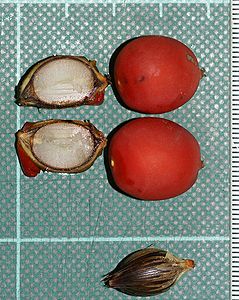
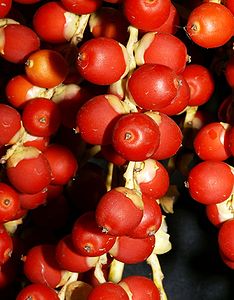
Solitary palm, 9-30 m tall, 15-20 cm diam. breast high, grey to light tan with widely spaced rings. Leaves 10-12 per crown, pinnate, 2-4 m long, narrow, arching, 40-60 x 1.2-1.5 cm long, deep green. Crownshaft smooth, green. Inflorescence arise from the upper leaf bases, and then progressively hanging down 1-2 m long, with flower clusters. 90-120 cm long peduncle, heavily branched, beneath the crown shaft bearing white male and female flowers. Flowers about 10 mm across. Sepals 3, petals 3 and the flowers in groups of 3, with 1 female between 2 male flowers. Male flowers with 30-40 stamens. Fruit globular and up to 20 mm in diameter, scarlet when ripe with up to 3 seeds within. Seeds smooth. Editing by edric.
Culture
The red fruit is planted in trays, defleshing is wise but not essential, as the flesh can burn sensitive skin. Bifid leaves will appear in 3 or 4 months, the seedlings are then tubed. Heavy shading results in long red petioles and large dark bifid leaves for 18 months before a pinnate leaf develops. Once they have filled a 200mm pot they will be about 2 years old, 2m tall, have some pinnate leaves and be ready to plant out. Heavy irrigation, fertilizer and mulch are required for best results. It establishes easily in gardens and is handsome in all stages of its rapid growth. Until the palm reaches maturity, the leaves are spaced evenly up the trunk, with the leaflets lying flat. As it ages, a crownshaft develops, the leaves arch and the pinnae rise to form a "V". Transplanting older specimens is usually successful. Carpentarias can be used indoors, being popular with plant hire companies triple planted. In a community of mixed species they will outgrow the others, adding height to the garden quickly. When spaced out in the sun as an avenue, the Carpie will grow uniformly, its self cleaning habit a bonus.
Comments and Curiosities
This is a monotypic genus.
May be confused with Archontophoenix cunninghamiana, which has pink to lavender flowers and all linear leaflets, rather than white to greenish-white flowers and broad apical leaflets in Carpentaria acuminata; Veitchia sp. which have leaflets that are drooping, rather than held in a V-shape.
External Links
- Glossary of Palm Terms
- Pronunciation Key
- Click on Arecacaea, for list of photos
- http://itp.lucidcentral.org/id/palms/palm-id/Carpentaria_acuminata.htm
- http://keys.trin.org.au/key-server/data/0e0f0504-0103-430d-8004-060d07080d04/media/Html/taxon/Carpentaria_acuminata.htm
References
Special thanks to Geoff Stein, (Palmbob) for his hundreds of photos, edric.
Special thanks to Dr. John Dransfield, Dr. Bill Baker & team, for their volumes of information and photos, edric.
- IMAGE GALLERY

Queensland, Australia. Photo by Dr. John Dransfield, edric.

AUSTRALIA: Darwin, 1964.
Fairchild Tropical Garden, Coconut Grove.

In low lying monsoonal forest.

Male flowers.

Female flowers.


On the Gold Coast, Queensland, Australia. Photo by Daryl O'Connor, edric.

Photo by Rolf Kyburz, edric.

Adelaide River, Northern Territory, Aus.

Australian Botanic Gardens.

Kuching, Sarawak. Photo by Mike Gray, edric.


Le Tampon, La Reunion Island photo by Ruddy Benezet, edric.


Davie, Florida, photo by George Fitzpatrick, edric.

New Caledonia, photo by Ben, edric.

New Caledonia, photo by Ben, edric.


Many Special Thanks to Ed Vaile for his long hours of tireless editing and numerous contributions.