Difference between revisions of "Ceroxylon alpinum"
(Created page with "__noeditsection__ <google>CH02</google> [[Image: {{Palmbox |image= |image_caption= |genus='''''Ceroxylon''''' |species='''''alpinum''''' |subspecies= |cultivar= |synonyms= |conti...") |
|||
| (46 intermediate revisions by 2 users not shown) | |||
| Line 1: | Line 1: | ||
__noeditsection__ | __noeditsection__ | ||
| − | |||
| − | |||
{{Palmbox | {{Palmbox | ||
| − | |image= | + | |image=Ceralp0001z.jpg |
| − | |image_caption= | + | |image_caption=Habitat. |
| − | |genus= | + | |genus=Ceroxylon (seh-ROKS-ih-lon) |
| − | |species= | + | |species=<br>alpinum (all-PEEN-uhm) |
|subspecies= | |subspecies= | ||
|cultivar= | |cultivar= | ||
| Line 19: | Line 17: | ||
|soil_type= | |soil_type= | ||
|msi= | |msi= | ||
| − | |common_names=Andean Wax Palm. | + | |common_names=Andean Wax Palm. Chonta (Quindío, Colombia); palma bendita (Venezuela); palma de cera (Quindío, Valle del Cauca, Colombia; Venezuela); palma real (Valle del Cauca, Colombia). |
}} | }} | ||
| − | |||
==Habitat and Distribution== | ==Habitat and Distribution== | ||
| − | + | ''Ceroxylon alpinum'' is found in Colombia, and Venezuela. Premontane Wet cloud forest, [[Image:9c387cad-630f-47a5-9b8e-3b2bb952b0c3z.jpg|thumb|left|350px|Colombia. Photo by Dr. John Dransfield, Royal Botanic Gardens, Kew/Palmweb.]]from 1400 to 2000 m, in the Andes of Venezuela (Distrito Federal, on the northwestern slopes of the Cordillera de La Costa, Aragua, and Táchira) and Colombia (western slope of the Eastern Cordillera, and eastern and western slopes of the Central and Western Cordilleras). | |
==Description== | ==Description== | ||
| − | + | Trunk 8-21 m tall, Solitary, 19-30 cm in diam., internodes covered with thin layers of wax, white at the base, grey to brown towards the apex. Leaves 17-20 (-25) in a hemispheric crown; sheath 75-125 cm long, densely covered with thick, eventually deciduous tomentum of white scales; petiole (10-) 20-30 cm long, 4.5-7.0 cm wide apically, adaxial surface concave to flattened, margins acute, glabrescent, abaxial surface convex, densely covered with thick, deciduous scales or their broken bases, indumentum more persistent towards the margins; rachis 194-270 cm long, adaxially flattened in 2/3-¾ of its length, twisted 90° on distal portion thereby holding the pinnae in a vertical position, abaxial surface covered with an indumentum resembling that of the petiole; pinnae 90-110 on each side, regularly arranged in one plane, horizontal to slightly pendulous, in the latter case forming an angle (abaxially) close to 75°, abaxial surface covered with elliptical, membranaceous, white scales, becoming gradually more scattered with age, midrib covered with one row of translucent, deciduous scales, pinnae at the extreme proximal end filiform, 22-41 (-62) × 0.2-0.3 (-1.4) cm, 10th pinna from base 52-74 × 1-2 cm, middle pinnae 49-80 × 3.5-5.5 cm, 2.3-5.5 cm apart, apical pinnae (15-) 24-31 × 0.5-1.0 cm, usually free, rarely united along the margins. | |
| + | {{read more top}} | ||
| + | Staminate inflorescences: peduncle about 80 cm long, covered with pale brown floccose scales; peduncular bracts 7, the longest 75 × 11 cm, leathery, covered with deciduous indumentum, only persisting towards margins; rachis 80-90 cm long, with about 56 first order branches, each subtended by a 0.5-1.5 mm membranaceous acuminate bract; rachis and branches covered with thick layer of persistent, white to cream indumentum of floccose scales; longest branches near base 37 cm long. Pistillate inflorescences up to five in various stages of development; peduncle 1.0-1.7 m long, 2.6-3.0 cm wide at apex, covered with pale brown, floccose, deciduous scales; prophyll covered with thick, brownish to yellowish, floccose; peduncular bracts 6-7, 22-148 × 11 cm, and an additional bract smaller, more distally inserted, about 8 cm, all bracts leathery, covered with thick indumentum like that of the prophyll; rachis 84-123 cm, with 54-62 first order branches, all branches subtended by a 0.5-2.0 mm, membranaceous, acuminate bract; longest branches 38-72 cm; rachis and first order branches densely covered with white and ferrugineous, persistent membranaceous scales. Staminate flowers: sepals 3, triangular-acuminate, apex narrow, 1.0-1.5 mm, connate basally for 1/3-½ their length, not reaching or exceeding edge of corolla tube; petals 3, ovate-acuminate to subulate, 4-8 mm, basally connate for 0.4-1.5 mm, apex long-acuminate, acumen 1-2 mm; stamens 10-17 (-19), exserted, 3-6 (-9) antesepalous, and 3-9 (-10) antepetalous, filaments 1.0-2.5 mm, anthers basifixed, 4-7 mm, connective exceeding theca in length by 0.2-0.4 mm. Pistillate flowers: sepals 3, elliptical-acuminate, 1-2 mm long, connate for approx. ½ their length, reaching or exceeding edge of corolla tube; petals 3, elliptical-subulate, 4-5 mm long, basally connate for up to 1 mm, acumen narrow, 1 mm long; staminodes 12-16, 0.5 mm long, with thick filaments, abortive anthers 1.5-2.0 mm long. Fruits globose, orange-red when ripe, 1.6-2.0 cm. in diam., exocarp with raised lenticels appearing as scattered warts; perianth with triangular-acuminate sepals, 1.0-1.8 mm long, connate basally for 0.5-1.0 mm, lobes reaching edge of corolla tube, petals elliptical-subulate, 4-9 mm long, widened at base, acumen 1-3 mm long, connate basally for 0.7-1.0 mm. Seeds about 1 cm. in diam. (Maria Jose Sanin and Gloria Galeano. 2011)/Palmweb. Editing by edric. | ||
| + | |||
| + | Ceroxylon alpinum is characterized by its regularly arranged, horizontal pinnae, inflorescence axes with reddish indumentum, staminate flowers with large and exserted anthers with a projected connective, and a warty fruit exocarp, with raised lenticels. C. alpinum subsp. ecuadorense described from the western Andes of Ecuador (Galeano 1995), is here included in C. echinulatum; see comments under that species. This decision is supported by phylogenetic analyses based on molecular data (Trénel et al. 2007b, 2008). The name Ceroxylon andicolum var. occidentale was published by Fawcett based on a description sent to him from Colombia by Robert B. White. The description was accompanied by a few seeds but apparently no specimen was ever made. White cited a locality "60 miles South of Cali, in the Valley of Cajamarca"; this locality is actually 114 km north of Cali, near the town of El Dovio, where the neotype was collected. (Maria Jose Sanin and Gloria Galeano. 2011)/Palmweb. | ||
| + | {{read more bottom}} | ||
==Culture== | ==Culture== | ||
It endures cool and damp conditions for most of the year. An acid soil suits it best (use Miracid) together with moist, and damp conditions and of course an adequate supply of water. Opinions as to its hardiness vary. Cool, sheltered and moist. Prefers a mild temperate climate, and doesn't like hot weather. Very slow growing. | It endures cool and damp conditions for most of the year. An acid soil suits it best (use Miracid) together with moist, and damp conditions and of course an adequate supply of water. Opinions as to its hardiness vary. Cool, sheltered and moist. Prefers a mild temperate climate, and doesn't like hot weather. Very slow growing. | ||
| − | ==Curiosities== | + | <center>[[file:PFC_for_PP.png|500px|link=http://www.palmpedia.net/palmsforcal/index.php5/Ceroxylon_alpinum]]</center> |
| − | + | ==Comments and Curiosities== | |
| + | {{read more top}} | ||
| + | Two subspecies are recognised. Notes for Ecuador. The subspecies that occurs in Ecuador, subsp. ecuadorense Galeano, is endemic to that country. | ||
| + | |||
| + | Conservation: The vast majority of the montane forest within the range of this species has been destroyed or fragmented by coffee plantations or pastures. According to the IUCN criteria (Version 3.1) this species is Endangered (EN) in Venezuela (Llamosas et al. 2003), as well as in Colombia. In the latter country it is estimated that natural populations have been reduced more than 80% in the last 210 years (Galeano & Bernal 2005). Moreover, in one of the best conserved populations genetic erosion has been detected in seedlings (Gaitán-Solís 2003). A demographic study revealed that the maximum age of palm individuals growing under natural conditions is 160 years and up to 213 years in one particular case (Vergara-Chaparro 2002). On average they developed an aerial stem at the approximate age of 57 years and started flowering when they were approximately 83 years old. (Maria Jose Sanin and Gloria Galeano. 2011)/Palmweb. | ||
| + | |||
| + | Uses: The young leaves have traditionally been used in religious processions on Palm Sunday, a practice that has been abandoned by law in Colombia. The stems are used as fencing around houses and farms, and to build walls. The fruits are consumed by pigs. | ||
| + | (Maria Jose Sanin and Gloria Galeano. 2011)/Palmweb. | ||
| + | {{read more bottom}} | ||
| + | This is a tillering palm, it exhibits saxophone style root growth (it has a heel), keep top third of heel above soil elevation! | ||
| + | |||
| + | <br style="clear:both;"/> | ||
| + | {{#Widget:AdResban}} | ||
| + | <center><gallery caption="IMAGE GALLERY" perrow="" widths="" heights=""> | ||
| + | image:9c387cad-630f-47a5-9b8e-3b2bb952b0c3z.jpg|Colombia. Photo by Dr. John Dransfield, Royal Botanic Gardens, Kew/Palmweb. | ||
| + | image:C6d6fa6a-4aa1-42ab-a3a9-e89c4d36deadz.jpg|Ecuador. Ceroxylon alpinum subsp. ecuadorense. Photo-AAU palm archive | ||
| + | image:2204519131_7eccf1fc9a_bz.jpg | ||
| + | image:Alpinumz.jpg|Cocora Valley, Colombia. Photo by Michael Calonje | ||
| + | image:Alpinum02z.jpg|Cocora Valley, Colombia. Photo by Michael Calonje | ||
| + | image:Ceralp0001z.jpg | ||
| + | image:P1080423z.jpg | ||
| + | image:P1080428z.jpg | ||
| + | image:P1080437z.jpg | ||
| + | image:P1090168z.jpg | ||
| + | image:P1090726z.jpg | ||
| + | image:P1090827z.jpg | ||
| + | image:P1090828z.jpg | ||
| + | image:P1090834z.jpg | ||
| + | image:P1090835z.jpg | ||
| + | image:P1090839z.jpg | ||
| + | image:P1090859z.jpg | ||
| + | image:P1120016z.jpg | ||
| + | image:P1120022z.jpg | ||
| + | image:Ceroxylon_alpinumooz.jpg | ||
| + | image:SoCal001.jpg|Southern California | ||
| + | |||
| + | File:5b15c81be79c7_Colmbia452.JPG.432505a040bb2d32c7d93d5b9c15d985.JPG|Ceroxylon alpinum with orange fruits in the town square of the small town of Salento, Colombia. Photo by Mauricio Moreira Caixeta. | ||
| + | File:5b15c87d00385_Colmbia453.JPG.14645ee5b918e52259b7ce636f5ebd02.JPG|Ceroxylon alpinum with orange fruits in the town square of the small town of Salento, Colombia. Photo by Mauricio Moreira Caixeta. | ||
| + | File:5b15c8b6154b9_Colmbia454.JPG.f9d02245bc4df6a1558f05ad94943d56.JPG|Ceroxylon alpinum with orange fruits in the town square of the small town of Salento, Colombia. Photo by Mauricio Moreira Caixeta. | ||
| + | File:5b15c8f984354_Colmbia459.JPG.8561bb70b48d5db5b62c959f2abd0a8b.JPG|Ceroxylon alpinum with orange fruits in the town square of the small town of Salento, Colombia. Photo by Mauricio Moreira Caixeta. | ||
| + | File:5b15ca54387c8_Colmbia462.JPG.294a80a50e3869a086fafce508512851.JPG|Ceroxylon alpinum with orange fruits in the town square of the small town of Salento, Colombia. Photo by Mauricio Moreira Caixeta. | ||
| + | File:5b15ca98d1cf2_Colmbia456.JPG.0a4895208d7aa8b515d7687862be70f3.JPG|Ceroxylon alpinum with orange fruits in the town square of the small town of Salento, Colombia. Photo by Mauricio Moreira Caixeta. | ||
| + | File:5b15cbad5de25_Colmbia455.JPG.957bb84dce2034f8a1a0082743b2cfe0.JPG||Ceroxylon alpinum with Flowers and silver leaves underneath in the town square of the small town of Salento, Colombia. Photo by Mauricio Moreira Caixeta. | ||
| + | File:5b15cc9ce6ab4_Colmbia461.JPG.994d760fca726a13bd836f76f489bc43.JPG|Ceroxylon alpinum with orange fruits in the town square of the small town of Salento, Colombia. Photo by Mauricio Moreira Caixeta. | ||
| + | File:5b15cd1f534d7_Colmbia457.JPG.a8befc976c14435e85e6a7e4abedfa22.JPG|Ceroxylon alpinum with orange fruits in the town square of the small town of Salento, Colombia. Photo by Mauricio Moreira Caixeta. | ||
| + | |||
| + | |||
| + | </gallery></center> | ||
| + | ==External Links== | ||
| + | *[http://eunops.org/content/glossary-palm-terms Glossary of Palm Terms] | ||
| + | *[http://www.calflora.net/botanicalnames/pronunciation.html MODERN BOTANICAL LATIN] | ||
| + | *[http://www.jlhudsonseeds.net/Pronunciation.htm "Just To Be Clear"] | ||
| + | *http://www.scielo.org.pe/scielo.php?pid=S1727-99332008000000007&script=sci_arttext | ||
| + | *http://www.palmtalk.org/forum/index.php?/topic/56831-ceroxylon-alpinum/ | ||
| + | *[http://w3.biosci.utexas.edu/prc/Sabal/saxophone.html THE SAXOPHONE STYLE ROOT GROWTH (HEEL)] | ||
==References== | ==References== | ||
| + | Phonetic spelling of Latin names by edric. | ||
| + | |||
Special thanks to Geoff Stein, (Palmbob) for his hundreds of photos. | Special thanks to Geoff Stein, (Palmbob) for his hundreds of photos. | ||
| − | + | Special thanks to [http://palmweb.org/?q=node/2 Palmweb.org], Dr. John Dransfield, Dr. Bill Baker & team, for their volumes of information and photos. | |
| − | + | ||
| − | + | Glossary of Palm Terms; Based on the glossary in Dransfield, J., N.W. Uhl, C.B. Asmussen-Lange, W.J. Baker, M.M. Harley & C.E. Lewis. 2008. Genera Palmarum - Evolution and Classification of the Palms. Royal Botanic Gardens, Kew. All images copyright of the artists and photographers (see images for credits). | |
| − | + | ||
| − | + | Sanin, Maria Jose & Galeano, Gloria. 2011. A revision of the Andean wax palms, Ceroxylon (Arecaceae). | |
| − | + | ||
| − | + | ||
| − | + | ||
| − | + | ||
| − | + | ||
| − | + | ||
| − | + | ||
| − | + | ||
| − | + | ||
| − | + | ||
| − | + | ||
| − | + | ||
| − | + | ||
| − | + | ||
| − | + | ||
| − | + | ||
| − | + | ||
{{SpeciesListBackLink}} | {{SpeciesListBackLink}} | ||
[[Category:CEROXYLON|alpinum]] | [[Category:CEROXYLON|alpinum]] | ||
Latest revision as of 10:20, 15 February 2019
| Ceroxylon (seh-ROKS-ih-lon) alpinum (all-PEEN-uhm) | |||||||
|---|---|---|---|---|---|---|---|
 Habitat. | |||||||
| Scientific Classification | |||||||
| |||||||
| Synonyms | |||||||
|
| |||||||
| Native Continent | |||||||
 | |||||||
| Morphology | |||||||
| |||||||
| Culture | |||||||
|
| |||||||
| Survivability index | |||||||
|
| |||||||
| Common names | |||||||
|
| |||||||
Contents
Habitat and Distribution
Ceroxylon alpinum is found in Colombia, and Venezuela. Premontane Wet cloud forest,
Description
Trunk 8-21 m tall, Solitary, 19-30 cm in diam., internodes covered with thin layers of wax, white at the base, grey to brown towards the apex. Leaves 17-20 (-25) in a hemispheric crown; sheath 75-125 cm long, densely covered with thick, eventually deciduous tomentum of white scales; petiole (10-) 20-30 cm long, 4.5-7.0 cm wide apically, adaxial surface concave to flattened, margins acute, glabrescent, abaxial surface convex, densely covered with thick, deciduous scales or their broken bases, indumentum more persistent towards the margins; rachis 194-270 cm long, adaxially flattened in 2/3-¾ of its length, twisted 90° on distal portion thereby holding the pinnae in a vertical position, abaxial surface covered with an indumentum resembling that of the petiole; pinnae 90-110 on each side, regularly arranged in one plane, horizontal to slightly pendulous, in the latter case forming an angle (abaxially) close to 75°, abaxial surface covered with elliptical, membranaceous, white scales, becoming gradually more scattered with age, midrib covered with one row of translucent, deciduous scales, pinnae at the extreme proximal end filiform, 22-41 (-62) × 0.2-0.3 (-1.4) cm, 10th pinna from base 52-74 × 1-2 cm, middle pinnae 49-80 × 3.5-5.5 cm, 2.3-5.5 cm apart, apical pinnae (15-) 24-31 × 0.5-1.0 cm, usually free, rarely united along the margins.
| read more |
|---|
|
Staminate inflorescences: peduncle about 80 cm long, covered with pale brown floccose scales; peduncular bracts 7, the longest 75 × 11 cm, leathery, covered with deciduous indumentum, only persisting towards margins; rachis 80-90 cm long, with about 56 first order branches, each subtended by a 0.5-1.5 mm membranaceous acuminate bract; rachis and branches covered with thick layer of persistent, white to cream indumentum of floccose scales; longest branches near base 37 cm long. Pistillate inflorescences up to five in various stages of development; peduncle 1.0-1.7 m long, 2.6-3.0 cm wide at apex, covered with pale brown, floccose, deciduous scales; prophyll covered with thick, brownish to yellowish, floccose; peduncular bracts 6-7, 22-148 × 11 cm, and an additional bract smaller, more distally inserted, about 8 cm, all bracts leathery, covered with thick indumentum like that of the prophyll; rachis 84-123 cm, with 54-62 first order branches, all branches subtended by a 0.5-2.0 mm, membranaceous, acuminate bract; longest branches 38-72 cm; rachis and first order branches densely covered with white and ferrugineous, persistent membranaceous scales. Staminate flowers: sepals 3, triangular-acuminate, apex narrow, 1.0-1.5 mm, connate basally for 1/3-½ their length, not reaching or exceeding edge of corolla tube; petals 3, ovate-acuminate to subulate, 4-8 mm, basally connate for 0.4-1.5 mm, apex long-acuminate, acumen 1-2 mm; stamens 10-17 (-19), exserted, 3-6 (-9) antesepalous, and 3-9 (-10) antepetalous, filaments 1.0-2.5 mm, anthers basifixed, 4-7 mm, connective exceeding theca in length by 0.2-0.4 mm. Pistillate flowers: sepals 3, elliptical-acuminate, 1-2 mm long, connate for approx. ½ their length, reaching or exceeding edge of corolla tube; petals 3, elliptical-subulate, 4-5 mm long, basally connate for up to 1 mm, acumen narrow, 1 mm long; staminodes 12-16, 0.5 mm long, with thick filaments, abortive anthers 1.5-2.0 mm long. Fruits globose, orange-red when ripe, 1.6-2.0 cm. in diam., exocarp with raised lenticels appearing as scattered warts; perianth with triangular-acuminate sepals, 1.0-1.8 mm long, connate basally for 0.5-1.0 mm, lobes reaching edge of corolla tube, petals elliptical-subulate, 4-9 mm long, widened at base, acumen 1-3 mm long, connate basally for 0.7-1.0 mm. Seeds about 1 cm. in diam. (Maria Jose Sanin and Gloria Galeano. 2011)/Palmweb. Editing by edric. Ceroxylon alpinum is characterized by its regularly arranged, horizontal pinnae, inflorescence axes with reddish indumentum, staminate flowers with large and exserted anthers with a projected connective, and a warty fruit exocarp, with raised lenticels. C. alpinum subsp. ecuadorense described from the western Andes of Ecuador (Galeano 1995), is here included in C. echinulatum; see comments under that species. This decision is supported by phylogenetic analyses based on molecular data (Trénel et al. 2007b, 2008). The name Ceroxylon andicolum var. occidentale was published by Fawcett based on a description sent to him from Colombia by Robert B. White. The description was accompanied by a few seeds but apparently no specimen was ever made. White cited a locality "60 miles South of Cali, in the Valley of Cajamarca"; this locality is actually 114 km north of Cali, near the town of El Dovio, where the neotype was collected. (Maria Jose Sanin and Gloria Galeano. 2011)/Palmweb. |
Culture
It endures cool and damp conditions for most of the year. An acid soil suits it best (use Miracid) together with moist, and damp conditions and of course an adequate supply of water. Opinions as to its hardiness vary. Cool, sheltered and moist. Prefers a mild temperate climate, and doesn't like hot weather. Very slow growing.

Comments and Curiosities
| read more |
|---|
|
Two subspecies are recognised. Notes for Ecuador. The subspecies that occurs in Ecuador, subsp. ecuadorense Galeano, is endemic to that country. Conservation: The vast majority of the montane forest within the range of this species has been destroyed or fragmented by coffee plantations or pastures. According to the IUCN criteria (Version 3.1) this species is Endangered (EN) in Venezuela (Llamosas et al. 2003), as well as in Colombia. In the latter country it is estimated that natural populations have been reduced more than 80% in the last 210 years (Galeano & Bernal 2005). Moreover, in one of the best conserved populations genetic erosion has been detected in seedlings (Gaitán-Solís 2003). A demographic study revealed that the maximum age of palm individuals growing under natural conditions is 160 years and up to 213 years in one particular case (Vergara-Chaparro 2002). On average they developed an aerial stem at the approximate age of 57 years and started flowering when they were approximately 83 years old. (Maria Jose Sanin and Gloria Galeano. 2011)/Palmweb. Uses: The young leaves have traditionally been used in religious processions on Palm Sunday, a practice that has been abandoned by law in Colombia. The stems are used as fencing around houses and farms, and to build walls. The fruits are consumed by pigs. (Maria Jose Sanin and Gloria Galeano. 2011)/Palmweb. |
This is a tillering palm, it exhibits saxophone style root growth (it has a heel), keep top third of heel above soil elevation!
- IMAGE GALLERY

Colombia. Photo by Dr. John Dransfield, Royal Botanic Gardens, Kew/Palmweb.

Ecuador. Ceroxylon alpinum subsp. ecuadorense. Photo-AAU palm archive


Cocora Valley, Colombia. Photo by Michael Calonje

Cocora Valley, Colombia. Photo by Michael Calonje


Southern California
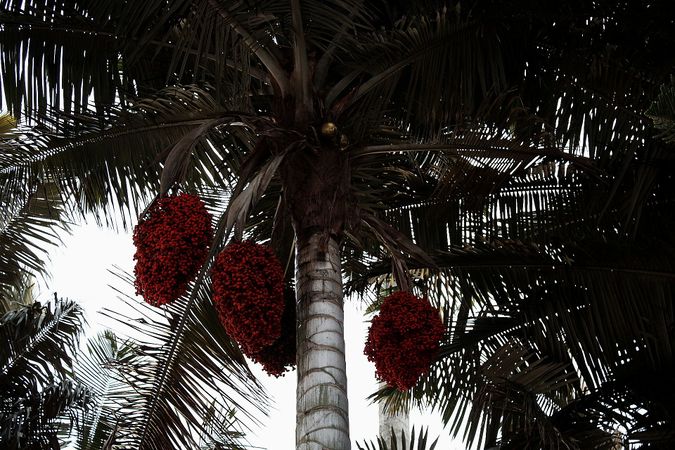
Ceroxylon alpinum with orange fruits in the town square of the small town of Salento, Colombia. Photo by Mauricio Moreira Caixeta.

Ceroxylon alpinum with orange fruits in the town square of the small town of Salento, Colombia. Photo by Mauricio Moreira Caixeta.

Ceroxylon alpinum with orange fruits in the town square of the small town of Salento, Colombia. Photo by Mauricio Moreira Caixeta.
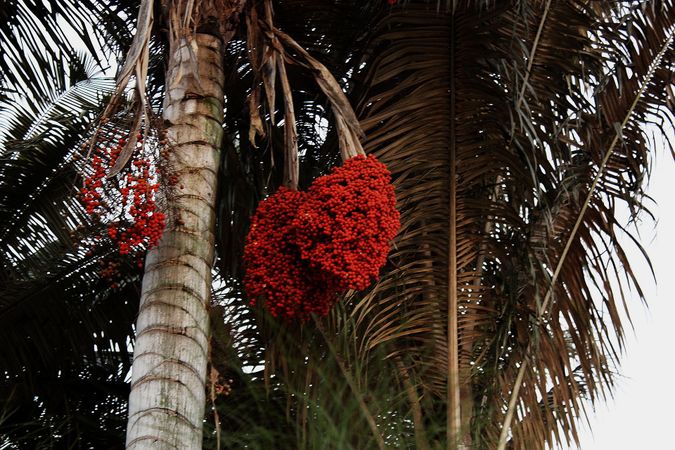
Ceroxylon alpinum with orange fruits in the town square of the small town of Salento, Colombia. Photo by Mauricio Moreira Caixeta.

Ceroxylon alpinum with orange fruits in the town square of the small town of Salento, Colombia. Photo by Mauricio Moreira Caixeta.

Ceroxylon alpinum with orange fruits in the town square of the small town of Salento, Colombia. Photo by Mauricio Moreira Caixeta.

|Ceroxylon alpinum with Flowers and silver leaves underneath in the town square of the small town of Salento, Colombia. Photo by Mauricio Moreira Caixeta.
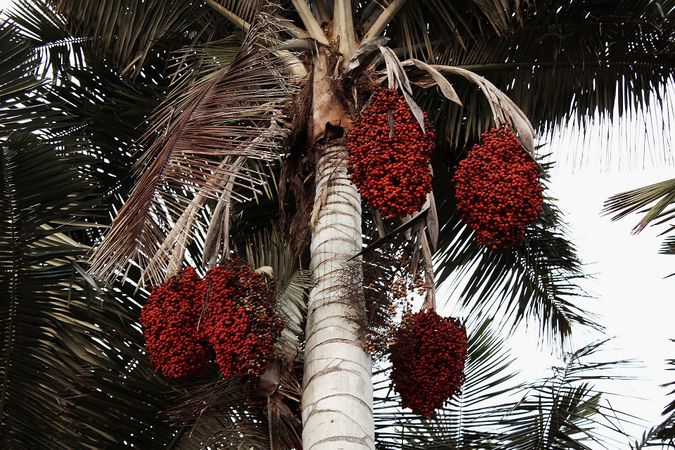
Ceroxylon alpinum with orange fruits in the town square of the small town of Salento, Colombia. Photo by Mauricio Moreira Caixeta.

Ceroxylon alpinum with orange fruits in the town square of the small town of Salento, Colombia. Photo by Mauricio Moreira Caixeta.


External Links
- Glossary of Palm Terms
- MODERN BOTANICAL LATIN
- "Just To Be Clear"
- http://www.scielo.org.pe/scielo.php?pid=S1727-99332008000000007&script=sci_arttext
- http://www.palmtalk.org/forum/index.php?/topic/56831-ceroxylon-alpinum/
- THE SAXOPHONE STYLE ROOT GROWTH (HEEL)
References
Phonetic spelling of Latin names by edric.
Special thanks to Geoff Stein, (Palmbob) for his hundreds of photos.
Special thanks to Palmweb.org, Dr. John Dransfield, Dr. Bill Baker & team, for their volumes of information and photos.
Glossary of Palm Terms; Based on the glossary in Dransfield, J., N.W. Uhl, C.B. Asmussen-Lange, W.J. Baker, M.M. Harley & C.E. Lewis. 2008. Genera Palmarum - Evolution and Classification of the Palms. Royal Botanic Gardens, Kew. All images copyright of the artists and photographers (see images for credits).
Sanin, Maria Jose & Galeano, Gloria. 2011. A revision of the Andean wax palms, Ceroxylon (Arecaceae).
Many Special Thanks to Ed Vaile for his long hours of tireless editing and numerous contributions.