Difference between revisions of "Chamaerops humilis"
(link) |
|||
| (72 intermediate revisions by 4 users not shown) | |||
| Line 1: | Line 1: | ||
| − | + | __noeditsection__ | |
{{Palmbox | {{Palmbox | ||
| − | |image=Chamaerops | + | |image=Chamaerops flowers H.JPG |
| − | |image_caption= | + | |image_caption=Flowers. |
| − | |genus= | + | |genus=Chamaerops (kahm-EH-ropes) |
| − | |species= | + | |species=<br>humilis (hoo-MIHL-iss) |
|synonyms=''Phoenix humilis'' | |synonyms=''Phoenix humilis'' | ||
| − | |variety= | + | |variety=''Chamaerops humilis'' var. ''humilis'', ''Chamaerops humilis'' var. ''argentea'' ''Chamaerops humilis var. elegans'' |
|continent=europe | |continent=europe | ||
| − | |habit= | + | |habit=Clustering |
|leaf_type=Fan | |leaf_type=Fan | ||
|height= 1.5 - 3m | |height= 1.5 - 3m | ||
| Line 16: | Line 16: | ||
|soil_type= Well drained | |soil_type= Well drained | ||
|hardiness=9 | |hardiness=9 | ||
| − | |common_names=European Fan Palm, Mediterranean Fan Palm | + | |common_names=European Fan Palm, Mediterranean Fan Palm, Moroccan Fan Palm. |
}} | }} | ||
| − | |||
| − | |||
| − | |||
| − | |||
| − | |||
| − | |||
| − | |||
| − | |||
| − | |||
| − | |||
| − | |||
| − | |||
| − | |||
| − | |||
| − | |||
| − | |||
| − | |||
| − | |||
| − | |||
| − | |||
==Habitat and Distribution== | ==Habitat and Distribution== | ||
| + | ''Chamaerops humilis'' is found in Algeria, Baleares, France, Italy, Libya, Morocco, [[image:ChIMG_4580.jpg|thumb|left|500px|At Len's place. Vista, CA. Photo by Troy Donovan]]Portugal, Sardegna, Sicilia, Spain, and Tunisia. | ||
Native to the western Mediterranean region. There are two varieties: | Native to the western Mediterranean region. There are two varieties: | ||
*'''''Chamaerops humilis'' var. ''humilis'''''. Southwestern Europe, including Portugal, Spain, southernmost France, and western Italy, plus various western Mediterranean islands, always at fairly low altitudes. The northernmost naturally occurring palm in the world, at 43° 07' N at Hyères-les-Palmiers on the south coast of France. | *'''''Chamaerops humilis'' var. ''humilis'''''. Southwestern Europe, including Portugal, Spain, southernmost France, and western Italy, plus various western Mediterranean islands, always at fairly low altitudes. The northernmost naturally occurring palm in the world, at 43° 07' N at Hyères-les-Palmiers on the south coast of France. | ||
*'''''Chamaerops humilis'' var. ''argentea''''' (syn. ''Chamaerops humilis'' var. ''cerifera''). Northwestern Africa, in the Atlas Mountains of Morocco at up to 2,000 m altitude. | *'''''Chamaerops humilis'' var. ''argentea''''' (syn. ''Chamaerops humilis'' var. ''cerifera''). Northwestern Africa, in the Atlas Mountains of Morocco at up to 2,000 m altitude. | ||
| − | + | More information on ''Chamaerops var. cerifera'' [http://www.palmpedia.net/palmsforcal/index.php5/Chamaerop_humilis_var._argentea HERE] | |
==Description== | ==Description== | ||
| − | ''Chamaerops humilis'' is the only species in the genus ''Chamaerops''; the genus is closely related to the Asian genus ''[[:Category: | + | ''Chamaerops humilis'' is the only species in the genus ''Chamaerops''; the genus is closely related to the Asian genus ''[[:Category:TRACHYCARPUS|Trachycarpus]]'', differing in the spined (not smooth) petioles and the multistemmed clustering habit. |
It is a small clustering palm, growing to a height of 1-4 metres, rarely to 6 metres. The leaves are palmately compound, 1-1.5 m long, with 10-20 fingered leaflets 50-80 cm long arranged in a fan at the end of the heavily armed 30-70 cm petiole. In ''C. humilis'' var. ''humilis'' the leaves are green, while in ''C. humilis'' var. ''argentea'' they are strongly glaucous a silvery-blue waxy coating, similar in colour to ''[[Brahea armata]]'' leaves. | It is a small clustering palm, growing to a height of 1-4 metres, rarely to 6 metres. The leaves are palmately compound, 1-1.5 m long, with 10-20 fingered leaflets 50-80 cm long arranged in a fan at the end of the heavily armed 30-70 cm petiole. In ''C. humilis'' var. ''humilis'' the leaves are green, while in ''C. humilis'' var. ''argentea'' they are strongly glaucous a silvery-blue waxy coating, similar in colour to ''[[Brahea armata]]'' leaves. | ||
| − | + | ==Culture== | |
| − | == | + | Although the northernmost naturally occurring palm in the world, ''Chamaerops humilis'' var. ''humilis'' is not as cold hardy as the high altitude Chinese [[Trachycarpus fortunei]], tolerating temperatures only down to about -15°C. Because of its multistemmed clumping nature, it is however more likely to grow back if frozen to the ground. ''C. humilis'' var. ''argentea'', coming from higher altitudes but further south, is about equally hardy; it grows somewhat slower. |
| − | + | ||
| − | Although the northernmost naturally occurring palm in the world, ''Chamaerops humilis'' var. ''humilis'' is not as cold hardy as the high altitude Chinese | + | |
The species grows best in Mediterranean climates like Italy, southern California, Chile, Western Australia and Cape Town, South Africa. Cool winters, with plenty of rain (or, not) and hot, dry summers are the best home for this species. It will take severe drought, but is happiest with regular, if infrequent water. | The species grows best in Mediterranean climates like Italy, southern California, Chile, Western Australia and Cape Town, South Africa. Cool winters, with plenty of rain (or, not) and hot, dry summers are the best home for this species. It will take severe drought, but is happiest with regular, if infrequent water. | ||
| Line 57: | Line 36: | ||
''C. humilis'' var. ''argentea'' is slower growing, and is prone to crown rot from overhead watering, far more than var. ''humilis''. It is probably more drought and heat tolerant, though. Although cold-hardy in Great Britain, the wet climate leads to poor success in cultivation, unless it is given exceptionally good drainage and some shelter from prolonged rain. | ''C. humilis'' var. ''argentea'' is slower growing, and is prone to crown rot from overhead watering, far more than var. ''humilis''. It is probably more drought and heat tolerant, though. Although cold-hardy in Great Britain, the wet climate leads to poor success in cultivation, unless it is given exceptionally good drainage and some shelter from prolonged rain. | ||
| + | <center> | ||
| + | [[{{PFC}}http://www.palmpedia.net/palmsforcal/index.php5/Chamaerops_humilis]] | ||
| + | </center> | ||
| + | ==Comments and Curiosities== | ||
| + | This is a [[monotypic]] genus. | ||
| + | |||
| + | There are two subspecies; Chamaerops humilis var. argentea, Morocco. Chamaerops humilis var. humilis, Algeria, Baleares, France, Italy, Libya, Morocco, Portugal, Sardegna, Sicilia, Spain, and Tunisia. | ||
| − | |||
In popular literature, ''C. humilis'' var. ''argentea'' has often been listed under the name ''C. humilis'' var. ''cerifera''. This name is however a later publication (1920, versus 1885; [http://apps.kew.org/wcsp/qsearch.do?plantName=Chamaerops&page=quickSearch Kew Palms Checklist]) so is not the valid name for the variety. | In popular literature, ''C. humilis'' var. ''argentea'' has often been listed under the name ''C. humilis'' var. ''cerifera''. This name is however a later publication (1920, versus 1885; [http://apps.kew.org/wcsp/qsearch.do?plantName=Chamaerops&page=quickSearch Kew Palms Checklist]) so is not the valid name for the variety. | ||
| − | = | + | <br style="clear:both;"/> |
| − | <gallery> | + | {{#Widget:AdResban}} |
| − | Image:Eur fan dstrick7.jpg|Bushy Juvenile - Athens, Georgia, USA | + | <center><gallery caption="IMAGE GALLERY" perrow="" widths="" heights=""> |
| − | Image:Chamaerops FA.jpg|Fullerton Arboretum, California | + | image:2e78cac0-692a-4730-af47-137c18d42886z.jpg|Mallorca. Photo by Dr. John Dransfield, Royal Botanic Gardens, Kew/Palmweb. |
| − | Image:Chamaerops flowers H.JPG|Flowers | + | image:E2c6ffaa-e25c-4a07-b18b-202d747be436z.jpg|Mallorca. Photo by Dr. John Dransfield, Royal Botanic Gardens, Kew/Palmweb. |
| − | Image:Chamaerops silvery tops.jpg|California | + | image:164fab74-0ee9-46a2-b65e-5432da6430d4z.jpg|Mallorca. Photo by Dr. John Dransfield, Royal Botanic Gardens, Kew/Palmweb. |
| − | Image:Chamaerops tall UCLA.jpg|UCLA Gardens, California | + | image:8b50acf6-025d-47a4-b2c2-7eb93ef1ea9bz.jpg|Asni, High Atlas, Morocco. Photo by Dr. H. Sanderson, Royal Botanic Gardens, Kew/Palmweb. |
| − | Image:Chamaerops fruits.jpg|Fruit | + | image:28e91c6c-d665-4d1e-a95b-4001cb8a8ad4z.jpg|Mallorca. Photo by Dr. John Dransfield, Royal Botanic Gardens, Kew/Palmweb. |
| + | image:2ff6ea21-14b3-48eb-a049-f52dc00f848ez.jpg|Near Ronda, Spain. Photo by Dr. John Dransfield, Royal Botanic Gardens, Kew/Palmweb. | ||
| + | image:3095fbe5-59fd-43d5-b397-bfac992c92a8z.jpg|Mallorca. Photo by Dr. John Dransfield, Royal Botanic Gardens, Kew/Palmweb. | ||
| + | image:Aad682d1-0aeb-403d-b4eb-68615f85d74dz.jpg|Mallorca. Photo by Dr. John Dransfield, Royal Botanic Gardens, Kew/Palmweb. | ||
| + | image:800b3345-0b10-424e-a5a5-07b31173540cz.jpg|Asni Cemetery, High Atlas, Morocco. Photo by Dr. H. Sanderson, Royal Botanic Gardens, Kew/Palmweb. | ||
| + | image:B77b4dc6-e15e-42a2-9b01-b583179adc8ez.jpg|Asni Cemetery, High Atlas, Morocco. Photo by Dr. H. Sanderson, Royal Botanic Gardens, Kew/Palmweb. | ||
| + | image:F2cf191f-0304-4a20-a1a4-cdb956842508.jpg|Trine Ourika, near Marrakech, Morocco. Photo by Dr. H. Sanderson, Royal Botanic Gardens, Kew/Palmweb. | ||
| + | Image:Eur fan dstrick7.jpg|Bushy Juvenile - Athens, Georgia, USA. | ||
| + | Image:Chamaerops FA.jpg|Fullerton Arboretum, California. | ||
| + | Image:Chamaerops flowers H.JPG|Flowers. | ||
| + | Image:Chamaerops silvery tops.jpg|California. | ||
| + | Image:Chamaerops tall UCLA.jpg|UCLA Gardens, California. | ||
| + | Image:Chamaerops fruits.jpg|Fruit. | ||
Image:Chamaerops cerifera Ralph's neighbor.jpg|''Chamaerops humilis'' var. ''argentea'', southern California | Image:Chamaerops cerifera Ralph's neighbor.jpg|''Chamaerops humilis'' var. ''argentea'', southern California | ||
Image:Chamaerops cerifera Riverside.jpg|''Chamaerops humilis'' var. ''argentea'', Riverside, California | Image:Chamaerops cerifera Riverside.jpg|''Chamaerops humilis'' var. ''argentea'', Riverside, California | ||
| − | Image:Chamaerops bizzare leaves LL.JPG|Bizarre leaf form | + | Image:Chamaerops bizzare leaves LL.JPG|Bizarre leaf form. |
| − | </gallery> | + | Image:Mediterranean fan palm.JPG|Green's Nursery Multi-trunk Santa Clarita, Ca. |
| + | image:Chamaerops_humilis_argentea_1.jpg|Between Tizi-n-Tichka and Agouim, Morocco. | ||
| + | image:Chamaerops humilis huntington.jpg|At the Huntington. | ||
| + | image:Chamaerops_1.jpg | ||
| + | image:Chamaerops_2.jpg | ||
| + | image:Chamaerops_3.jpg | ||
| + | image:Chamaerops_4.jpg | ||
| + | image:Chamaerops_5.jpg | ||
| + | image:Chamaerops_6.jpg | ||
| + | image:Chamaerops_32.jpg | ||
| + | image:Chamaerops_111.jpg | ||
| + | image:Chamaerops_122.jpg | ||
| + | image:Chamaerops_233.jpg | ||
| + | image:Chamaerops_humilis_2.jpg | ||
| + | image:Chamaerops_humilis0.jpg | ||
| + | image:Chamaerops_humilis01.jpg | ||
| + | image:Chamaerops_humilis1.JPG | ||
| + | image:Chamaerops_humilis2.jpg | ||
| + | image:Chamaerops_humilis321.jpg | ||
| + | image:8x10_St_Cloud18.jpg | ||
| + | image:4e2172.jpg | ||
| + | image:75b448.jpg | ||
| + | image:3559ea.jpg | ||
| + | image:675847.jpg | ||
| + | image:A8ef1a.jpg | ||
| + | image:C27fd8.jpg | ||
| + | image:Cf666a.jpg | ||
| + | image:Chamaerops_humilis_(Zingaro)015.jpg | ||
| + | image:Chamaerops77.jpg | ||
| + | image:Chamhum0002.jpg | ||
| + | image:Chamhum0003.jpg | ||
| + | image:Chamhum0004.jpg | ||
| + | image:Chamhum0005.jpg | ||
| + | image:Chamhum0006.jpg | ||
| + | image:Chamhum0007.jpg | ||
| + | image:Chamhum0008.jpg | ||
| + | image:Chamhum0009.jpg | ||
| + | image:Chamhum0010.jpg | ||
| + | image:Chamhum0011.jpg | ||
| + | image:Chamhum0012.jpg | ||
| + | image:Chamhum0013.jpg | ||
| + | image:Chamhum0014.jpg | ||
| + | image:Chamhum0015.jpg | ||
| + | image:Chamhum0016.jpg | ||
| + | image:Chamhum0017.jpg | ||
| + | image:Chamhum0018.jpg | ||
| + | image:Chamhum0019.jpg | ||
| + | image:Chamhum0021.jpg | ||
| + | image:Chamhum0022.jpg | ||
| + | image:Chamhumchile01.jpg|Chile. | ||
| + | image:Chamhumsol01.jpg|Rare solitary form. | ||
| + | image:Chamhumsol02.jpg|Rare solitary form. | ||
| + | image:CHPT1-4.jpg | ||
| + | image:Mediterranean_fan_palm_Chamaerops_humilis.jpg | ||
| + | image:Humilis04.jpg|In habitat, Morrocco. Photo by Antonius Verhoeven, edric. | ||
| + | image:Chamaerops_rickmeyer02.jpg|El Chorro, Andalusia Spain, photo by Jens Rickmeyer, edric. | ||
| + | image:110711_Chamaerops_Fitzpatrick33.JPG|Riverwalk, Fort Lauderdale, Florida, photo by George Fitzpatrick, edric. | ||
| + | image:Chamaerops_rickmeyer01.jpg|El Chorro, Andalusia Spain, photo by Jens Rickmeyer, edric. | ||
| + | Image:Chamaerops_humilis_argentea_2.jpg|''Chamaerops humilis'' var. ''argentea'' in native habitat between Tizi-n-Tichka and Agouim, Morocco, at about 2000 m altitude. | ||
| + | image:ChDSCF8949.jpg|Menton, French Côte d'Azur, France. Photo by Philippe, edric. | ||
| + | image:ChIMG_4526.jpg|At Len's place. Vista, CA. Photo by Troy Donovan, edric. | ||
| + | image:ChIMG_4580.jpg|At Len's place. Vista, CA. Photo by Troy Donovan, edric. | ||
| + | image:ChIMG_4728.jpg|''Chamaerops humilis'' var. ''argentea'' At Matty Bradford's place. Spring Valley, CA. Photo by Troy Donovan, edric. | ||
| + | image:ChDSC_5373.jpg|Roma Street Parklands, in central Brisbane, Australia. Photo by Daryl O'connor, edric. | ||
| + | image:DSC03756z.jpg | ||
| + | image:Chcer.jpg|Czech Republic. Chamaerops humilis var. cerifera. Photo-tropik.cz, edric. | ||
| + | image:Chcer1.jpg|Czech Republic. Chamaerops humilis var. cerifera. Photo-tropik.cz, edric. | ||
| + | image:ChamTizi1.jpg|Chamaerops cerifera showing yellow inflorescence. South side of Tizi-n-Test mountain pass, Morocco. Photo by Gareth Mann. | ||
| + | image:ChamTizi2.jpg|Chamaerops cerifera growing amongst Phoenix dactilyfera. South side of Tizi-n-Test mountain pass, Morocco. Photo by Gareth Mann. | ||
| + | image:ChamTizi3.jpg|Chamaerops cerifera growing in the Atlas Mountains. South side of Tizi-n-Test mountain pass, Morocco. Photo by Gareth Mann. | ||
| + | image:ChamTizi4.jpg|Chamaerops cerifera growing in the Atlas Mountains. South side of Tizi-n-Test mountain pass, Morocco. Photo by Gareth Mann. | ||
| + | image:ChamTizi5.jpg|Chamaerops cerifera growing in the Atlas Mountains. South side of Tizi-n-Test mountain pass, Morocco. Photo by Gareth Mann. | ||
| + | </gallery></center> | ||
| + | ==External Links== | ||
| + | *[http://eunops.org/content/glossary-palm-terms Glossary of Palm Terms] | ||
| + | *[http://www.calflora.net/botanicalnames/pronunciation.html MODERN BOTANICAL LATIN] | ||
| + | *[http://www.jlhudsonseeds.net/Pronunciation.htm "Just To Be Clear"] | ||
| + | *http://itp.lucidcentral.org/id/palms/palm-id/Chamaerops_humilis.htm | ||
| + | *[http://www.hear.org/starr/images/species/?q=chamaerops+humilis&o=plants Forest & Kim Starr] | ||
| + | *[https://www.youtube.com/watch?v=Dcd1wUhXrxI Video from "Palm Savanna" of Chamaerops cerifera and Phoenix dactilyfera growing in the Atlas Mountains] | ||
| + | ==References== | ||
| + | Phonetic spelling of Latin names by edric. | ||
| + | |||
| + | Special thanks to Geoff Stein, (Palmbob) for his hundreds of photos. | ||
| + | |||
| + | Special thanks to [http://palmweb.org/?q=node/2 Palmweb.org], Dr. John Dransfield, Dr. Bill Baker & team, for their volumes of information and photos. | ||
| + | |||
| + | Glossary of Palm Terms; Based on the glossary in Dransfield, J., N.W. Uhl, C.B. Asmussen-Lange, W.J. Baker, M.M. Harley & C.E. Lewis. 2008. Genera Palmarum - Evolution and Classification of the Palms. Royal Botanic Gardens, Kew. All images copyright of the artists and photographers (see images for credits). | ||
| + | {{SpeciesListBackLink}} | ||
[[Category:CHAMAEROPS|humilis]] | [[Category:CHAMAEROPS|humilis]] | ||
Latest revision as of 09:17, 25 July 2018
| Chamaerops (kahm-EH-ropes) humilis (hoo-MIHL-iss) | ||||||||
|---|---|---|---|---|---|---|---|---|
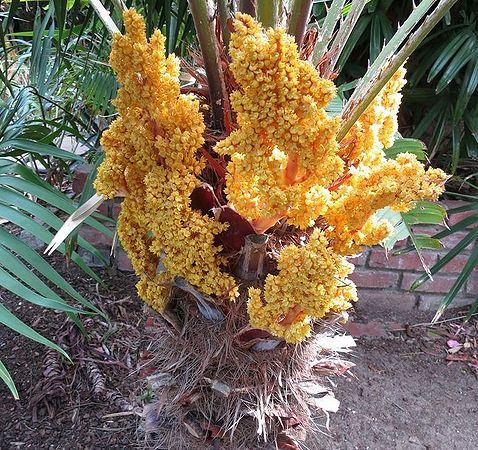
 Flowers. | ||||||||
| Scientific Classification | ||||||||
| ||||||||
| Synonyms | ||||||||
|
| ||||||||
| Native Continent | ||||||||
 | ||||||||
| Morphology | ||||||||
| ||||||||
| Culture | ||||||||
| ||||||||
| Survivability index | ||||||||
|
| ||||||||
| Common names | ||||||||
|
| ||||||||
Contents
Habitat and Distribution
Chamaerops humilis is found in Algeria, Baleares, France, Italy, Libya, Morocco,
Native to the western Mediterranean region. There are two varieties:
- Chamaerops humilis var. humilis. Southwestern Europe, including Portugal, Spain, southernmost France, and western Italy, plus various western Mediterranean islands, always at fairly low altitudes. The northernmost naturally occurring palm in the world, at 43° 07' N at Hyères-les-Palmiers on the south coast of France.
- Chamaerops humilis var. argentea (syn. Chamaerops humilis var. cerifera). Northwestern Africa, in the Atlas Mountains of Morocco at up to 2,000 m altitude.
More information on Chamaerops var. cerifera HERE
Description
Chamaerops humilis is the only species in the genus Chamaerops; the genus is closely related to the Asian genus Trachycarpus, differing in the spined (not smooth) petioles and the multistemmed clustering habit.
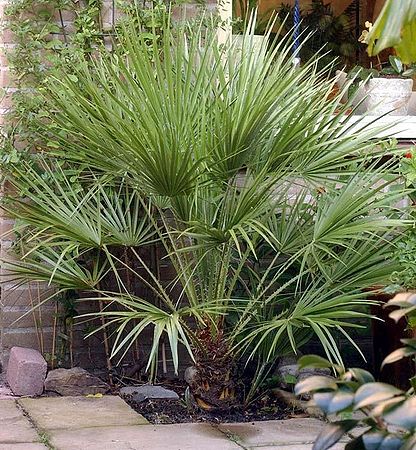
It is a small clustering palm, growing to a height of 1-4 metres, rarely to 6 metres. The leaves are palmately compound, 1-1.5 m long, with 10-20 fingered leaflets 50-80 cm long arranged in a fan at the end of the heavily armed 30-70 cm petiole. In C. humilis var. humilis the leaves are green, while in C. humilis var. argentea they are strongly glaucous a silvery-blue waxy coating, similar in colour to Brahea armata leaves.
Culture
Although the northernmost naturally occurring palm in the world, Chamaerops humilis var. humilis is not as cold hardy as the high altitude Chinese Trachycarpus fortunei, tolerating temperatures only down to about -15°C. Because of its multistemmed clumping nature, it is however more likely to grow back if frozen to the ground. C. humilis var. argentea, coming from higher altitudes but further south, is about equally hardy; it grows somewhat slower.
The species grows best in Mediterranean climates like Italy, southern California, Chile, Western Australia and Cape Town, South Africa. Cool winters, with plenty of rain (or, not) and hot, dry summers are the best home for this species. It will take severe drought, but is happiest with regular, if infrequent water.
C. humilis var. humilis tolerates high humidity, but may not look its best in moist climates. As plants get very old, the various stems can be cut back, or cut down from a freeze, and grow back from the base. It is hardy in the milder parts of Great Britain, but not nearly as commonly grown as the more reliable Trachycarpus fortunei.
C. humilis var. argentea is slower growing, and is prone to crown rot from overhead watering, far more than var. humilis. It is probably more drought and heat tolerant, though. Although cold-hardy in Great Britain, the wet climate leads to poor success in cultivation, unless it is given exceptionally good drainage and some shelter from prolonged rain.

Comments and Curiosities
This is a monotypic genus.
There are two subspecies; Chamaerops humilis var. argentea, Morocco. Chamaerops humilis var. humilis, Algeria, Baleares, France, Italy, Libya, Morocco, Portugal, Sardegna, Sicilia, Spain, and Tunisia.
In popular literature, C. humilis var. argentea has often been listed under the name C. humilis var. cerifera. This name is however a later publication (1920, versus 1885; Kew Palms Checklist) so is not the valid name for the variety.
- IMAGE GALLERY

Mallorca. Photo by Dr. John Dransfield, Royal Botanic Gardens, Kew/Palmweb.

Mallorca. Photo by Dr. John Dransfield, Royal Botanic Gardens, Kew/Palmweb.

Mallorca. Photo by Dr. John Dransfield, Royal Botanic Gardens, Kew/Palmweb.

Asni, High Atlas, Morocco. Photo by Dr. H. Sanderson, Royal Botanic Gardens, Kew/Palmweb.

Mallorca. Photo by Dr. John Dransfield, Royal Botanic Gardens, Kew/Palmweb.

Near Ronda, Spain. Photo by Dr. John Dransfield, Royal Botanic Gardens, Kew/Palmweb.

Mallorca. Photo by Dr. John Dransfield, Royal Botanic Gardens, Kew/Palmweb.

Mallorca. Photo by Dr. John Dransfield, Royal Botanic Gardens, Kew/Palmweb.

Asni Cemetery, High Atlas, Morocco. Photo by Dr. H. Sanderson, Royal Botanic Gardens, Kew/Palmweb.

Asni Cemetery, High Atlas, Morocco. Photo by Dr. H. Sanderson, Royal Botanic Gardens, Kew/Palmweb.

Trine Ourika, near Marrakech, Morocco. Photo by Dr. H. Sanderson, Royal Botanic Gardens, Kew/Palmweb.

Bushy Juvenile - Athens, Georgia, USA.

Fullerton Arboretum, California.

Flowers.

California.

UCLA Gardens, California.

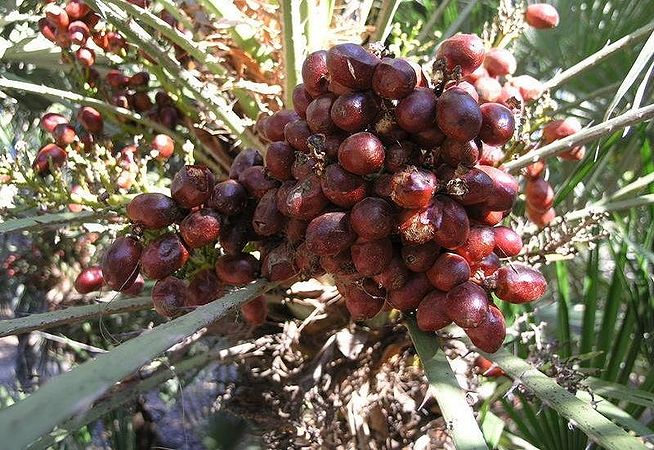
Fruit.

Chamaerops humilis var. argentea, southern California

Chamaerops humilis var. argentea, Riverside, California

Bizarre leaf form.

Green's Nursery Multi-trunk Santa Clarita, Ca.

Between Tizi-n-Tichka and Agouim, Morocco.

At the Huntington.
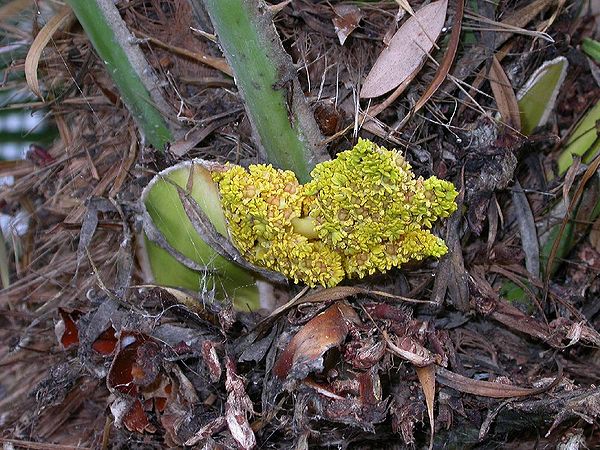


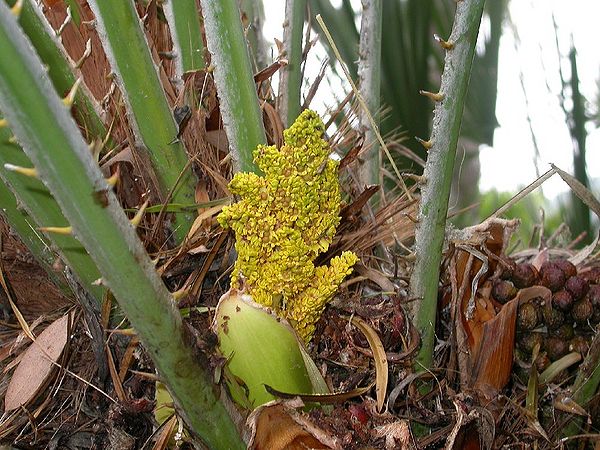


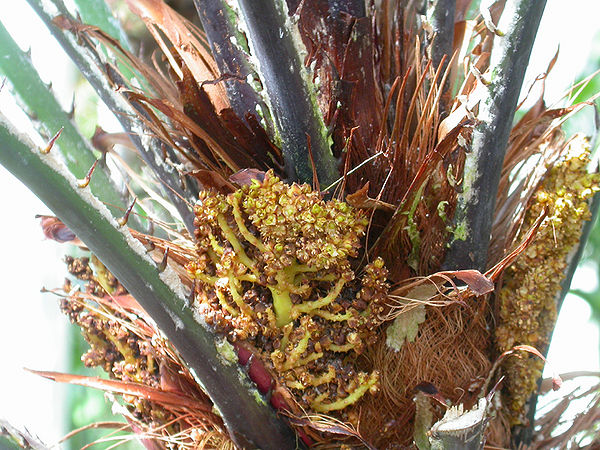


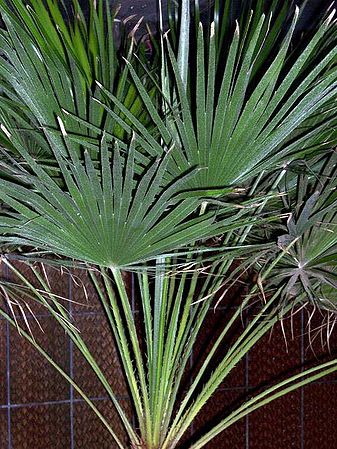





Chile.

Rare solitary form.

Rare solitary form.


In habitat, Morrocco. Photo by Antonius Verhoeven, edric.

El Chorro, Andalusia Spain, photo by Jens Rickmeyer, edric.

Riverwalk, Fort Lauderdale, Florida, photo by George Fitzpatrick, edric.

El Chorro, Andalusia Spain, photo by Jens Rickmeyer, edric.

Chamaerops humilis var. argentea in native habitat between Tizi-n-Tichka and Agouim, Morocco, at about 2000 m altitude.

Menton, French Côte d'Azur, France. Photo by Philippe, edric.

At Len's place. Vista, CA. Photo by Troy Donovan, edric.

At Len's place. Vista, CA. Photo by Troy Donovan, edric.

Chamaerops humilis var. argentea At Matty Bradford's place. Spring Valley, CA. Photo by Troy Donovan, edric.

Roma Street Parklands, in central Brisbane, Australia. Photo by Daryl O'connor, edric.


Czech Republic. Chamaerops humilis var. cerifera. Photo-tropik.cz, edric.

Czech Republic. Chamaerops humilis var. cerifera. Photo-tropik.cz, edric.

Chamaerops cerifera showing yellow inflorescence. South side of Tizi-n-Test mountain pass, Morocco. Photo by Gareth Mann.

Chamaerops cerifera growing amongst Phoenix dactilyfera. South side of Tizi-n-Test mountain pass, Morocco. Photo by Gareth Mann.

Chamaerops cerifera growing in the Atlas Mountains. South side of Tizi-n-Test mountain pass, Morocco. Photo by Gareth Mann.

Chamaerops cerifera growing in the Atlas Mountains. South side of Tizi-n-Test mountain pass, Morocco. Photo by Gareth Mann.

Chamaerops cerifera growing in the Atlas Mountains. South side of Tizi-n-Test mountain pass, Morocco. Photo by Gareth Mann.


015.jpg)


External Links
- Glossary of Palm Terms
- MODERN BOTANICAL LATIN
- "Just To Be Clear"
- http://itp.lucidcentral.org/id/palms/palm-id/Chamaerops_humilis.htm
- Forest & Kim Starr
- Video from "Palm Savanna" of Chamaerops cerifera and Phoenix dactilyfera growing in the Atlas Mountains
References
Phonetic spelling of Latin names by edric.
Special thanks to Geoff Stein, (Palmbob) for his hundreds of photos.
Special thanks to Palmweb.org, Dr. John Dransfield, Dr. Bill Baker & team, for their volumes of information and photos.
Glossary of Palm Terms; Based on the glossary in Dransfield, J., N.W. Uhl, C.B. Asmussen-Lange, W.J. Baker, M.M. Harley & C.E. Lewis. 2008. Genera Palmarum - Evolution and Classification of the Palms. Royal Botanic Gardens, Kew. All images copyright of the artists and photographers (see images for credits).
Many Special Thanks to Ed Vaile for his long hours of tireless editing and numerous contributions.