Difference between revisions of "Chrysalidocarpus ovobontsira"
Dypsisdean (Talk | contribs) |
|||
| (16 intermediate revisions by 2 users not shown) | |||
| Line 1: | Line 1: | ||
| − | __NOEDITSECTION__ | + | <big>__NOEDITSECTION__ |
| + | "Ovobontsira Palm"</big> | ||
{{Palmbox | {{Palmbox | ||
|image=P1010085 Dypsis ovobontsira.JPG | |image=P1010085 Dypsis ovobontsira.JPG | ||
|image_caption=Habitat, Madagascar. Photo: Phil Arrowsmith. | |image_caption=Habitat, Madagascar. Photo: Phil Arrowsmith. | ||
| − | |genus= | + | |genus=Chrysalidocarpus |
|species=<br>ovobontsira <br>(oh-voh-bohnt-SIHR-ah) | |species=<br>ovobontsira <br>(oh-voh-bohnt-SIHR-ah) | ||
|subspecies= | |subspecies= | ||
| Line 20: | Line 21: | ||
}} | }} | ||
==Habitat and Distribution== | ==Habitat and Distribution== | ||
| − | Endemic to Madagascar. Only known from the Mananara Biosphere Reserve. Moist forest, | + | Endemic to Madagascar. Only known from the Mananara Biosphere Reserve. Moist forest, [[Image:P1010086 Dypsis ovobontsira.JPG|thumb|left|400px|Habitat, Madagascar. Photo: Phil Arrowsmith.]]steep mid slope, ultramafic soils with deep humus layer; at about 265 m. |
| − | [[Image:P1010086 Dypsis ovobontsira.JPG|thumb|left|400px|Habitat, Madagascar. Photo: Phil Arrowsmith.]] | + | |
''Dypsis ovobontsira'' is found in dense diminishing fragmented forest. 10-15 years ago the reserve where this palm is located was mostly bush., and now there is perhaps only 7 or 8 individuals left. So it is likely (and unfortunate) that this palm has not yet made it into cultivation. | ''Dypsis ovobontsira'' is found in dense diminishing fragmented forest. 10-15 years ago the reserve where this palm is located was mostly bush., and now there is perhaps only 7 or 8 individuals left. So it is likely (and unfortunate) that this palm has not yet made it into cultivation. | ||
| Line 27: | Line 27: | ||
==Description== | ==Description== | ||
| − | + | As the photos above illustrate, ''Chrysalidocarpus ovobontsira'' is a unique palm, and of a magnificant form with color. The trunk appears to hold a shiny black color that sets it apart. Other photos have shown a green ringed trunk, so different exposures may yield a different look. And the form and coloration of the crownshaft, along with distinctive petioles, make this a fairly easy palm to differentiate. But because it's a Dypsis, there must be some controversy. :) | |
| − | As the photos above illustrate, '' | + | |
Another palm in the trade has mistakenly acquired the name ''D. ovobontsira''. This palm also known as the Dark (or Red) Mealy Bug, is also a beautiful palm, but most have agreed this is not the real ''D. ovobontsira'' pictured at the top of this page. Notice the lack of much of a petiole on the Dark Mealy Bug in the photo to the right as opposed to the very long petioles on the ''D. ovobontsira'' above. | Another palm in the trade has mistakenly acquired the name ''D. ovobontsira''. This palm also known as the Dark (or Red) Mealy Bug, is also a beautiful palm, but most have agreed this is not the real ''D. ovobontsira'' pictured at the top of this page. Notice the lack of much of a petiole on the Dark Mealy Bug in the photo to the right as opposed to the very long petioles on the ''D. ovobontsira'' above. | ||
| Line 38: | Line 37: | ||
In Madagascar there is sometimes an overlap between the scientific and local names. (See 'Curiosities' below) This is probably why there are several palms that end up in the trade with the same name. | In Madagascar there is sometimes an overlap between the scientific and local names. (See 'Curiosities' below) This is probably why there are several palms that end up in the trade with the same name. | ||
| − | Solitary palm. TRUNK to 8-10 m high, 13 cm in diam., near the crown 9 cm in diam.; internodes 14 cm, near the crown 2-2.5 cm; wood pink, with dense fibre-layer below bark. LEAVES spiral, 6, arching; sheath about 62 cm, at crown 14 cm. in diam., green with dense brown and white scales; petiole about 47 cm, green with dense white scales, proximally 6 x 5 cm, distally 5 x 4.5 cm, channelled with sharp edges; rachis 2.5-2.6 m, in midleaf 2.5 x 2.3 cm, green, waxy with sparse scattered scales; pinnae 68-69 on each side of the rachis, very regular, stiff, in 1 plane, the proximal 68-71 x 3.3-4.2 cm (sometimes with long pendulous reins), median 86-90 x 4.6-5.2 cm, dark green, glabrous. INFLORESCENCE interfoliar, arching with spreading rachillae, 170 x 90 cm, branched to 3 orders; peduncle 79 x 7 x 2 cm proximally, distally 7 x 4 cm; prophyll borne at 34 cm above the base of the peduncle, 56 cm x 14 cm, split very much on 1 side; peduncular bract deciduous, borne at 53 cm above the base of the peduncle; rachis with 22 branched and 19 unbranched first order branches, these proximally flattened, 4 x 1.7 cm; rachillae 10-18.5 cm, about 6 mm across. FLOWERS unknown. FRUIT green, 15-17 x 13-15 mm when fresh, 10 x 7 mm when dried. SEED 13-15 x 11-13 mm, rounded at the apex, pointed at the base, broader than wide, with sub-basal depression; endosperm slightly ruminate. (J. Dransfield and H. Beentje. 1995)/Palmweb. | + | Solitary palm. TRUNK to 8-10 m high, 13 cm in diam., near the crown 9 cm in diam.; internodes 14 cm, near the crown 2-2.5 cm; wood pink, with dense fibre-layer below bark. LEAVES spiral, 6, arching; sheath about 62 cm, at crown 14 cm. in diam., green with dense brown and white scales; petiole about 47 cm, green with dense white scales, proximally 6 x 5 cm, distally 5 x 4.5 cm, channelled with sharp edges; rachis 2.5-2.6 m, in midleaf 2.5 x 2.3 cm, green, waxy with sparse scattered scales; pinnae 68-69 on each side of the rachis, very regular, stiff, in 1 plane, the proximal 68-71 x 3.3-4.2 cm (sometimes with long pendulous reins), median 86-90 x 4.6-5.2 cm, dark green, glabrous. INFLORESCENCE interfoliar, arching with spreading rachillae, 170 x 90 cm, branched to 3 orders; peduncle 79 x 7 x 2 cm proximally, distally 7 x 4 cm; prophyll borne at 34 cm above the base of the peduncle, 56 cm x 14 cm, split very much on 1 side; peduncular bract deciduous, borne at 53 cm above the base of the peduncle; rachis with 22 branched and 19 unbranched first order branches, these proximally flattened, 4 x 1.7 cm; rachillae 10-18.5 cm, about 6 mm across. FLOWERS unknown. FRUIT green, 15-17 x 13-15 mm when fresh, 10 x 7 mm when dried. SEED 13-15 x 11-13 mm, rounded at the apex, pointed at the base, broader than wide, with sub-basal depression; endosperm slightly ruminate. (J. Dransfield and H. Beentje. 1995)/Palmweb. Editing by edric. |
In its group of large palms with regular leaflets and ruminate endosperm distinct by the interfoliar inflorescence with its long peduncle and bracts, the very hairy leaf sheath, and the spirally inserted leaves. It does not really resemble any other species closely. (J. Dransfield and H. Beentje. 1995)/Palmweb. | In its group of large palms with regular leaflets and ruminate endosperm distinct by the interfoliar inflorescence with its long peduncle and bracts, the very hairy leaf sheath, and the spirally inserted leaves. It does not really resemble any other species closely. (J. Dransfield and H. Beentje. 1995)/Palmweb. | ||
| Line 61: | Line 60: | ||
Image:P1010086 Dypsis ovobontsira.JPG|Habitat, Madagascar. Photo: Phil Arrowsmith. | Image:P1010086 Dypsis ovobontsira.JPG|Habitat, Madagascar. Photo: Phil Arrowsmith. | ||
image:JMMAD_Dyps_ovob1.jpg|In Analalafa, Madagascar. Photo by Jeff Marcus | image:JMMAD_Dyps_ovob1.jpg|In Analalafa, Madagascar. Photo by Jeff Marcus | ||
| − | |||
| − | |||
| − | |||
Image:d ovo-2.jpg|Photo by Bruce Lowey | Image:d ovo-2.jpg|Photo by Bruce Lowey | ||
Image:d ovo2-2.jpg|Photo by Bruce Lowey | Image:d ovo2-2.jpg|Photo by Bruce Lowey | ||
Image:d ovo3-2.jpg|Photo by Bruce Lowey | Image:d ovo3-2.jpg|Photo by Bruce Lowey | ||
| + | File:post-5709-0-16485200-1424395105.jpg|Mt. Warning Caldera Nth. NSW, Australia. Photo by Pete. | ||
| + | File:post-5709-0-84162500-1424395196.jpg|Mt. Warning Caldera Nth. NSW, Australia. Photo by Pete. | ||
| + | File:post-5709-0-11058500-1424395013.jpg|Mt. Warning Caldera Nth. NSW, Australia. Photo by Pete. | ||
| + | File:msg-5709-0-65333700-1424422210.jpg|Mt. Warning Caldera Nth. NSW, Australia. Photo by Pete. | ||
| + | File:msg-5709-0-22532600-1424422444.jpg|Mt. Warning Caldera Nth. NSW, Australia. Photo by Pete. | ||
| + | File:d111a6b2a30ce3296020aceae773582e.JPG|Mt. Warning Caldera Nth. NSW, Australia. Photo by Pete. | ||
| + | File:fb9423d26da0ed5bfc28871fb4e25e6d.JPG|Mt. Warning Caldera Nth. NSW, Australia. Photo by Pete. | ||
| + | File:47ad15a3c5dab8bc6e9851b05863e21b.JPG|Mt. Warning Caldera Nth. NSW, Australia. Photo by Pete. | ||
| + | File:doIMGP3420.JPG|Mt. Warning Caldera Nth. NSW, Australia. Photo by Pete. | ||
| + | |||
| + | |||
| + | File:post-426-0-65956400-1417538727.jpg|Bill Austins garden. Photo by Geoff Stein. | ||
| + | File:post-426-0-59848900-1417538743.jpg|Bill Austins garden. Photo by Geoff Stein. | ||
| + | File:FJ4A6706_zps3tbqxtwx.jpg|SoCal. Photo by Matt in SD | ||
| + | File:FJ4A6707_zpsrdje4nxo.jpg|SoCal. Photo by Matt in SD | ||
| + | Image:IMG_2984.jpg|22 months old, edric, Oak Hill FL. | ||
| + | Image:IMG_3407.jpg|23 months old, edric, Oak Hill FL. | ||
| + | Image:IMG_3415.jpg|23 months old, edric, Oak Hill FL. | ||
| + | Image:IMG_3418.jpg|23 months old, edric, Oak Hill FL. | ||
| + | Image:IMG_3419.jpg|23 months old, edric, Oak Hill FL. | ||
| + | Image:IMG_3422.jpg|23 months old, edric, Oak HIll FL. | ||
| + | Image:IMG_3540.jpg|23 months old, edric, Oak Hill FL. | ||
| + | Image:IMG_3542.jpg|23 months old, edric, Oak Hill FL. | ||
| + | Image:IMG_3848.jpg|Two years old, edric, Oak Hill FL. | ||
| + | Image:IMG_3853.jpg|Two years old, edric, Oak Hill FL. | ||
| + | Image:IMG_3858.jpg|Two Years old, edric, Oak Hill Fl. | ||
| + | Image:IMG_3887.jpg|Two years old, edric, Oak Hill FL. | ||
| + | image:IMG_4555.jpg|26 months old, edric, Oak Hill FL. | ||
| + | image:IMG_4559.jpg|26 motnhs old, edric, Oak Hill FL. | ||
| + | image:IMG_4562.jpg|26 months old, edric. Oak Hill FL. | ||
| + | image:IMG_4624.jpg|26 months old, edric, Oak Hill FL. | ||
| + | image:IMG_4627.jpg|26 months old, edric, Oak Hill FL. | ||
| + | image:IMG_4629.jpg|26 months old, edric, Oak Hill FL. | ||
| + | image:IMG_4630.jpg|26 months old, edric, Oak Hill FL. | ||
| + | image:IMG_4634.jpg|26 months old, edric, Oak Hill FL. | ||
| + | image:IMG_4644.jpg|26 months old, edric, Oak Hill FL. | ||
| + | image:IMG_4646.jpg|26 months old, edric, Oak Hill FL. | ||
| + | image:IMG_4647.jpg|26 months old, edric, Oak Hill FL. | ||
| + | image:IMG_4649.jpg|26 months old, edric, Oak Hill FL. | ||
| + | image:IMG_4652.jpg|26 months old, edric, Oak Hill FL. | ||
| + | image:IMG_5566.jpg|33 months old, edric, Oak Hill FL. | ||
| + | image:IMG_5571.jpg|33 months old, edric, Oak Hill FL. | ||
| + | image:IMG_5574.jpg|33 months old, edric, Oak Hill FL. | ||
| + | image:IMG_5576.jpg|33 months old, edric, Oak Hill FL. | ||
| + | image:IMG_5577.jpg|33 months old, edric, Oak Hill FL. | ||
| + | image:DwpIMG_9066.jpg|50 months old, edric, Oak Hill FL. | ||
| + | image:DwpIMG_9300.jpg|50 months old, edric, Oak Hill FL. | ||
| + | image:DwpIMG_9302.jpg|50 months old, edric, Oak Hill FL. | ||
| + | image:DwpIMG_9305.jpg|50 months old, edric, Oak Hill FL. | ||
| + | image:DwpIMG_9309.jpg|50 months old, edric, Oak Hill FL. | ||
| + | image:DwpIMG_9312.jpg|50 months old, edric, Oak Hill FL. | ||
| + | image:8150422163_c65d95c284_k.jpg|39 months old. One of my D. sp. white pepper seedlings I gave a buddy of mine in Northport FL. near Sarasota, rarely freezes there, it's doing great, edric. | ||
| + | image:Doimg_1592_zps253cc60a.jpg|H.P. Leu Gardens, Orlando FL. Photo by Eric. | ||
| + | image:IMG_2762.jpg|Seed detail, edric, Oak Hill FL. | ||
| + | Image:IMG_1809.JPG|Seed detail, approx. .50 inches across, edric, Oak Hill, Florida. | ||
| + | |||
image:DypOvo.jpg|In habitat. Photo-Rare Palm Seeds.com | image:DypOvo.jpg|In habitat. Photo-Rare Palm Seeds.com | ||
| − | + | ||
| − | + | ||
| − | + | ||
| − | + | ||
| − | + | ||
| − | + | ||
| − | + | ||
| − | + | ||
| − | + | ||
| − | + | ||
</gallery></center> | </gallery></center> | ||
==External Links== | ==External Links== | ||
| Line 86: | Line 129: | ||
==References== | ==References== | ||
Phonetic spelling of Latin names by edric. | Phonetic spelling of Latin names by edric. | ||
| + | Edit by João Santos Costa | ||
Special thanks to Geoff Stein, (Palmbob) for his hundreds of photos. | Special thanks to Geoff Stein, (Palmbob) for his hundreds of photos. | ||
| Line 96: | Line 140: | ||
{{SpeciesListBackLink}} | {{SpeciesListBackLink}} | ||
[[Category:Palms of Madagascar]] | [[Category:Palms of Madagascar]] | ||
| − | [[Category: | + | [[Category:CHRYSALIDOCARPUS|ovobontsira]] |
Latest revision as of 12:36, 13 February 2023
"Ovobontsira Palm"
| Chrysalidocarpus ovobontsira (oh-voh-bohnt-SIHR-ah) | |||||||
|---|---|---|---|---|---|---|---|
 Habitat, Madagascar. Photo: Phil Arrowsmith. | |||||||
| Scientific Classification | |||||||
| |||||||
| Synonyms | |||||||
|
| |||||||
| Native Continent | |||||||
 | |||||||
| Morphology | |||||||
| |||||||
| Culture | |||||||
|
| |||||||
| Survivability index | |||||||
|
| |||||||
| Common names | |||||||
|
| |||||||
Contents
Habitat and Distribution
Endemic to Madagascar. Only known from the Mananara Biosphere Reserve. Moist forest,
Dypsis ovobontsira is found in dense diminishing fragmented forest. 10-15 years ago the reserve where this palm is located was mostly bush., and now there is perhaps only 7 or 8 individuals left. So it is likely (and unfortunate) that this palm has not yet made it into cultivation.
It is known only from this single locality in the protected area of Mananara-Nord at an elevation of 500 meters.
Description
As the photos above illustrate, Chrysalidocarpus ovobontsira is a unique palm, and of a magnificant form with color. The trunk appears to hold a shiny black color that sets it apart. Other photos have shown a green ringed trunk, so different exposures may yield a different look. And the form and coloration of the crownshaft, along with distinctive petioles, make this a fairly easy palm to differentiate. But because it's a Dypsis, there must be some controversy. :)
Another palm in the trade has mistakenly acquired the name D. ovobontsira. This palm also known as the Dark (or Red) Mealy Bug, is also a beautiful palm, but most have agreed this is not the real D. ovobontsira pictured at the top of this page. Notice the lack of much of a petiole on the Dark Mealy Bug in the photo to the right as opposed to the very long petioles on the D. ovobontsira above.
To further confuse matters is the possiblity of descriptive errors in the Palms of Madagascar, possibly resulting from incorrect or incomplete herbarium specimens at the time of publication. In any case, those who saw this palm in Madagascar along with Dr. John Dransfield identified it as D. aff. ovobontsira. So while not an official "done deal," the best minds appear to think this is what will be the real D. ovobontsira.
As with many of these Dypsis, the true identity of this palm appears to be getting less certain instead of more (Nov, 2014). It is no longer certain that the above featured photos are the real deal. There is apparently more work to be done before any positive identifications can be made. Stay tuned.
In Madagascar there is sometimes an overlap between the scientific and local names. (See 'Curiosities' below) This is probably why there are several palms that end up in the trade with the same name.
Solitary palm. TRUNK to 8-10 m high, 13 cm in diam., near the crown 9 cm in diam.; internodes 14 cm, near the crown 2-2.5 cm; wood pink, with dense fibre-layer below bark. LEAVES spiral, 6, arching; sheath about 62 cm, at crown 14 cm. in diam., green with dense brown and white scales; petiole about 47 cm, green with dense white scales, proximally 6 x 5 cm, distally 5 x 4.5 cm, channelled with sharp edges; rachis 2.5-2.6 m, in midleaf 2.5 x 2.3 cm, green, waxy with sparse scattered scales; pinnae 68-69 on each side of the rachis, very regular, stiff, in 1 plane, the proximal 68-71 x 3.3-4.2 cm (sometimes with long pendulous reins), median 86-90 x 4.6-5.2 cm, dark green, glabrous. INFLORESCENCE interfoliar, arching with spreading rachillae, 170 x 90 cm, branched to 3 orders; peduncle 79 x 7 x 2 cm proximally, distally 7 x 4 cm; prophyll borne at 34 cm above the base of the peduncle, 56 cm x 14 cm, split very much on 1 side; peduncular bract deciduous, borne at 53 cm above the base of the peduncle; rachis with 22 branched and 19 unbranched first order branches, these proximally flattened, 4 x 1.7 cm; rachillae 10-18.5 cm, about 6 mm across. FLOWERS unknown. FRUIT green, 15-17 x 13-15 mm when fresh, 10 x 7 mm when dried. SEED 13-15 x 11-13 mm, rounded at the apex, pointed at the base, broader than wide, with sub-basal depression; endosperm slightly ruminate. (J. Dransfield and H. Beentje. 1995)/Palmweb. Editing by edric.
In its group of large palms with regular leaflets and ruminate endosperm distinct by the interfoliar inflorescence with its long peduncle and bracts, the very hairy leaf sheath, and the spirally inserted leaves. It does not really resemble any other species closely. (J. Dransfield and H. Beentje. 1995)/Palmweb.
Culture
Since this palm may not yet be in cultivation, any cultural information would be purely conjecture, but probably along the same lines as other larger forest Dypsis.
Comments and Curiosities
In the Malagasy language Ovobontsira means mongoose palm. Because of other references to palm hearts in Malagasy palm names, one collector infered at first thought that this was a reference to to the palm heart tasting like mongoose to the locals. :) But more than likely the name originates from the habit of the mongoose making homes in the old palm trunks lying on the ground. In the local language, "hovotra" means palm or palm heart, and “vontsira” is the name for mongoose. So, ovobontsira is mongoose palm or mongoose palm heart. Another possible translation could be that when these palms are cut down and lay rotting on the ground, there is a type of white grub/worm that flourish inside the trunks that the mongoose love to eat. So the local Malagasy people often see mongoose digging inside these fallen trunks. So whatever the reason, mongoose are often associated with this species - hence the name "Ovobontsira."
Below is a photo of the ringed tailed mongoose, which is more than likely the species of mongoose that the palm was named after.
This is a beautiful palm of restricted distribution. The name is taken from the Betsimisaraka name for this species.
Conservation: Critical. Only known from a single site, where less than ten individuals are known. (J. Dransfield and H. Beentje. 1995)/Palmweb.
This is a tillering palm, it exhibits saxophone style root growth (it has a heel), keep top third of heel above soil elevation!
- IMAGE GALLERY
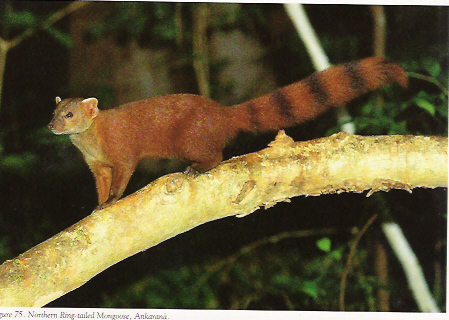
Ring Tailed Mongoose, Dypsis ovobontsira - The Mongoose Palm

Habitat, Madagascar. Photo: Phil Arrowsmith.

Habitat, Madagascar. Photo: Phil Arrowsmith.

In Analalafa, Madagascar. Photo by Jeff Marcus

Photo by Bruce Lowey

Photo by Bruce Lowey

Photo by Bruce Lowey

Mt. Warning Caldera Nth. NSW, Australia. Photo by Pete.

Mt. Warning Caldera Nth. NSW, Australia. Photo by Pete.

Mt. Warning Caldera Nth. NSW, Australia. Photo by Pete.

Mt. Warning Caldera Nth. NSW, Australia. Photo by Pete.

Mt. Warning Caldera Nth. NSW, Australia. Photo by Pete.

Mt. Warning Caldera Nth. NSW, Australia. Photo by Pete.

Mt. Warning Caldera Nth. NSW, Australia. Photo by Pete.

Mt. Warning Caldera Nth. NSW, Australia. Photo by Pete.

Mt. Warning Caldera Nth. NSW, Australia. Photo by Pete.

Bill Austins garden. Photo by Geoff Stein.

Bill Austins garden. Photo by Geoff Stein.

SoCal. Photo by Matt in SD

SoCal. Photo by Matt in SD

22 months old, edric, Oak Hill FL.

23 months old, edric, Oak Hill FL.

23 months old, edric, Oak Hill FL.

23 months old, edric, Oak Hill FL.

23 months old, edric, Oak Hill FL.

23 months old, edric, Oak HIll FL.

23 months old, edric, Oak Hill FL.

23 months old, edric, Oak Hill FL.

Two years old, edric, Oak Hill FL.

Two years old, edric, Oak Hill FL.

Two Years old, edric, Oak Hill Fl.

Two years old, edric, Oak Hill FL.

26 months old, edric, Oak Hill FL.

26 motnhs old, edric, Oak Hill FL.

26 months old, edric. Oak Hill FL.

26 months old, edric, Oak Hill FL.

26 months old, edric, Oak Hill FL.

26 months old, edric, Oak Hill FL.

26 months old, edric, Oak Hill FL.

26 months old, edric, Oak Hill FL.

26 months old, edric, Oak Hill FL.

26 months old, edric, Oak Hill FL.

26 months old, edric, Oak Hill FL.

26 months old, edric, Oak Hill FL.

26 months old, edric, Oak Hill FL.

33 months old, edric, Oak Hill FL.

33 months old, edric, Oak Hill FL.

33 months old, edric, Oak Hill FL.

33 months old, edric, Oak Hill FL.

33 months old, edric, Oak Hill FL.

50 months old, edric, Oak Hill FL.
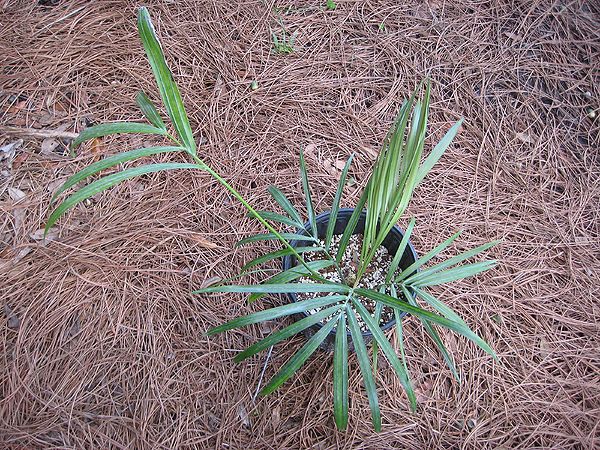
50 months old, edric, Oak Hill FL.

50 months old, edric, Oak Hill FL.

50 months old, edric, Oak Hill FL.

50 months old, edric, Oak Hill FL.
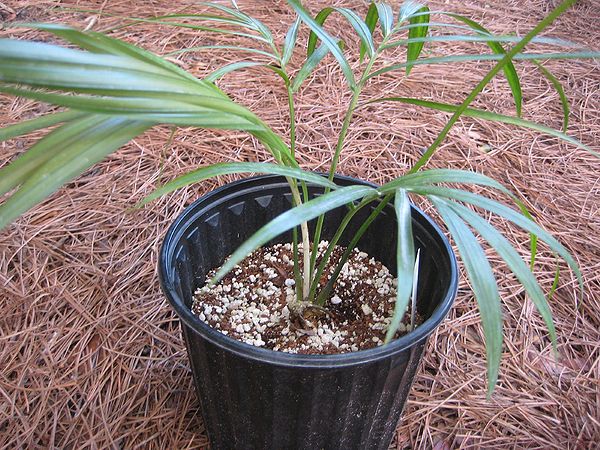
50 months old, edric, Oak Hill FL.

39 months old. One of my D. sp. white pepper seedlings I gave a buddy of mine in Northport FL. near Sarasota, rarely freezes there, it's doing great, edric.

H.P. Leu Gardens, Orlando FL. Photo by Eric.

Seed detail, edric, Oak Hill FL.

Seed detail, approx. .50 inches across, edric, Oak Hill, Florida.

In habitat. Photo-Rare Palm Seeds.com


External Links
- Glossary of Palm Terms
- MODERN BOTANICAL LATIN
- "Just To Be Clear"
- THE SAXOPHONE STYLE ROOT GROWTH (HEEL)
References
Phonetic spelling of Latin names by edric. Edit by João Santos Costa
Special thanks to Geoff Stein, (Palmbob) for his hundreds of photos.
Special thanks to Palmweb.org, Dr. John Dransfield, Dr. Bill Baker & team, for their volumes of information and photos.
Glossary of Palm Terms; Based on the glossary in Dransfield, J., N.W. Uhl, C.B. Asmussen-Lange, W.J. Baker, M.M. Harley & C.E. Lewis. 2008. Genera Palmarum - Evolution and Classification of the Palms. Royal Botanic Gardens, Kew. All images copyright of the artists and photographers (see images for credits).
Dransfield, J. & Beentje, H. 1995. The Palms of Madagascar. Royal Botanic Gardens, Kew and The International Palm Society.
Many Special Thanks to Ed Vaile for his long hours of tireless editing and numerous contributions.