Difference between revisions of "Chrysalidocarpus lastelliana"
(re classification) |
|||
| (26 intermediate revisions by 3 users not shown) | |||
| Line 1: | Line 1: | ||
| − | __noeditsection__ | + | <big>__noeditsection__ |
| + | "Red Neck Palm"</big> | ||
{{Palmbox | {{Palmbox | ||
|image=lastelliana.jpg | |image=lastelliana.jpg | ||
|image_caption=Courtesy of Daryl O'Connor, Brisbane, Queensland. | |image_caption=Courtesy of Daryl O'Connor, Brisbane, Queensland. | ||
| − | |genus= | + | |genus=Chrysalidocarpus |
| − | |species=<br>lastelliana (lahs-teh-leh-AHN-ah | + | |species=<br>lastelliana (lahs-teh-leh-AHN-ah) |
|subspecies= | |subspecies= | ||
|cultivar= | |cultivar= | ||
| Line 20: | Line 21: | ||
}} | }} | ||
==Habitat and Distribution== | ==Habitat and Distribution== | ||
| − | Endemic to Northwest, Northeast and East Madagascar. Moist lowland forest on slopes (gneiss, quartz, granite), often rather open or near forest margins, or near water, in ravines, also in coastal forest on white sand; alt. 1-450 m. | + | Endemic to Northwest, Northeast and East Madagascar. [[File:dloriginal098977.jpg|thumb|left|400px|Mananara, Madagascar. Photo by Dr.Romer Rabarijaona.]]Moist lowland forest on slopes (gneiss, quartz, granite), often rather open or near forest margins, or near water, in ravines, also in coastal forest on white sand; alt. 1-450 m. |
| − | + | ||
| − | + | ||
==Description== | ==Description== | ||
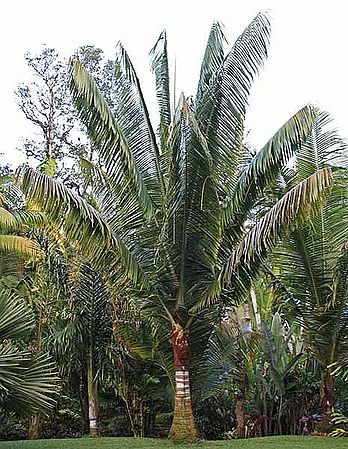
| − | This is one of the more elegant and colorful Dypsis, and is now widespread in cultivation. With it's large stature and fuzzy bright red crownshaft, it stands out in any setting. In the past ''Dypsis lastelliana'', the "Redneck Palm, " was often confused with ''Dypsis lepthocheilos'', the "Teddy Bear Palm." This confusion was engrained and still persists somewhat today. ''D. lastelliana'' can be differentiated from ''D. leptocheilos'' by its larger, slightly open, redder crownshaft, more "shuttlecock" leaf arrangement, and overall as a more robust palm in habitat and cultivation. ''D. leptocheilos'' differs in having an orangish, more slender crownshaft, with leafs that tend to more horizontal. Once an observer recognizes these differences, identification becomes much easier, and almost certain in most instances | + | This is one of the more elegant and colorful Dypsis, and is now widespread in cultivation. With it's large stature and fuzzy bright red crownshaft, it stands out in any setting. In the past ''Dypsis lastelliana'', the "Redneck Palm, " was often confused with ''Dypsis lepthocheilos'', the "Teddy Bear Palm." This confusion was engrained and still persists somewhat today. ''D. lastelliana'' can be differentiated from ''D. leptocheilos'' by its larger, slightly open, redder crownshaft, more "shuttlecock" leaf arrangement, and overall as a more robust palm in habitat and cultivation. ''D. leptocheilos'' differs in having an orangish, more slender crownshaft, with leafs that tend to more horizontal. Once an observer recognizes these differences, identification becomes much easier, and almost certain in most instances. |
Interestingly enough, some photos from habitat show a palm with fronds tending well below the horizontal, while most palms in cultivation are oftentimes extremely "shuttlecock." Perhaps this is explained by the variability often seen in Dypsis species. A form with striking persistent white streaks in the petiole is in cultivation and can be seen in the photos below, | Interestingly enough, some photos from habitat show a palm with fronds tending well below the horizontal, while most palms in cultivation are oftentimes extremely "shuttlecock." Perhaps this is explained by the variability often seen in Dypsis species. A form with striking persistent white streaks in the petiole is in cultivation and can be seen in the photos below, | ||
| − | A solitary palm. TRUNK 5-15 m tall, 18-25 cm in diam., with swollen base; wood hard; internodes 8-10 cm, pale green to grey waxy green, nodal scars c. 4 cm, pale brown; crownshaft 70-75 cm tall, rich velvet red-brown. LEAVES 9-15 in the crown, spirally inserted; sheath 40- 60 cm long, partially open, adaxially brilliant cherry-red, abaxially densely red-brown pubescent; petiole 0-10 cm long, proximally to 11 x 3.5 cm, distally about 6 x 3.7 cm, channelled; rachis yellowish, to 3.8 m long, in mid-leaf 1.2-2.2 x 1.5-1.6 cm in diam. and here either channelled or keeled, glabrous, sometimes waxy; leaflets (50 -) 94-102 on each side of the rachis, regular, somewhat pendulous, the proximal 39-66 x 0.7-2 cm, median 56-89 x 2.4-4.3 cm, distal 18-54 x 0.4-2.3 cm, with a few tufts of laciniate ramenta on the proximal part of the abaxial midrib, but otherwise glabrous, main veins 1, prominent adaxially, as well as margins thickened, apices bifid and acute. INFLORESCENCE interfoliar, branched to 3 orders, spreading, 1.3-2.2 x 1.2 m; peduncle 60-96 cm long, distally 2.5-3.2 x 1.7-1.5 cm; prophyll 30-52 x 6.5- 11 cm, borne at 3-13 cm above the base of the peduncle, rusty pubescent; peduncular bract deciduous, inserted at about 30 cm from the base of the peduncle, 80-110 cm long, about 12 cm wide when flat, splitting along its length but for the upper about 28 cm, with a beak of up to 7 cm long, densely reddish pubescent; rachis about 97 cm long, yellow-green, sometimes tinged red, with 13-17 branched and about 10 unbranched first order branches, the proximal of these with a rachis 2.5-3.5 x 1-1.3 cm in diam. at the base, to 45 cm long, and with up to 15 second order branches; rachis bracts up to 3 cm long, triangular and acute; rachillae pale or yellow-green, 27-47 cm long, 3-6 mm in diam., glabrous, with dense, slightly sunken triads. {{read more top}}STAMINATE FLOWERS only known from rather young buds, with sepals 2-2.3 x 1.4-2.3 mm, keeled, slightly gibbous, concave, with membranous wings, truncate or nearly so; receptacle 0.2-0.6 mm high; petals 1.7-2.7 x 1.3-1.6 mm, ovate, acute; stamens 6, very slightly biseriate, the antepetalous stamens inserted slightly higher up, filaments 0.5-0.6 mm and thin-cylindrical, anthers 1.3-1.6 x 0.5-0.7 mm, the locules parallel and obtuse; pistillode about 2.2 x 0.6 mm. PISTILLATE FLOWERS with sepals 1.7-2.4 x 2.2-2.6 mm; petals 2.4-2.8 x 1.8-2.4 mm; staminodes about 0.5-0.6 mm high; gynoecium about 2.5 x 1 mm. FRUIT obovoid with a narrowed base, slightly asymmetrical, 18-24 x 12-17 mm, with obtuse apex; endocarp fibrous, with anastomosing fibres. SEED 12-21 x 10.5-16 mm, the base apiculate with a small depression just above the apiculus, this corresponding to the position of the embryo, the apex rounded; endosperm deeply ruminate, the intrusions many and 2-4 mm deep. SEEDLING with two scale leaves, the distal one densely scaly; eophyll pinnate, with petiole scaly with reddish and silvery scales; leaflets of eophyll 4-6 on each side of the rachis. (J. Dransfield and H. Beentje. 1995)/Palmweb. | + | A solitary palm. TRUNK 5-15 m tall, 18-25 cm in diam., with swollen base; wood hard; internodes 8-10 cm, pale green to grey waxy green, nodal scars c. 4 cm, pale brown; crownshaft 70-75 cm tall, rich velvet red-brown. LEAVES 9-15 in the crown, spirally inserted; sheath 40- 60 cm long, partially open, adaxially brilliant cherry-red, abaxially densely red-brown pubescent; petiole 0-10 cm long, proximally to 11 x 3.5 cm, distally about 6 x 3.7 cm, channelled; rachis yellowish, to 3.8 m long, in mid-leaf 1.2-2.2 x 1.5-1.6 cm in diam. and here either channelled or keeled, glabrous, sometimes waxy; leaflets (50 -) 94-102 on each side of the rachis, regular, somewhat pendulous, the proximal 39-66 x 0.7-2 cm, median 56-89 x 2.4-4.3 cm, distal 18-54 x 0.4-2.3 cm, with a few tufts of laciniate ramenta on the proximal part of the abaxial midrib, but otherwise glabrous, main veins 1, prominent adaxially, as well as margins thickened, apices bifid and acute. INFLORESCENCE interfoliar, branched to 3 orders, spreading, 1.3-2.2 x 1.2 m; peduncle 60-96 cm long, distally 2.5-3.2 x 1.7-1.5 cm; prophyll 30-52 x 6.5- 11 cm, borne at 3-13 cm above the base of the peduncle, rusty pubescent; peduncular bract deciduous, inserted at about 30 cm from the base of the peduncle, 80-110 cm long, about 12 cm wide when flat, splitting along its length but for the upper about 28 cm, with a beak of up to 7 cm long, densely reddish pubescent; rachis about 97 cm long, yellow-green, sometimes tinged red, with 13-17 branched and about 10 unbranched first order branches, the proximal of these with a rachis 2.5-3.5 x 1-1.3 cm in diam. at the base, to 45 cm long, and with up to 15 second order branches; rachis bracts up to 3 cm long, triangular and acute; rachillae pale or yellow-green, 27-47 cm long, 3-6 mm in diam., glabrous, with dense, slightly sunken triads. {{read more top}}STAMINATE FLOWERS only known from rather young buds, with sepals 2-2.3 x 1.4-2.3 mm, keeled, slightly gibbous, concave, with membranous wings, truncate or nearly so; receptacle 0.2-0.6 mm high; petals 1.7-2.7 x 1.3-1.6 mm, ovate, acute; stamens 6, very slightly biseriate, the antepetalous stamens inserted slightly higher up, filaments 0.5-0.6 mm and thin-cylindrical, anthers 1.3-1.6 x 0.5-0.7 mm, the locules parallel and obtuse; pistillode about 2.2 x 0.6 mm. PISTILLATE FLOWERS with sepals 1.7-2.4 x 2.2-2.6 mm; petals 2.4-2.8 x 1.8-2.4 mm; staminodes about 0.5-0.6 mm high; gynoecium about 2.5 x 1 mm. FRUIT obovoid with a narrowed base, slightly asymmetrical, 18-24 x 12-17 mm, with obtuse apex; endocarp fibrous, with anastomosing fibres. SEED 12-21 x 10.5-16 mm, the base apiculate with a small depression just above the apiculus, this corresponding to the position of the embryo, the apex rounded; endosperm deeply ruminate, the intrusions many and 2-4 mm deep. SEEDLING with two scale leaves, the distal one densely scaly; eophyll pinnate, with petiole scaly with reddish and silvery scales; leaflets of eophyll 4-6 on each side of the rachis. (J. Dransfield and H. Beentje. 1995)/Palmweb. Editing by edric. |
| − | The type consists of a partial inflorescence with staminate and pistillate buds, but there is no doubt that it is conspecific with the other cited material; Miller & Randrianasolo 4491 is at the same stage of development and is an almost exact match. Baillon mentions another de Lastellé specimen in the protologue, this one with fruits, and states this probably belongs to another species. The fruit has homogeneous endosperm. Beccari (1906, l.c.) describes the proper fruit of D. lastelliana from a Baron collection, and identified the fruiting specimen of de Lastellé as Chrysalidocarpus piluliferus (= D. pilulifera). (J. Dransfield and H. Beentje. 1995)/Palmweb | + | The type consists of a partial inflorescence with staminate and pistillate buds, but there is no doubt that it is conspecific with the other cited material; Miller & Randrianasolo 4491 is at the same stage of development and is an almost exact match. Baillon mentions another de Lastellé specimen in the protologue, this one with fruits, and states this probably belongs to another species. The fruit has homogeneous endosperm. Beccari (1906, l.c.) describes the proper fruit of D. lastelliana from a Baron collection, and identified the fruiting specimen of de Lastellé as Chrysalidocarpus piluliferus (= D. pilulifera). (J. Dransfield and H. Beentje. 1995)/Palmweb. |
{{read more bottom}} | {{read more bottom}} | ||
==Culture== | ==Culture== | ||
This species likes a rich soil with regular fertilizer and watering, intolerant of any frost. But grows well in warmer months in 4 C to 40 C. Grows best above 18 C. An easily grown palm in the tropics which likes full sun/light shade, and a moist, well drained position. Cold Hardiness Zone: 10b | This species likes a rich soil with regular fertilizer and watering, intolerant of any frost. But grows well in warmer months in 4 C to 40 C. Grows best above 18 C. An easily grown palm in the tropics which likes full sun/light shade, and a moist, well drained position. Cold Hardiness Zone: 10b | ||
| + | <center> | ||
| + | [[{{PFC}}http://www.palmpedia.net/palmsforcal/index.php5/Dypsis_lastelliana]] | ||
| + | </center> | ||
==Comments and Curiosities== | ==Comments and Curiosities== | ||
Despite its robust growth habit in the tropics and sub-tropics, it has proven not as adaptable in the more temperate climates and languishes in comparison to its oft confused brethren, Dypsis leptocheilos. The name derives from the collector of the type, de Lastellé. | Despite its robust growth habit in the tropics and sub-tropics, it has proven not as adaptable in the more temperate climates and languishes in comparison to its oft confused brethren, Dypsis leptocheilos. The name derives from the collector of the type, de Lastellé. | ||
| Line 40: | Line 42: | ||
Uses: Pith formerly used to make salt; palm-heart bitter, inedible, said to be poisonous by the Sakalava and Tsimihety. (J. Dransfield and H. Beentje. 1995)/Palmweb. | Uses: Pith formerly used to make salt; palm-heart bitter, inedible, said to be poisonous by the Sakalava and Tsimihety. (J. Dransfield and H. Beentje. 1995)/Palmweb. | ||
| + | |||
| + | D. lastelliana, the Red Neck Palm, is popular for its fuzzy, rusty-red crownshaft. A | ||
| + | solitary species endemic to the northern end of Madagascar, it reaches 16 to 49 ft. | ||
| + | high, with a trunk diameter of 7 to 10 in. Its pendulous leaflets are arrayed in a | ||
| + | regular pattern along the rachis. A particularly striking ornamental use is to plant it | ||
| + | out in groups of three or more specimens. D. lastelliana favors warm, moist | ||
| + | conditions. The similar-looking Teddy Bear Palm, D. leptocheilos, prefers a | ||
| + | cooler, drier climate, and accordingly grows better in southern California than in | ||
| + | our region. The IUCN Red List conservation status of D. lastelliana is Least | ||
| + | Concern, with a stable population trend. (fairchildgarden.org) | ||
A fabulous, tall and slender palm from northern Madagascar, where it grows in rainforest or coastal forest. The Red Neck Palm has huge, pinnate leaves with pendulous leaflets and a dark red-brown to purple-black crownshaft. It has similarities to D. leptocheilos, the Teddy Bear Palm, but is generally taller and more elegant. D. lastelliana is easy to grow and best suited to warm subtropical and tropical regions. (RPS.com) | A fabulous, tall and slender palm from northern Madagascar, where it grows in rainforest or coastal forest. The Red Neck Palm has huge, pinnate leaves with pendulous leaflets and a dark red-brown to purple-black crownshaft. It has similarities to D. leptocheilos, the Teddy Bear Palm, but is generally taller and more elegant. D. lastelliana is easy to grow and best suited to warm subtropical and tropical regions. (RPS.com) | ||
| Line 46: | Line 58: | ||
{{#Widget:AdResban}} | {{#Widget:AdResban}} | ||
<center><gallery caption="IMAGE GALLERY" perrow="" widths="" heights=""> | <center><gallery caption="IMAGE GALLERY" perrow="" widths="" heights=""> | ||
| − | image:3fbff9d3-ca3e-495b-b658- | + | image:3fbff9d3-ca3e-495b-b658-5bea9f15f30c.jpg|Antanambe, Madagascar. Photo by Dr. John Dransfield, Royal Botanic Gardens, Kew/Palmweb. |
| − | image:32f6a93c-2f1e-4c5e-ad30- | + | image:32f6a93c-2f1e-4c5e-ad30-8971ab2356f0.jpg|Mananara, Madagascar. Photo by Dr. John Dransfield, Royal Botanic Gardens, Kew/Palmweb. |
| − | image:8426e00d-a67a-4f21-babc- | + | image:8426e00d-a67a-4f21-babc-aebf1cd097af.jpg|Sahavary, Masoala, Madagascar. Photo by Dr. John Dransfield, Royal Botanic Gardens, Kew/Palmweb. |
image:Ed89cd9d-0de7-4a05-b85f-20353dc174fb.jpg|Maroansetra, Madagascar. Photo by Dr. John Dransfield, Royal Botanic Gardens, Kew/Palmweb. | image:Ed89cd9d-0de7-4a05-b85f-20353dc174fb.jpg|Maroansetra, Madagascar. Photo by Dr. John Dransfield, Royal Botanic Gardens, Kew/Palmweb. | ||
| + | File:dloriginal098977.jpg|Mananara, Madagascar. Photo by Dr. Romer Rabarijaona. | ||
Image:4683093592_86219f1f24_oscottzdiplas.jpg|Photo by Dr. Scott Zona, Boa Esperanza ranch, Brazil. | Image:4683093592_86219f1f24_oscottzdiplas.jpg|Photo by Dr. Scott Zona, Boa Esperanza ranch, Brazil. | ||
Image:Ho'o30.jpg|Ho'omaluhia, Hawaii. | Image:Ho'o30.jpg|Ho'omaluhia, Hawaii. | ||
| Line 68: | Line 81: | ||
image:A-aaxbillaustin.jpg|Hawaii, photo by Bill Austin | image:A-aaxbillaustin.jpg|Hawaii, photo by Bill Austin | ||
image:A-dbillaustin.jpg|Hawaii, photo by Bill Austin | image:A-dbillaustin.jpg|Hawaii, photo by Bill Austin | ||
| + | File:post-7381-0-77026000-1433672869.jpg|Hawaii. Bill Austin's place. Photo by Paul Latzias. | ||
| + | File:post-7381-0-61704600-1436651352.jpg|Roma Street Parklands, Brisbane, Australia. Photo by Paul Latzias. | ||
| + | File:post-7381-0-17407300-1436655046.jpg|Roma Street Parklands, Brisbane, Australia. Dypsis ampasindavae on right. Photo by Paul Latzias. | ||
| + | File:post-7381-0-06417300-1436663577.jpg|Brisbane Botanic Gardens, Mount Coot-tha, Brisbane, Australia. Photo by Paul Latzias. | ||
| + | File:post-7381-0-83677300-1436663584.jpg|Brisbane Botanic Gardens, Mount Coot-tha, Brisbane, Australia. Photo by Paul Latzias. | ||
| + | |||
| + | |||
image:-gallery-members-Dypsis_lastelliana_craftz.jpg|Andersen Garden, Hawaii, photo by Paul Craft. | image:-gallery-members-Dypsis_lastelliana_craftz.jpg|Andersen Garden, Hawaii, photo by Paul Craft. | ||
image:Dypsis_lastelliana_craft2.jpg|Andersen Garden, Hawaii, photo by Paul Craft. | image:Dypsis_lastelliana_craft2.jpg|Andersen Garden, Hawaii, photo by Paul Craft. | ||
image:Lastelliana99z.jpg|QLD. Austalia, photo by David Tanswell. | image:Lastelliana99z.jpg|QLD. Austalia, photo by David Tanswell. | ||
image:Lastelliana022z.jpg|Madagascar. Photo by Rolf Kyburz. | image:Lastelliana022z.jpg|Madagascar. Photo by Rolf Kyburz. | ||
| + | File:Dypsisrobusta._000.JPG|Queensland, Australia. Photo by Clayton York, Utopia Palms & Cycads. | ||
| + | File:Dypsisrobusta.IMG_4538.JPG|Queensland, Australia. Photo by Clayton York, Utopia Palms & Cycads. | ||
| + | File:drIMG_1939.JPG|Queensland, Australia. Photo by Clayton York, Utopia Palms & Cycads. | ||
image:Dypsis.Lastellianautopiaz.jpg|QLD. Australia. Photo by Utopia Palms & Cycads. | image:Dypsis.Lastellianautopiaz.jpg|QLD. Australia. Photo by Utopia Palms & Cycads. | ||
image:Dypsislastellianacrownshaftutopiaz.jpg|QLD. Australia. Photo by Utopia Palms & Cycads. | image:Dypsislastellianacrownshaftutopiaz.jpg|QLD. Australia. Photo by Utopia Palms & Cycads. | ||
| Line 89: | Line 112: | ||
image:10713971945_d02dc76a63_k.jpg|Analalava reserve - Foulpointe, Madagascar. "Photo by Olivier Reilhes". | image:10713971945_d02dc76a63_k.jpg|Analalava reserve - Foulpointe, Madagascar. "Photo by Olivier Reilhes". | ||
image:10714045946_8c27cde9e4_k.jpg|Analalava reserve - Foulpointe, Madagascar. "Photo by Olivier Reilhes". | image:10714045946_8c27cde9e4_k.jpg|Analalava reserve - Foulpointe, Madagascar. "Photo by Olivier Reilhes". | ||
| − | File: | + | File:27321166482_c7ba4776a4_o.jpg|Farankaraina - Masoala - East Coast of Madagascar. Photo by "Olivier Reilhes". |
| − | File: | + | |
| − | File: | + | File:dlDSCN9342.jpg.45422534cb56d4ac4b6f8567fab015b5.jpg|IPS Direstor Cindy Adair, visits the Satranala reserve, Madagascar. Photo by Cindy Adair. |
| − | File: | + | File:dlDSCN9343.jpg.48a50f26d3c910696f3ef5bb6f695435.jpg|IPS Direstor Cindy Adair, visits the Satranala reserve, Madagascar. Photo by Cindy Adair. |
| + | |||
| + | |||
| + | File:2iash2t.jpg|Gold Coast, Queensland, Australia. In ground 1997. Photo by Steven. | ||
| + | File:fw0f9t.jpg|Gold Coast, Queensland, Australia. In ground 1997. Photo by Steven. | ||
| + | File:s2rv9y.jpg|Gold Coast, Queensland, Australia. In ground 1997. Photo by Steven. | ||
| + | File:nx2xxy.jpg|Gold Coast, Queensland, Australia. In ground 1997. Photo by Steven. | ||
| + | File:P1180744.JPG.4b94d1312a5ed2890335a0fb2863c924.JPG|In Thabit's garden: Sri Lanka. Photo by Philippe. | ||
| + | File:P1180743.JPG.7751378c9073db4bf5c8fe3ad87c1147.JPG|In Thabit's garden: Sri Lanka. Photo by Philippe. | ||
| + | File:P1180742.JPG.c21a7ca1d861a5a5bad53f2b5f6150e5.JPG|In Thabit's garden: Sri Lanka. Photo by Philippe. | ||
| + | File:P1180741.JPG.16f0ecb5bf2f6f4f1c766aeb7abbdb64.JPG|In Thabit's garden: Sri Lanka. Philippe giving scale. Photo by Philippe. | ||
| + | |||
image:DypLas.jpg|In habitat. Photo-Rare Palm Seeds.com | image:DypLas.jpg|In habitat. Photo-Rare Palm Seeds.com | ||
| Line 104: | Line 138: | ||
==References== | ==References== | ||
Phonetic spelling of Latin names by edric. | Phonetic spelling of Latin names by edric. | ||
| + | Edit by João Santos Costa | ||
Special thanks to Geoff Stein, (Palmbob) for his hundreds of photos. | Special thanks to Geoff Stein, (Palmbob) for his hundreds of photos. | ||
| Line 112: | Line 147: | ||
Dransfield, J. & Beentje, H. 1995. The Palms of Madagascar. Royal Botanic Gardens, Kew and The International Palm Society. | Dransfield, J. & Beentje, H. 1995. The Palms of Madagascar. Royal Botanic Gardens, Kew and The International Palm Society. | ||
| + | |||
{{SpeciesListBackLink}} | {{SpeciesListBackLink}} | ||
[[Category:Palms of Madagascar]] | [[Category:Palms of Madagascar]] | ||
| − | [[Category: | + | [[Category:CHRYSALIDOCARPUS|lastelliana]] |
Latest revision as of 11:56, 13 February 2023
"Red Neck Palm"
| Chrysalidocarpus lastelliana (lahs-teh-leh-AHN-ah) | |||||||
|---|---|---|---|---|---|---|---|
 Courtesy of Daryl O'Connor, Brisbane, Queensland. | |||||||
| Scientific Classification | |||||||
| |||||||
| Synonyms | |||||||
|
| |||||||
| Native Continent | |||||||
 | |||||||
| Morphology | |||||||
| |||||||
| Culture | |||||||
|
| |||||||
| Survivability index | |||||||
|
| |||||||
| Common names | |||||||
|
| |||||||
Contents
Habitat and Distribution
Endemic to Northwest, Northeast and East Madagascar.
Description
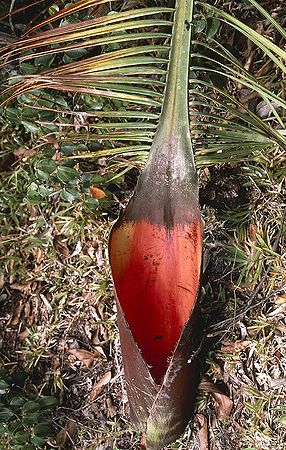
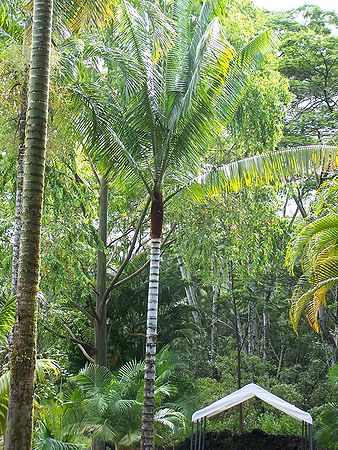
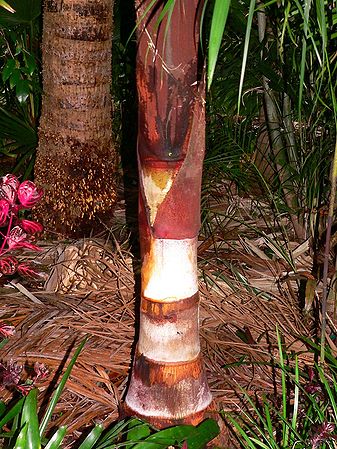
This is one of the more elegant and colorful Dypsis, and is now widespread in cultivation. With it's large stature and fuzzy bright red crownshaft, it stands out in any setting. In the past Dypsis lastelliana, the "Redneck Palm, " was often confused with Dypsis lepthocheilos, the "Teddy Bear Palm." This confusion was engrained and still persists somewhat today. D. lastelliana can be differentiated from D. leptocheilos by its larger, slightly open, redder crownshaft, more "shuttlecock" leaf arrangement, and overall as a more robust palm in habitat and cultivation. D. leptocheilos differs in having an orangish, more slender crownshaft, with leafs that tend to more horizontal. Once an observer recognizes these differences, identification becomes much easier, and almost certain in most instances.
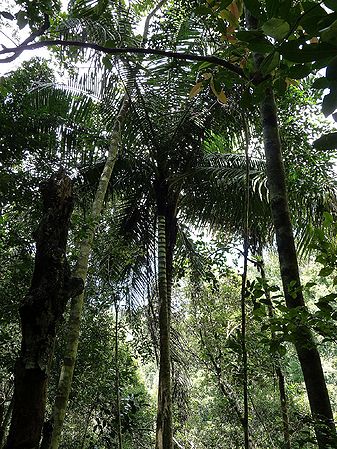
Interestingly enough, some photos from habitat show a palm with fronds tending well below the horizontal, while most palms in cultivation are oftentimes extremely "shuttlecock." Perhaps this is explained by the variability often seen in Dypsis species. A form with striking persistent white streaks in the petiole is in cultivation and can be seen in the photos below,
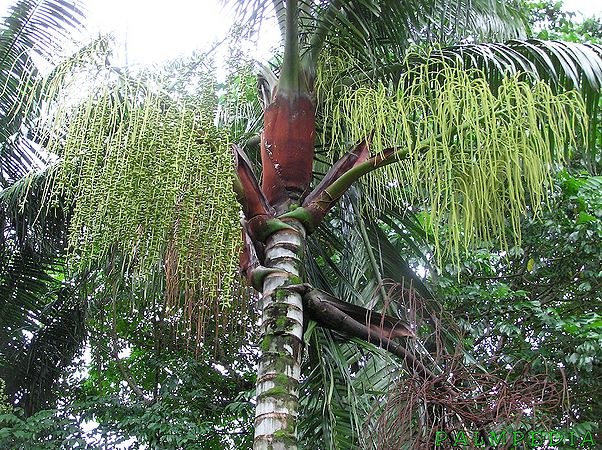
A solitary palm. TRUNK 5-15 m tall, 18-25 cm in diam., with swollen base; wood hard; internodes 8-10 cm, pale green to grey waxy green, nodal scars c. 4 cm, pale brown; crownshaft 70-75 cm tall, rich velvet red-brown. LEAVES 9-15 in the crown, spirally inserted; sheath 40- 60 cm long, partially open, adaxially brilliant cherry-red, abaxially densely red-brown pubescent; petiole 0-10 cm long, proximally to 11 x 3.5 cm, distally about 6 x 3.7 cm, channelled; rachis yellowish, to 3.8 m long, in mid-leaf 1.2-2.2 x 1.5-1.6 cm in diam. and here either channelled or keeled, glabrous, sometimes waxy; leaflets (50 -) 94-102 on each side of the rachis, regular, somewhat pendulous, the proximal 39-66 x 0.7-2 cm, median 56-89 x 2.4-4.3 cm, distal 18-54 x 0.4-2.3 cm, with a few tufts of laciniate ramenta on the proximal part of the abaxial midrib, but otherwise glabrous, main veins 1, prominent adaxially, as well as margins thickened, apices bifid and acute. INFLORESCENCE interfoliar, branched to 3 orders, spreading, 1.3-2.2 x 1.2 m; peduncle 60-96 cm long, distally 2.5-3.2 x 1.7-1.5 cm; prophyll 30-52 x 6.5- 11 cm, borne at 3-13 cm above the base of the peduncle, rusty pubescent; peduncular bract deciduous, inserted at about 30 cm from the base of the peduncle, 80-110 cm long, about 12 cm wide when flat, splitting along its length but for the upper about 28 cm, with a beak of up to 7 cm long, densely reddish pubescent; rachis about 97 cm long, yellow-green, sometimes tinged red, with 13-17 branched and about 10 unbranched first order branches, the proximal of these with a rachis 2.5-3.5 x 1-1.3 cm in diam. at the base, to 45 cm long, and with up to 15 second order branches; rachis bracts up to 3 cm long, triangular and acute; rachillae pale or yellow-green, 27-47 cm long, 3-6 mm in diam., glabrous, with dense, slightly sunken triads.| read more |
|---|
| STAMINATE FLOWERS only known from rather young buds, with sepals 2-2.3 x 1.4-2.3 mm, keeled, slightly gibbous, concave, with membranous wings, truncate or nearly so; receptacle 0.2-0.6 mm high; petals 1.7-2.7 x 1.3-1.6 mm, ovate, acute; stamens 6, very slightly biseriate, the antepetalous stamens inserted slightly higher up, filaments 0.5-0.6 mm and thin-cylindrical, anthers 1.3-1.6 x 0.5-0.7 mm, the locules parallel and obtuse; pistillode about 2.2 x 0.6 mm. PISTILLATE FLOWERS with sepals 1.7-2.4 x 2.2-2.6 mm; petals 2.4-2.8 x 1.8-2.4 mm; staminodes about 0.5-0.6 mm high; gynoecium about 2.5 x 1 mm. FRUIT obovoid with a narrowed base, slightly asymmetrical, 18-24 x 12-17 mm, with obtuse apex; endocarp fibrous, with anastomosing fibres. SEED 12-21 x 10.5-16 mm, the base apiculate with a small depression just above the apiculus, this corresponding to the position of the embryo, the apex rounded; endosperm deeply ruminate, the intrusions many and 2-4 mm deep. SEEDLING with two scale leaves, the distal one densely scaly; eophyll pinnate, with petiole scaly with reddish and silvery scales; leaflets of eophyll 4-6 on each side of the rachis. (J. Dransfield and H. Beentje. 1995)/Palmweb. Editing by edric.
The type consists of a partial inflorescence with staminate and pistillate buds, but there is no doubt that it is conspecific with the other cited material; Miller & Randrianasolo 4491 is at the same stage of development and is an almost exact match. Baillon mentions another de Lastellé specimen in the protologue, this one with fruits, and states this probably belongs to another species. The fruit has homogeneous endosperm. Beccari (1906, l.c.) describes the proper fruit of D. lastelliana from a Baron collection, and identified the fruiting specimen of de Lastellé as Chrysalidocarpus piluliferus (= D. pilulifera). (J. Dransfield and H. Beentje. 1995)/Palmweb. |
Culture
This species likes a rich soil with regular fertilizer and watering, intolerant of any frost. But grows well in warmer months in 4 C to 40 C. Grows best above 18 C. An easily grown palm in the tropics which likes full sun/light shade, and a moist, well drained position. Cold Hardiness Zone: 10b

Comments and Curiosities
Despite its robust growth habit in the tropics and sub-tropics, it has proven not as adaptable in the more temperate climates and languishes in comparison to its oft confused brethren, Dypsis leptocheilos. The name derives from the collector of the type, de Lastellé.
Conservation: Not threatened. Seems to be fairly widespread, over a wide altitude range. (J. Dransfield and H. Beentje. 1995)/Palmweb.
Uses: Pith formerly used to make salt; palm-heart bitter, inedible, said to be poisonous by the Sakalava and Tsimihety. (J. Dransfield and H. Beentje. 1995)/Palmweb.
D. lastelliana, the Red Neck Palm, is popular for its fuzzy, rusty-red crownshaft. A solitary species endemic to the northern end of Madagascar, it reaches 16 to 49 ft. high, with a trunk diameter of 7 to 10 in. Its pendulous leaflets are arrayed in a regular pattern along the rachis. A particularly striking ornamental use is to plant it out in groups of three or more specimens. D. lastelliana favors warm, moist conditions. The similar-looking Teddy Bear Palm, D. leptocheilos, prefers a cooler, drier climate, and accordingly grows better in southern California than in our region. The IUCN Red List conservation status of D. lastelliana is Least Concern, with a stable population trend. (fairchildgarden.org)
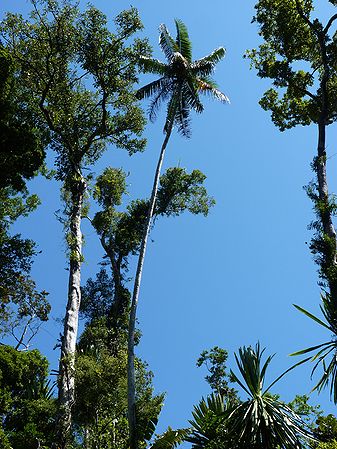
A fabulous, tall and slender palm from northern Madagascar, where it grows in rainforest or coastal forest. The Red Neck Palm has huge, pinnate leaves with pendulous leaflets and a dark red-brown to purple-black crownshaft. It has similarities to D. leptocheilos, the Teddy Bear Palm, but is generally taller and more elegant. D. lastelliana is easy to grow and best suited to warm subtropical and tropical regions. (RPS.com)
- IMAGE GALLERY

Antanambe, Madagascar. Photo by Dr. John Dransfield, Royal Botanic Gardens, Kew/Palmweb.

Mananara, Madagascar. Photo by Dr. John Dransfield, Royal Botanic Gardens, Kew/Palmweb.

Sahavary, Masoala, Madagascar. Photo by Dr. John Dransfield, Royal Botanic Gardens, Kew/Palmweb.
Maroansetra, Madagascar. Photo by Dr. John Dransfield, Royal Botanic Gardens, Kew/Palmweb.

Mananara, Madagascar. Photo by Dr. Romer Rabarijaona.
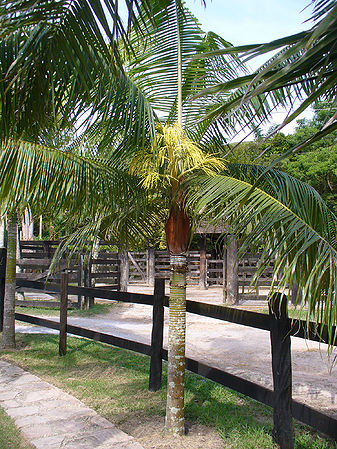
Photo by Dr. Scott Zona, Boa Esperanza ranch, Brazil.

Ho'omaluhia, Hawaii.

Hawaii.
Seed and Flowers.

Australia.

Hawaii.

Hawaii.


Dypsis lastelliana demonstrating that it's quite a robust palm, Ho'omaluhia, Hawaii.


Courtesy of Daryl O'Connor, Brisbane, Queensland.

Miami FL. Photo by Ryan D. Gallivan.

Miami FL. Photo by Ryan D. Gallivan.

Cairns, Australia, photo by Harry.

Mt Warning Caldera. Nth NSW Australia. Photo by Pete.
Hawaii, photo by Bill Austin.

Hawaii, photo by Bill Austin

Hawaii, photo by Bill Austin

Hawaii. Bill Austin's place. Photo by Paul Latzias.

Roma Street Parklands, Brisbane, Australia. Photo by Paul Latzias.

Roma Street Parklands, Brisbane, Australia. Dypsis ampasindavae on right. Photo by Paul Latzias.

Brisbane Botanic Gardens, Mount Coot-tha, Brisbane, Australia. Photo by Paul Latzias.

Brisbane Botanic Gardens, Mount Coot-tha, Brisbane, Australia. Photo by Paul Latzias.
Andersen Garden, Hawaii, photo by Paul Craft.

Andersen Garden, Hawaii, photo by Paul Craft.

QLD. Austalia, photo by David Tanswell.

Madagascar. Photo by Rolf Kyburz.

Queensland, Australia. Photo by Clayton York, Utopia Palms & Cycads.

Queensland, Australia. Photo by Clayton York, Utopia Palms & Cycads.

Queensland, Australia. Photo by Clayton York, Utopia Palms & Cycads.

QLD. Australia. Photo by Utopia Palms & Cycads.

QLD. Australia. Photo by Utopia Palms & Cycads.

Sunshine coast, Queensland, Australia. Leo Gamble's place. Photo by Paul Latzias.

Royal Botanic Gardens Sydney, New South Wales, Australia. Troy giving scale. Photo by Wal.

Gold Coast Hinterland, Queensland. Photo by Daryl O'Connor.
Pigafetta elata in background, Gold Coast Hinterland, Queensland. Photo by Daryl O'Connor.

Wollongong Botanical Gardens Palm Collection, 90 minute drive south of Sydney. Photo by Daryl O'Connor.

At Daryl O'Connors, Gold Coast Hinterland, Queensland Australia. Photo by Wal.

Ambodiriana reserve - Manompana, Madagascar. "Photo by Olivier Reilhes".
Ambodiriana reserve - Manompana, Madagascar. "Photo by Olivier Reilhes".
Ambodiriana reserve - Manompana, Madagascar. "Photo by Olivier Reilhes".

Analalava reserve - Foulpointe, Madagascar. "Photo by Olivier Reilhes".

Analalava reserve - Foulpointe, Madagascar. "Photo by Olivier Reilhes".

Analalava reserve - Foulpointe, Madagascar. "Photo by Olivier Reilhes".

Analalava reserve - Foulpointe, Madagascar. "Photo by Olivier Reilhes".
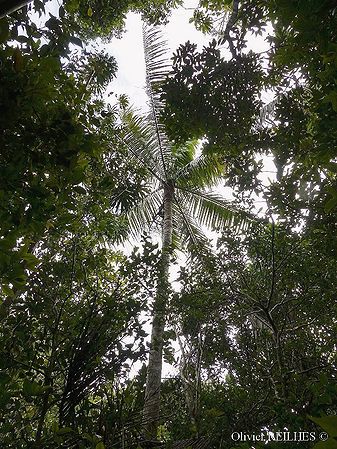
Farankaraina - Masoala - East Coast of Madagascar. Photo by "Olivier Reilhes".
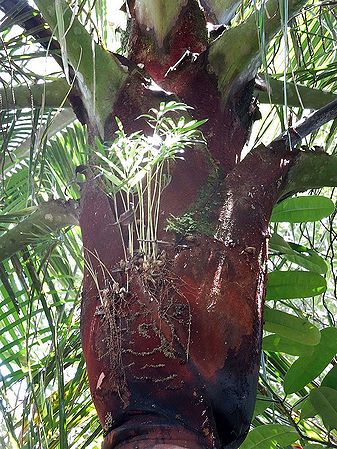
IPS Direstor Cindy Adair, visits the Satranala reserve, Madagascar. Photo by Cindy Adair.

IPS Direstor Cindy Adair, visits the Satranala reserve, Madagascar. Photo by Cindy Adair.

Gold Coast, Queensland, Australia. In ground 1997. Photo by Steven.

Gold Coast, Queensland, Australia. In ground 1997. Photo by Steven.

Gold Coast, Queensland, Australia. In ground 1997. Photo by Steven.

Gold Coast, Queensland, Australia. In ground 1997. Photo by Steven.

In Thabit's garden: Sri Lanka. Photo by Philippe.

In Thabit's garden: Sri Lanka. Photo by Philippe.
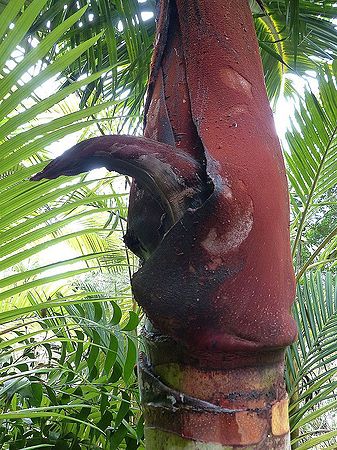
In Thabit's garden: Sri Lanka. Photo by Philippe.
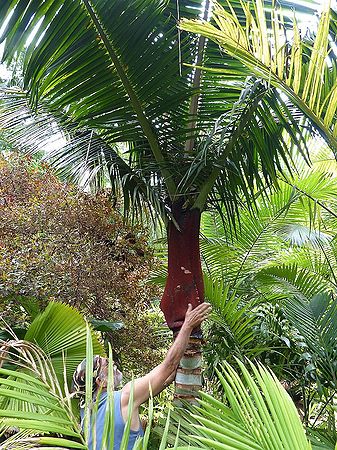
In Thabit's garden: Sri Lanka. Philippe giving scale. Photo by Philippe.

In habitat. Photo-Rare Palm Seeds.com


External Links
- Glossary of Palm Terms
- MODERN BOTANICAL LATIN
- "Just To Be Clear"
- http://www.cites.org/common/com/pc/20/inf%20docs/F20-11i-A6.pdf
References
Phonetic spelling of Latin names by edric. Edit by João Santos Costa
Special thanks to Geoff Stein, (Palmbob) for his hundreds of photos.
Special thanks to Palmweb.org, Dr. John Dransfield, Dr. Bill Baker & team, for their volumes of information and photos.
Glossary of Palm Terms; Based on the glossary in Dransfield, J., N.W. Uhl, C.B. Asmussen-Lange, W.J. Baker, M.M. Harley & C.E. Lewis. 2008. Genera Palmarum - Evolution and Classification of the Palms. Royal Botanic Gardens, Kew. All images copyright of the artists and photographers (see images for credits).
Dransfield, J. & Beentje, H. 1995. The Palms of Madagascar. Royal Botanic Gardens, Kew and The International Palm Society.
Many Special Thanks to Ed Vaile for his long hours of tireless editing and numerous contributions.