Difference between revisions of "Chrysalidocarpus decipiens"
| (38 intermediate revisions by 3 users not shown) | |||
| Line 1: | Line 1: | ||
| − | + | <big>__noeditsection__ | |
| − | __noeditsection__ | + | "Manambe Palm"</big> |
| − | + | ||
{{Palmbox | {{Palmbox | ||
| − | |image= | + | |image=dypsis-decipiens-itremo-2.jpg |
| − | |image_caption= | + | |image_caption=Itremo Commune, Ambatofinandrahana District, Amoron'i Mania Region, Fianarantsoa Province, Madagascar. Photo by Dr. Mijoro Rakotoarinivo/Kew. |
| − | |genus= | + | |genus=Chrysalidocarpus |
|species=<br>decipiens (deh-sip-EE-enz) | |species=<br>decipiens (deh-sip-EE-enz) | ||
|subspecies= | |subspecies= | ||
| Line 22: | Line 21: | ||
}} | }} | ||
==Habitat and Distribution== | ==Habitat and Distribution== | ||
| − | Endemic to Central Madagascar, between Ankazobe and Fianarantsoa. Plateau forest (remnants), either near streams or in rocky sites; alt. 1400-2000 m. | + | Endemic to Central Madagascar, between Ankazobe and Fianarantsoa. [[Image:P1010291 Dypsis decipiens,north of Fianarantosa.JPG|thumb|left|400px|Habitat, North of Fianarantosa.]]Plateau forest (remnants), either near streams or in rocky sites; alt. 1400-2000 m. |
==Desciption== | ==Desciption== | ||
| − | This imposing palm has such a presence, that a habitat photo commanded the back cover for "The Palms of Madagascar" by John Dransfield and Henk Beentje. Because this palm has been in cultivation for some time now, several forms have been observed ranging from slighly to very plumose irregular pinnae, always tough and rigid to the touch. Several color variations have also been grown ranging from all green to reddish, with many different hues in the developing spear. It can be solitary or frequently double in its native environment. However, in cultivation it has been seen with as many as seven stems before trunking. | + | This imposing palm has such a presence, that a habitat photo commanded the back cover for "The Palms of Madagascar" by John Dransfield and Henk Beentje. Because this palm has been in cultivation for some time now, several forms have been observed ranging from slighly to very plumose irregular pinnae, always tough and rigid to the touch. Several color variations have also been grown ranging from all green to reddish, with many different hues in the developing spear. It can be solitary or frequently double in its native environment. However, in cultivation it has been seen with as many as seven stems before trunking. As more and more palms spread through cultivated gardens from many different and diverse seed sources, more palms, that appear to be related or in this complex, are appearing. Including a strikingly beautiful blue form, that so far has demonstrated a peculiarity to remain solitary. As one of the first palms from Madagascar to be introduced, and because of its reputation as one of the most cold hardy pinnate palms in the world, many mature specimens are now growing outside of its natural habitat despite its slow growth rate. |
| − | Imposing and handsome, often clustering palm, sometimes appearing solitary, but more often doubling or tripling, with younger shoots at the base. TRUNK 6-20 m high, ventricose; 50-70 cm in diam., at the very base 30-40 cm in diam., near the crown 25-30 cm diam.; internodes 4-5 cm long, grey, more distally shiny green, nodal scars about 2 cm high, grey-brown; crownshaft pale waxy-grey-green. LEAVES 9-12 in the crown, spirally inserted, porrect; sheath c. 70 cm long, pale green with waxy white bloom, adaxially dark chestnut red-brown, one third to half open in the oldest leaf, with brown ligules where the sheath margin makes a right angle towards the base of the petiole, with waxy scales or glabrous; petiole 10-25 cm long, proximally about 11 x 5 cm, distally about 7 x 5 cm in diam., deeply channelled with sharp edges; rachis about 2.2 m long, channelled proximally, in mid-leaf 3-4 x 2-2.7 cm in diam. and keeled, with whitish tomentum or glabrous; leaflets about 90 on each side of the rachis, in groups of 2-6, fanned within the groups giving the leaf a plumose appearance (though almost in one plane in very young trees), stiff with only the apices bending over, the proximal 70-94 x 1.3-1.7 cm (the most proximal often very long, narrow and pendulous), median 73-101 x 2.8-4.3 cm, distal 26-42 x 0.8-1.2 cm, in mid-leaf interval < 0.5-1 cm, the interval between the groups 3-8 cm, main veins 1, the other veins faint, apices attenuate and unequally bifid, with sparse large (1 cm) red-brown ramenta on the proximal midrib, and many small scattered reddish scales on the fainter veins. INFLORESCENCE infrafoliar, strongly curved, branched to 2 orders, about 110 x 65 cm; peduncle 15-17 cm long, 9-10 x 4-6 cm in diam.; prophyll 39-41 x about 10 cm, borne at 6-6.5 cm above the base of the peduncle, split abaxially, but distally with a small horizontal adaxial split, dark brown, ± glabrous; peduncular bract insertion point uncertain, quickly deciduous, 42- 58 x 12-16 cm, opening over its whole length except for the beaked apex 5-6 cm long, pale waxy brown with scattered scales; rachis about 60 cm, greyish white, glabrous, with about 13 branched and 18 unbranched first order branches, the more proximal of these with flattened bases to 4.7 x 1.3 cm in diam.; rachis bracts about 9 mm high; rachillae 7-40 cm long, 3.5-7 mm in diam., with distant triads in pits; rachilla bracts 2.5-3 x 3.5 mm, acute. STAMINATE FLOWERS with sepals 2-4 x 1.8-2.5 mm, concave, keeled, gibbous, with membranous margins, apiculate; petals connate for 1.3-1.6 mm, the free lobes 3.8-5.6 x 2.3-3.7 mm, ovate, acute to obtuse; stamens 6, in 1 series, the filaments (2-) 3.2-5 mm long and connate at base for 0.3 mm, anthers 2.3-2.8 x 0.8-1.4 mm, dorsifixed, versatile; pistillode columnar, 1.9-2.7 x 0.7-1.5 mm. PISTILLATE FLOWERS with sepals 5.1-6.3 x 3.5-5 mm, concave, orbicular, with small hooded tip; petals resembling the sepals, 4-5.3 x 3- 3.8 mm, concave, ovate, with small apiculus, staminodes 0.3-0.5 mm, dentiform; ovary 3.5-4.3 mm high, 1.5-2 mm in diam. FRUIT broadly ellipsoid or almost globose, colour unknown, 22-25 x 20-22 mm; endocarp very fibrous with long anastomosing fibres. SEED 10-20 x 11.5-18mm, with rounded base and apex; endosperm homogeneous. (J. Dransfield and H. Beentje. 1995)/Palmweb | + | Imposing and handsome, often clustering palm, sometimes appearing solitary, but more often doubling or tripling, with younger shoots at the base. TRUNK 6-20 m high, ventricose; 50-70 cm in diam., at the very base 30-40 cm in diam., near the crown 25-30 cm diam.; internodes 4-5 cm long, grey, more distally shiny green, nodal scars about 2 cm high, grey-brown; crownshaft pale waxy-grey-green. LEAVES 9-12 in the crown, spirally inserted, porrect; sheath c. 70 cm long, pale green with waxy white bloom, adaxially dark chestnut red-brown, one third to half open in the oldest leaf, with brown ligules where the sheath margin makes a right angle towards the base of the petiole, with waxy scales or glabrous; petiole 10-25 cm long, proximally about 11 x 5 cm, distally about 7 x 5 cm in diam., deeply channelled with sharp edges; rachis about 2.2 m long, channelled proximally, in mid-leaf 3-4 x 2-2.7 cm in diam. and keeled, with whitish tomentum or glabrous; leaflets about 90 on each side of the rachis, in groups of 2-6, fanned within the groups giving the leaf a plumose appearance (though almost in one plane in very young trees), stiff with only the apices bending over, the proximal 70-94 x 1.3-1.7 cm (the most proximal often very long, narrow and pendulous), median 73-101 x 2.8-4.3 cm, distal 26-42 x 0.8-1.2 cm, in mid-leaf interval < 0.5-1 cm, the interval between the groups 3-8 cm, main veins 1, the other veins faint, apices attenuate and unequally bifid, with sparse large (1 cm) red-brown ramenta on the proximal midrib, and many small scattered reddish scales on the fainter veins. INFLORESCENCE infrafoliar, strongly curved, branched to 2 orders, about 110 x 65 cm; peduncle 15-17 cm long, 9-10 x 4-6 cm in diam.; prophyll 39-41 x about 10 cm, borne at 6-6.5 cm above the base of the peduncle, split abaxially, but distally with a small horizontal adaxial split, dark brown, ± glabrous; peduncular bract insertion point uncertain, quickly deciduous, 42- 58 x 12-16 cm, opening over its whole length except for the beaked apex 5-6 cm long, pale waxy brown with scattered scales; rachis about 60 cm, greyish white, glabrous, with about 13 branched and 18 unbranched first order branches, the more proximal of these with flattened bases to 4.7 x 1.3 cm in diam.; rachis bracts about 9 mm high; rachillae 7-40 cm long, 3.5-7 mm in diam., with distant triads in pits; rachilla bracts 2.5-3 x 3.5 mm, acute. STAMINATE FLOWERS with sepals 2-4 x 1.8-2.5 mm, concave, keeled, gibbous, with membranous margins, apiculate; petals connate for 1.3-1.6 mm, the free lobes 3.8-5.6 x 2.3-3.7 mm, ovate, acute to obtuse; stamens 6, in 1 series, the filaments (2-) 3.2-5 mm long and connate at base for 0.3 mm, anthers 2.3-2.8 x 0.8-1.4 mm, dorsifixed, versatile; pistillode columnar, 1.9-2.7 x 0.7-1.5 mm. PISTILLATE FLOWERS with sepals 5.1-6.3 x 3.5-5 mm, concave, orbicular, with small hooded tip; petals resembling the sepals, 4-5.3 x 3- 3.8 mm, concave, ovate, with small apiculus, staminodes 0.3-0.5 mm, dentiform; ovary 3.5-4.3 mm high, 1.5-2 mm in diam. FRUIT broadly ellipsoid or almost globose, colour unknown, 22-25 x 20-22 mm; endocarp very fibrous with long anastomosing fibres. SEED 10-20 x 11.5-18mm, with rounded base and apex; endosperm homogeneous. (J. Dransfield and H. Beentje. 1995)/Palmweb. |
Beccari established the new genus Macrophloga based on two different taxa: his own Chrysalidocarpus decipiens, and Neodypsis basilongus based on a Perrier specimen (no. 12088) with seed showing ruminate endosperm. True Chrysalidocarpus decipiens has homogeneous endosperm. The combination Neodypsis decipiens (Becc.) Jumelle & Perrier existed only in Beccari's imagination; Jumelle & Perrier (1913) mentioned the possibility but specifically refrained from making it. HB has seen bees visiting the flowers of a cultivated specimen in Antananarivo. (J. Dransfield and H. Beentje. 1995)/Palmweb. | Beccari established the new genus Macrophloga based on two different taxa: his own Chrysalidocarpus decipiens, and Neodypsis basilongus based on a Perrier specimen (no. 12088) with seed showing ruminate endosperm. True Chrysalidocarpus decipiens has homogeneous endosperm. The combination Neodypsis decipiens (Becc.) Jumelle & Perrier existed only in Beccari's imagination; Jumelle & Perrier (1913) mentioned the possibility but specifically refrained from making it. HB has seen bees visiting the flowers of a cultivated specimen in Antananarivo. (J. Dransfield and H. Beentje. 1995)/Palmweb. | ||
| + | |||
==Culture== | ==Culture== | ||
| − | ''D. decipiens'' may be the most cold hardy palm of Madagascar. There are reports of a young plant surviving 22 degrees F/-5. | + | ''D. decipiens'' may be the most cold hardy palm of Madagascar. There are reports of a young plant surviving 22 degrees F/-5.55 C unscathed. It is also tolerant, and probably prefers full hot sun with cool nights. Because it grows in an open well drained soil, in an area with an extended dry season, a constantly wet climate does not appear to be to its liking, except in areas where the soil is extremely well draining. Young plants seem especially susceptible to rotting in a potting mix and climate that does not allow periods of drying. |
| + | <center> | ||
| + | [[{{PFC}}http://www.palmpedia.net/palmsforcal/index.php5/Dypsis_decipiens]] | ||
| + | </center> | ||
==Comments and Curiosities== | ==Comments and Curiosities== | ||
One of the most imposing palms of the island, but that may have something to do with its occurring in the austere surroundings of the Central Plateau, where it stands out dramatically. This makes a wonderful ornamental, able to withstand some cold (though not freezing) and periods of dry weather. The species name means 'deceiving', indicating that it closely resembles something else; in this case, it is a particularly inappropriate name! (J. Dransfield and H. Beentje. 1995)/Palmweb. | One of the most imposing palms of the island, but that may have something to do with its occurring in the austere surroundings of the Central Plateau, where it stands out dramatically. This makes a wonderful ornamental, able to withstand some cold (though not freezing) and periods of dry weather. The species name means 'deceiving', indicating that it closely resembles something else; in this case, it is a particularly inappropriate name! (J. Dransfield and H. Beentje. 1995)/Palmweb. | ||
| Line 38: | Line 41: | ||
Uses: Good palm heart; leaves used for erosion control (Betsileo). | Uses: Good palm heart; leaves used for erosion control (Betsileo). | ||
| − | This palm is one of a few palms of Madagascar which exhibits a branching habit that may be unique to the palms of Madagascar. The stem splits below ground as a younger plant by extending a spear that apppears split down the middle. Over a period of years, this then develops into two separate trunks. If anyone knows of another palm, from outside Madagascar, that exhibits this same habit (exclusively below ground), | + | This palm is one of a few palms of Madagascar which exhibits a branching habit that may be unique to the palms of Madagascar. The stem splits below ground as a younger plant by extending a spear that apppears split down the middle. Over a period of years, this then develops into two separate trunks. If anyone knows of another palm, from outside Madagascar, that exhibits this same habit (exclusively below ground), we would love to be informed. |
| − | This large and truly spectacular palm comes from the dry highlands of central Madagacar. With its leathery, blue green, plumose leaves; tall, pale crownshaft; and smooth, cigar-shaped, gray trunk, it is reminiscent of a Royal Palm (Roystonea). Dypsis decipiens grows to altitudes of 2000 m (6700 ft.) and is one of the most cold tolerant palms from Madagascar. It requires a temperate or subtropical climate and will survive quite heavy frosts. (RPS.com) | + | This large and truly spectacular palm comes from the dry highlands of central Madagacar. With its leathery, blue green, plumose leaves; tall, pale crownshaft; and smooth, cigar-shaped, gray trunk, it is reminiscent of a Royal Palm (Roystonea). Dypsis decipiens grows to altitudes of 2000 m (6700 ft.) and is one of the most cold tolerant palms from Madagascar. It requires a temperate or subtropical climate and will survive quite heavy frosts. (RPS.com) |
This is a tillering palm, it exhibits saxophone style root growth (it has a heel), keep top third of heel above soil elevation! | This is a tillering palm, it exhibits saxophone style root growth (it has a heel), keep top third of heel above soil elevation! | ||
| − | |||
| − | |||
| − | |||
| − | |||
| − | |||
| − | |||
| − | |||
| − | |||
| − | |||
| − | + | <br clear="all"> | |
| − | + | {{#Widget:AdResban}} | |
| − | + | <center><gallery caption="IMAGE GALLERY" perrow="" widths="" heights=""> | |
| − | + | ||
| − | + | ||
| − | + | ||
| − | + | ||
| − | + | ||
| − | <center><gallery caption="IMAGE GALLERY" perrow=" | + | |
Image:Dyp decip ov2.jpg|In Habitat - Gary Le Vine for Scale. | Image:Dyp decip ov2.jpg|In Habitat - Gary Le Vine for Scale. | ||
| + | File:post-151-0-61420300-1428631950.jpg|Gary's DD flowers for the first time. Photo by Gary T. Le Vine. | ||
Image:DDD1.JPG|Margaret Kraa's D.decipiens in Brisbane - Mike Green for scale - Photo: Daryl O'Connnor. | Image:DDD1.JPG|Margaret Kraa's D.decipiens in Brisbane - Mike Green for scale - Photo: Daryl O'Connnor. | ||
Image:DDD2.JPG|Garden of Margaret Kraa, Brisbane - Photo: Daryl O'Connnor. | Image:DDD2.JPG|Garden of Margaret Kraa, Brisbane - Photo: Daryl O'Connnor. | ||
| − | image:DdDSC_5375.jpg|Roma Street Parklands, in central Brisbane, Australia. Photo by Daryl O'connor | + | image:DdDSC_5375.jpg|Roma Street Parklands, in central Brisbane, Australia. Photo by Daryl O'connor |
Image:Dypdec2.jpg|Floribunda Palms, Hawaii. | Image:Dypdec2.jpg|Floribunda Palms, Hawaii. | ||
Image:Dypdec3.jpg|Floribunda Palms, Hawaii, Jeff Marcus for scale. | Image:Dypdec3.jpg|Floribunda Palms, Hawaii, Jeff Marcus for scale. | ||
Image:Dypdec1.jpg|Floribunda Palms, Hawaii. | Image:Dypdec1.jpg|Floribunda Palms, Hawaii. | ||
| − | image:F120614r2.JPG|Floribunda Palms, Hawaii, var. 'blue', photo by BGL | + | image:F120614r2.JPG|Floribunda Palms, Hawaii, var. 'blue', photo by BGL |
| − | image:F120614r3.JPG|Floribunda Palms, Hawaii, var. 'blue', photo by BGL, | + | image:F120614r3.JPG|Floribunda Palms, Hawaii, var. 'blue', photo by BGL |
| + | File:post-22-0-06121700-1420342121.jpg|Karolyn's garden in Leilani Estates, Hawaii. Photo by Bo-Göran Lundkvist. | ||
| + | File:post-22-0-09409200-1420342146.jpg|Karolyn's garden in Leilani Estates, Hawaii. Photo by Bo-Göran Lundkvist. | ||
| + | |||
Image:Dyp decip sc.jpg|California. | Image:Dyp decip sc.jpg|California. | ||
Image:P1010296 Dypsis decipiens,north of Fianarantosa.JPG|Habitat, North of Fianarantosa Jeff Marcus for Scale. | Image:P1010296 Dypsis decipiens,north of Fianarantosa.JPG|Habitat, North of Fianarantosa Jeff Marcus for Scale. | ||
| − | Image:P1010291 Dypsis decipiens,north of Fianarantosa.JPG|Habitat. | + | Image:P1010291 Dypsis decipiens,north of Fianarantosa.JPG|Habitat, North of Fianarantosa. |
| + | |||
Image:Dypsis decipiens tall.jpg|Ventura, California. | Image:Dypsis decipiens tall.jpg|Ventura, California. | ||
| − | + | ||
| − | + | Image:Ho'o23.jpg|Ho'omaluhia botanical garden, Oahu, Hawaii. | |
| − | + | Image:Ho'o40.jpg|Ho'omaluhia botanical garden, Oahu, Hawaii. | |
| − | Image:Ho' | + | |
| − | Image:Ho' | + | |
Image:Dypsis decipiens crownshaft.jpg|Ventura crownshaft. | Image:Dypsis decipiens crownshaft.jpg|Ventura crownshaft. | ||
| − | Image:Dyp decip | + | Image:Dyp decip eye.jpg|Hawaii. |
Image:Dypsis decipiens trunk with sucker.jpg|Still trying to sucker. | Image:Dypsis decipiens trunk with sucker.jpg|Still trying to sucker. | ||
Image:Dypsis decipiens trunk P.jpg|Ventura trunk. | Image:Dypsis decipiens trunk P.jpg|Ventura trunk. | ||
Image:Dypsis decipiens.jpg|Ho'omaluhia, Hawaii. | Image:Dypsis decipiens.jpg|Ho'omaluhia, Hawaii. | ||
| − | image:Dypsisdecipiens032.jpg|Modesto, CA. Photo by Jeff in Modesto | + | image:Dypsisdecipiens032.jpg|Modesto, CA. Photo by Jeff in Modesto |
File:post-3101-0-19412500-1370402614-10-2010.jpg|Fallbrook, CA. 10/2010 Photo by Jason Dunn. | File:post-3101-0-19412500-1370402614-10-2010.jpg|Fallbrook, CA. 10/2010 Photo by Jason Dunn. | ||
| − | + | File:post-3101-0-72159900-1370402640-2-2012.jpg|Fallbrook, CA. 2/2012 Photo by Jason Dunn. | |
| − | + | File:post-3101-0-92714200-1370402771-6-2013.jpg|Fallbrook, CA. 6/2013 Photo by Jason Dunn. | |
| − | + | File:post-3101-0-34783200-1370402825-6-2013.jpg|Fallbrook, CA. 6/2013 Photo by Jason Dunn. | |
| − | + | File:post-3101-0-25325700-1370402885-6-2013.jpg|Fallbrook, CA. 6/2013 Photo by Jason Dunn. | |
| − | + | File:post-3101-0-64508600-1370402949-6-2013.jpg|Fallbrook, CA. 6/2013 Photo by Jason Dunn. | |
| − | + | File:post-3101-0-30639400-1401470839-5-2014.jpg|Fallbrook, CA. 5/2014 Photo by Jason Dunn. | |
| − | + | File:post-3101-0-82066600-1401470853-5-2014.jpg|Fallbrook, CA. 5/2014 Photo by Jason Dunn. | |
| − | image:DdrsIMG_4571.jpg|Lens Monster Dypsis decipiens, with Rhopalostylis sapida on the left. At Len's place. Vista, CA. Photo by Troy Donovan | + | image:Dypsisdecipens1.jpg|Tonga apartments. Ventura CA. Photo by Troy Donovan |
| − | image:DdIMG_4691.jpg|At Gary Le Vines place. Escondito, CA. Photo by Troy Donovan | + | image:Dypsisdecipens2.jpg|Tonga apartments. Ventura CA. Photo by Troy Donovan |
| − | image:DdIMG_4648.jpg|At Gary Le Vines place. Escondito, CA. Photo by Troy Donovan | + | image:DdIMG_3837.jpg|Tonga apartments. Ventura CA. Photo by Troy Donovan |
| − | image:DdIMG_4906.jpg|Encinitas CA. At Dorian Ouer's place (Dean Ouer's old place). Photo by Troy Donavon | + | image:DdrsIMG_4571.jpg|Lens Monster Dypsis decipiens, with Rhopalostylis sapida on the left. At Len's place. Vista, CA. Photo by Troy Donovan |
| − | image:DdIMG_4894.jpg|Encinitas CA. At Dorian Ouer's place (Dean Ouer's old place). Photo by Troy Donavon | + | image:DdIMG_4691.jpg|At Gary Le Vines place. Escondito, CA. Photo by Troy Donovan |
| − | image:DdIMG_4895.jpg|Encinitas CA. At Dorian Ouer's place (Dean Ouer's old place). Photo by Troy Donavon, | + | image:DdIMG_4648.jpg|At Gary Le Vines place. Escondito, CA. Photo by Troy Donovan |
| − | image:-gallery-members- | + | image:DdIMG_4906.jpg|Encinitas CA. At Dorian Ouer's place (Dean Ouer's old place). Photo by Troy Donavon |
| + | image:DdIMG_4894.jpg|Encinitas CA. At Dorian Ouer's place (Dean Ouer's old place). Photo by Troy Donavon | ||
| + | image:DdIMG_4895.jpg|Encinitas CA. At Dorian Ouer's place (Dean Ouer's old place). Photo by Troy Donavon | ||
| + | File:ddIMG_7373.jpg|Old Beach, Tasmania. Garden of Troy Donovan. Photo by Troy Donovan. | ||
| + | File:ddIMG_7389.jpg|Old Beach, Tasmania. Garden of Troy Donovan. Photo by Troy Donovan. | ||
| + | |||
| + | image:-gallery-members-Dypsis_decipiens_craft.jpg|Ho'omaluhia botanical garden, Oahu Hawaii, photo by Paul Craft | ||
image:D decipiens11.jpg|Hawaii. | image:D decipiens11.jpg|Hawaii. | ||
| − | image:E8434308-1608-4c96-bac8- | + | File:dypsis-decipiens-itremo-2.jpg|Itremo Commune, Ambatofinandrahana District, Amoron'i Mania Region, Fianarantsoa Province, Madagascar. Photo by Dr. Mijoro Rakotoarinivo/Kew. |
| − | image:8cb41d77-3eb6-4fa3-be41- | + | File:dypsis-decipiens-itremo.jpg|Itremo Commune, Ambatofinandrahana District, Amoron'i Mania Region, Fianarantsoa Province, Madagascar. Photo by Dr. Mijoro Rakotoarinivo/Kew. |
| − | image:8f95d93f-b8c4-4c4b-a3e9- | + | image:E8434308-1608-4c96-bac8-ee5c9f9993e1.jpg|Near Ambositra, Madagascar. Photo by Dr. John Dransfield, Royal Botanic Gardens, Kew/Palmweb. |
| − | image:A6abb247-2a99-4832-adf3- | + | image:8cb41d77-3eb6-4fa3-be41-4909418d464e.jpg|Madagascar. Photo by Dr. David Du Puy/Palmweb. |
| − | image: | + | image:8f95d93f-b8c4-4c4b-a3e9-f1ab90d19d2c.jpg|South of Ambositra, Madagascar. Photo by Dr. John Dransfield, Royal Botanic Gardens, Kew/Palmweb. |
| − | image: | + | image:A6abb247-2a99-4832-adf3-c080d84bb8bd.jpg|Madagascar. Photo by Dr. M. Rakotoarinivo/Palmweb. |
| + | image:FLdecipiens1.jpg|Saint Augustine, FL. | ||
| + | image:70d91551.jpg|Saint Augustine, FL. | ||
image:Ambohitantely Ankazobe avril 08 054 1z.jpg|Madagascar. | image:Ambohitantely Ankazobe avril 08 054 1z.jpg|Madagascar. | ||
image:Ambohitantely Ankazobe avril 08 058 1z.jpg|Madagascar. | image:Ambohitantely Ankazobe avril 08 058 1z.jpg|Madagascar. | ||
| Line 114: | Line 113: | ||
image:Ambohitantely Ankazobe avril 08 063 1z.jpg|Madagascar. | image:Ambohitantely Ankazobe avril 08 063 1z.jpg|Madagascar. | ||
image:Ambohitantely Ankazobe avril 08 082 1z.jpg|Madagascar. | image:Ambohitantely Ankazobe avril 08 082 1z.jpg|Madagascar. | ||
| − | image: | + | image:GBPIX_photo_546843.jpg|Madagascar. "Photo by Olivier Reilhes" |
| − | image: | + | image:GBPIX_photo_546844.jpg|Madagascar. "Photo by Olivier Reilhes" |
| − | image:8102342863_09f5096f26_o.jpg|Ambohitantely Reserve, Madagascar. "Photo by Olivier Reilhes" | + | image:8102342863_09f5096f26_o.jpg|Ambohitantely Reserve, Madagascar. "Photo by Olivier Reilhes" |
| − | image:8102343267_3a4febe1b2_o.jpg|Ambohitantely Reserve, Madagascar. "Photo by Olivier Reilhes" | + | image:8102343267_3a4febe1b2_o.jpg|Ambohitantely Reserve, Madagascar. "Photo by Olivier Reilhes" |
| − | image:8102343457_e6805eb6fd_o.jpg|Ambohitantely Reserve, Madagascar. "Photo by Olivier Reilhes" | + | image:8102343457_e6805eb6fd_o.jpg|Ambohitantely Reserve, Madagascar. "Photo by Olivier Reilhes" |
| − | image:8102344311_f937a9cdb9_o.jpg|Ambohitantely Reserve, Madagascar. "Photo by Olivier Reilhes" | + | image:8102344311_f937a9cdb9_o.jpg|Ambohitantely Reserve, Madagascar. "Photo by Olivier Reilhes" |
| − | image:8102344519_78eba3392e_o.jpg|Ambohitantely Reserve, Madagascar. "Photo by Olivier Reilhes" | + | image:8102344519_78eba3392e_o.jpg|Ambohitantely Reserve, Madagascar. "Photo by Olivier Reilhes" |
| − | image:8102344691_eeb4dc9603_o.jpg|Ambohitantely Reserve, Madagascar. "Photo by Olivier Reilhes" | + | image:8102344691_eeb4dc9603_o.jpg|Ambohitantely Reserve, Madagascar. "Photo by Olivier Reilhes" |
| − | image:8102344829_9de4d6c73d_o.jpg|Ambohitantely Reserve, Madagascar. "Photo by Olivier Reilhes" | + | image:8102344829_9de4d6c73d_o.jpg|Ambohitantely Reserve, Madagascar. "Photo by Olivier Reilhes" |
| − | image:8102344993_47dd07640c_o.jpg|Ambohitantely Reserve, Madagascar. "Photo by Olivier Reilhes" | + | image:8102344993_47dd07640c_o.jpg|Ambohitantely Reserve, Madagascar. "Photo by Olivier Reilhes" |
| − | image:8102345613_5c4164f73e_o.jpg|Ambohitantely Reserve, Madagascar. "Photo by Olivier Reilhes" | + | image:8102345613_5c4164f73e_o.jpg|Ambohitantely Reserve, Madagascar. "Photo by Olivier Reilhes" |
| − | image:8102355638_9242ae8526_o.jpg|Ambohitantely Reserve, Madagascar. "Photo by Olivier Reilhes" | + | image:8102355638_9242ae8526_o.jpg|Ambohitantely Reserve, Madagascar. "Photo by Olivier Reilhes" |
| − | image:8102356126_4107a8c277_o.jpg|Ambohitantely Reserve, Madagascar. "Photo by Olivier Reilhes" | + | image:8102356126_4107a8c277_o.jpg|Ambohitantely Reserve, Madagascar. "Photo by Olivier Reilhes" |
| − | image:8102356274_ebb4eca1e5_o.jpg|Ambohitantely Reserve, Madagascar. "Photo by Olivier Reilhes" | + | image:8102356274_ebb4eca1e5_o.jpg|Ambohitantely Reserve, Madagascar. "Photo by Olivier Reilhes" |
| − | image:8102356430_2ac46eea41_o.jpg|Ambohitantely Reserve, Madagascar. "Photo by Olivier Reilhes" | + | image:8102356430_2ac46eea41_o.jpg|Ambohitantely Reserve, Madagascar. "Photo by Olivier Reilhes" |
| − | image:8102356614_3d7a836857_o.jpg|Ambohitantely Reserve, Madagascar. "Photo by Olivier Reilhes" | + | image:8102356614_3d7a836857_o.jpg|Ambohitantely Reserve, Madagascar. "Photo by Olivier Reilhes" |
| − | image:8102357556_e44c267151_o.jpg|Ambohitantely Reserve, Madagascar. "Photo by Olivier Reilhes" | + | image:8102357556_e44c267151_o.jpg|Ambohitantely Reserve, Madagascar. "Photo by Olivier Reilhes" |
| − | image:8102357904_b0a8769066_o.jpg|Ambohitantely Reserve, Madagascar. "Photo by Olivier Reilhes" | + | image:8102357904_b0a8769066_o.jpg|Ambohitantely Reserve, Madagascar. "Photo by Olivier Reilhes" |
| − | image:8102357710_6c25a5b13c_o.jpg|Ambohitantely Reserve, Madagascar. "Photo by Olivier Reilhes" | + | image:8102357710_6c25a5b13c_o.jpg|Ambohitantely Reserve, Madagascar. "Photo by Olivier Reilhes" |
| − | image:8102337505_b1e99f4308_o.jpg|Ambohitantely Reserve, Madagascar. "Photo by Olivier Reilhes" | + | image:8102337505_b1e99f4308_o.jpg|Ambohitantely Reserve, Madagascar. "Photo by Olivier Reilhes" |
| − | image:8102337635_4ea4d7096a_o.jpg|Ambohitantely Reserve, Madagascar. "Photo by Olivier Reilhes" | + | image:8102337635_4ea4d7096a_o.jpg|Ambohitantely Reserve, Madagascar. "Photo by Olivier Reilhes" |
| − | image:8102340127_8c38cb02a2_o.jpg|Ambohitantely Reserve, Madagascar. "Photo by Olivier Reilhes" | + | image:8102340127_8c38cb02a2_o.jpg|Ambohitantely Reserve, Madagascar. "Photo by Olivier Reilhes" |
| − | image:8102340615_4b390eb8bc_o.jpg|Ambohitantely Reserve, Madagascar. "Photo by Olivier Reilhes" | + | image:8102340615_4b390eb8bc_o.jpg|Ambohitantely Reserve, Madagascar. "Photo by Olivier Reilhes" |
| − | image:8102342349_7191cc408e_o.jpg|Ambohitantely Reserve, Madagascar. "Photo by Olivier Reilhes" | + | image:8102342349_7191cc408e_o.jpg|Ambohitantely Reserve, Madagascar. "Photo by Olivier Reilhes" |
| − | image:8102353538_16fcf92d1e_o.jpg|Ambohitantely Reserve, Madagascar. "Photo by Olivier Reilhes" | + | image:8102353538_16fcf92d1e_o.jpg|Ambohitantely Reserve, Madagascar. "Photo by Olivier Reilhes" |
| − | image:8102337863_1dd71a769d_oboth.jpg|Ambohitantely Reserve, Madagascar. D. oropedionis on left. "Photo by Olivier Reilhes" | + | image:8102337863_1dd71a769d_oboth.jpg|Ambohitantely Reserve, Madagascar. D. oropedionis on left. "Photo by Olivier Reilhes" |
| − | image:8102352596_9acfabce08_oboth.jpg|Ambohitantely Reserve, Madagascar. Thin stem palm in center D. oropedionis. "Photo by Olivier Reilhes" | + | image:8102352596_9acfabce08_oboth.jpg|Ambohitantely Reserve, Madagascar. Thin stem palm in center D. oropedionis. "Photo by Olivier Reilhes" |
| − | image:8102338073_80c4f96d10_oboth.jpg|Ambohitantely Reserve, Madagascar. D. oropedionis on left. "Photo by Olivier Reilhes" | + | image:8102338073_80c4f96d10_oboth.jpg|Ambohitantely Reserve, Madagascar. D. oropedionis on left. "Photo by Olivier Reilhes" |
| − | image:8102338703_4234951def_oboth.jpg|Ambohitantely Reserve, Madagascar. D. oropedionis on left. "Photo by Olivier Reilhes", | + | image:8102338703_4234951def_oboth.jpg|Ambohitantely Reserve, Madagascar. D. oropedionis on left. "Photo by Olivier Reilhes" |
| − | + | ||
| − | + | File:post-6412-0-80318400-1431582523.jpg|Some of the trees bound for Wollongong Botanical Gardens Palm Collection, 90 minute drive south of Sydney. Photo by Benjamin Smith. | |
| − | + | File:post-6412-0-90330100-1431582554.jpg|Some of the trees bound for Wollongong Botanical Gardens Palm Collection, 90 minute drive south of Sydney. Photo by Benjamin Smith. | |
| + | File:post-42-0-97360400-1431589208.jpg|The two on the truck as they appeared last November, before being dug up for the move to Wollongong Botanical Gardens. Mike Green giving scale. Photo by Daryl O'Connor. | ||
| + | |||
image:DypDeci.jpg|Photo-Rare Palm Seeds.com | image:DypDeci.jpg|Photo-Rare Palm Seeds.com | ||
image:DypDeci2.jpg|In habitat. Photo-Rare Palm Seeds.com | image:DypDeci2.jpg|In habitat. Photo-Rare Palm Seeds.com | ||
image:DypDeci_seeds.jpg|Photo-Rare Palm Seeds.com | image:DypDeci_seeds.jpg|Photo-Rare Palm Seeds.com | ||
</gallery></center> | </gallery></center> | ||
| + | ==External Links== | ||
| + | *[http://eunops.org/content/glossary-palm-terms Glossary of Palm Terms] | ||
| + | *[http://www.calflora.net/botanicalnames/pronunciation.html MODERN BOTANICAL LATIN] | ||
| + | *[http://www.jlhudsonseeds.net/Pronunciation.htm "Just To Be Clear"] | ||
| + | *[http://www.youtube.com/watch?v=buyFV3CLwbU&feature=player_embedded At Gary Le Vine's place. Video by Troy Donovan. Troy giving scale.] | ||
| + | *http://www.cites.org/common/com/pc/20/inf%20docs/F20-11i-A6.pdf | ||
| + | *[http://w3.biosci.utexas.edu/prc/Sabal/saxophone.html THE SAXOPHONE STYLE ROOT GROWTH (HEEL)] | ||
| + | ==References== | ||
| + | Phonetic spelling of Latin names by edric. | ||
| + | Edit by João Santos Costa | ||
| + | |||
| + | Special thanks to Geoff Stein, (Palmbob) for his hundreds of photos. | ||
| + | |||
| + | Special thanks to [http://palmweb.org/?q=node/2 Palmweb.org], Dr. John Dransfield, Dr. Bill Baker & team, for their volumes of information and photos. | ||
| + | |||
| + | Glossary of Palm Terms; Based on the glossary in Dransfield, J., N.W. Uhl, C.B. Asmussen-Lange, W.J. Baker, M.M. Harley & C.E. Lewis. 2008. Genera Palmarum - Evolution and Classification of the Palms. Royal Botanic Gardens, Kew. All images copyright of the artists and photographers (see images for credits). | ||
| + | |||
| + | Dransfield, J. & Beentje, H. 1995. The Palms of Madagascar. Royal Botanic Gardens, Kew and The International Palm Society. | ||
{{SpeciesListBackLink}} | {{SpeciesListBackLink}} | ||
[[Category:Palms of Madagascar]] | [[Category:Palms of Madagascar]] | ||
| − | [[Category: | + | [[Category:CHRYSALIDOCARPUS|decipiens]] |
Latest revision as of 11:05, 13 February 2023
"Manambe Palm"
| Chrysalidocarpus decipiens (deh-sip-EE-enz) | |||||||
|---|---|---|---|---|---|---|---|
 Itremo Commune, Ambatofinandrahana District, Amoron'i Mania Region, Fianarantsoa Province, Madagascar. Photo by Dr. Mijoro Rakotoarinivo/Kew. | |||||||
| Scientific Classification | |||||||
| |||||||
| Synonyms | |||||||
|
| |||||||
| Native Continent | |||||||
 | |||||||
| Morphology | |||||||
| |||||||
| Culture | |||||||
|
| |||||||
| Survivability index | |||||||
|
| |||||||
| Common names | |||||||
|
| |||||||
Contents
Habitat and Distribution
Endemic to Central Madagascar, between Ankazobe and Fianarantsoa.
Desciption
This imposing palm has such a presence, that a habitat photo commanded the back cover for "The Palms of Madagascar" by John Dransfield and Henk Beentje. Because this palm has been in cultivation for some time now, several forms have been observed ranging from slighly to very plumose irregular pinnae, always tough and rigid to the touch. Several color variations have also been grown ranging from all green to reddish, with many different hues in the developing spear. It can be solitary or frequently double in its native environment. However, in cultivation it has been seen with as many as seven stems before trunking. As more and more palms spread through cultivated gardens from many different and diverse seed sources, more palms, that appear to be related or in this complex, are appearing. Including a strikingly beautiful blue form, that so far has demonstrated a peculiarity to remain solitary. As one of the first palms from Madagascar to be introduced, and because of its reputation as one of the most cold hardy pinnate palms in the world, many mature specimens are now growing outside of its natural habitat despite its slow growth rate.
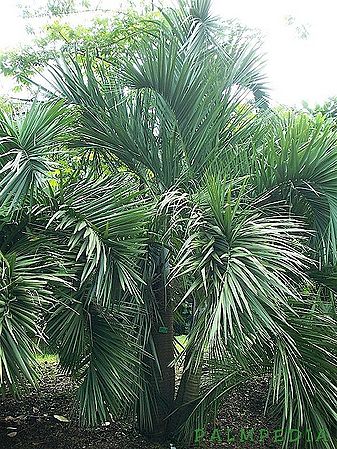
Imposing and handsome, often clustering palm, sometimes appearing solitary, but more often doubling or tripling, with younger shoots at the base. TRUNK 6-20 m high, ventricose; 50-70 cm in diam., at the very base 30-40 cm in diam., near the crown 25-30 cm diam.; internodes 4-5 cm long, grey, more distally shiny green, nodal scars about 2 cm high, grey-brown; crownshaft pale waxy-grey-green. LEAVES 9-12 in the crown, spirally inserted, porrect; sheath c. 70 cm long, pale green with waxy white bloom, adaxially dark chestnut red-brown, one third to half open in the oldest leaf, with brown ligules where the sheath margin makes a right angle towards the base of the petiole, with waxy scales or glabrous; petiole 10-25 cm long, proximally about 11 x 5 cm, distally about 7 x 5 cm in diam., deeply channelled with sharp edges; rachis about 2.2 m long, channelled proximally, in mid-leaf 3-4 x 2-2.7 cm in diam. and keeled, with whitish tomentum or glabrous; leaflets about 90 on each side of the rachis, in groups of 2-6, fanned within the groups giving the leaf a plumose appearance (though almost in one plane in very young trees), stiff with only the apices bending over, the proximal 70-94 x 1.3-1.7 cm (the most proximal often very long, narrow and pendulous), median 73-101 x 2.8-4.3 cm, distal 26-42 x 0.8-1.2 cm, in mid-leaf interval < 0.5-1 cm, the interval between the groups 3-8 cm, main veins 1, the other veins faint, apices attenuate and unequally bifid, with sparse large (1 cm) red-brown ramenta on the proximal midrib, and many small scattered reddish scales on the fainter veins. INFLORESCENCE infrafoliar, strongly curved, branched to 2 orders, about 110 x 65 cm; peduncle 15-17 cm long, 9-10 x 4-6 cm in diam.; prophyll 39-41 x about 10 cm, borne at 6-6.5 cm above the base of the peduncle, split abaxially, but distally with a small horizontal adaxial split, dark brown, ± glabrous; peduncular bract insertion point uncertain, quickly deciduous, 42- 58 x 12-16 cm, opening over its whole length except for the beaked apex 5-6 cm long, pale waxy brown with scattered scales; rachis about 60 cm, greyish white, glabrous, with about 13 branched and 18 unbranched first order branches, the more proximal of these with flattened bases to 4.7 x 1.3 cm in diam.; rachis bracts about 9 mm high; rachillae 7-40 cm long, 3.5-7 mm in diam., with distant triads in pits; rachilla bracts 2.5-3 x 3.5 mm, acute. STAMINATE FLOWERS with sepals 2-4 x 1.8-2.5 mm, concave, keeled, gibbous, with membranous margins, apiculate; petals connate for 1.3-1.6 mm, the free lobes 3.8-5.6 x 2.3-3.7 mm, ovate, acute to obtuse; stamens 6, in 1 series, the filaments (2-) 3.2-5 mm long and connate at base for 0.3 mm, anthers 2.3-2.8 x 0.8-1.4 mm, dorsifixed, versatile; pistillode columnar, 1.9-2.7 x 0.7-1.5 mm. PISTILLATE FLOWERS with sepals 5.1-6.3 x 3.5-5 mm, concave, orbicular, with small hooded tip; petals resembling the sepals, 4-5.3 x 3- 3.8 mm, concave, ovate, with small apiculus, staminodes 0.3-0.5 mm, dentiform; ovary 3.5-4.3 mm high, 1.5-2 mm in diam. FRUIT broadly ellipsoid or almost globose, colour unknown, 22-25 x 20-22 mm; endocarp very fibrous with long anastomosing fibres. SEED 10-20 x 11.5-18mm, with rounded base and apex; endosperm homogeneous. (J. Dransfield and H. Beentje. 1995)/Palmweb.
Beccari established the new genus Macrophloga based on two different taxa: his own Chrysalidocarpus decipiens, and Neodypsis basilongus based on a Perrier specimen (no. 12088) with seed showing ruminate endosperm. True Chrysalidocarpus decipiens has homogeneous endosperm. The combination Neodypsis decipiens (Becc.) Jumelle & Perrier existed only in Beccari's imagination; Jumelle & Perrier (1913) mentioned the possibility but specifically refrained from making it. HB has seen bees visiting the flowers of a cultivated specimen in Antananarivo. (J. Dransfield and H. Beentje. 1995)/Palmweb.
Culture
D. decipiens may be the most cold hardy palm of Madagascar. There are reports of a young plant surviving 22 degrees F/-5.55 C unscathed. It is also tolerant, and probably prefers full hot sun with cool nights. Because it grows in an open well drained soil, in an area with an extended dry season, a constantly wet climate does not appear to be to its liking, except in areas where the soil is extremely well draining. Young plants seem especially susceptible to rotting in a potting mix and climate that does not allow periods of drying.

Comments and Curiosities
One of the most imposing palms of the island, but that may have something to do with its occurring in the austere surroundings of the Central Plateau, where it stands out dramatically. This makes a wonderful ornamental, able to withstand some cold (though not freezing) and periods of dry weather. The species name means 'deceiving', indicating that it closely resembles something else; in this case, it is a particularly inappropriate name! (J. Dransfield and H. Beentje. 1995)/Palmweb.
Conservation: Endangered. The number of individuals in the wild is estimated at around two hundred; their distribution area is prone to destruction and fire. This species is listed in CITES Annexe II. (J. Dransfield and H. Beentje. 1995).
Uses: Good palm heart; leaves used for erosion control (Betsileo).
This palm is one of a few palms of Madagascar which exhibits a branching habit that may be unique to the palms of Madagascar. The stem splits below ground as a younger plant by extending a spear that apppears split down the middle. Over a period of years, this then develops into two separate trunks. If anyone knows of another palm, from outside Madagascar, that exhibits this same habit (exclusively below ground), we would love to be informed.
This large and truly spectacular palm comes from the dry highlands of central Madagacar. With its leathery, blue green, plumose leaves; tall, pale crownshaft; and smooth, cigar-shaped, gray trunk, it is reminiscent of a Royal Palm (Roystonea). Dypsis decipiens grows to altitudes of 2000 m (6700 ft.) and is one of the most cold tolerant palms from Madagascar. It requires a temperate or subtropical climate and will survive quite heavy frosts. (RPS.com)
This is a tillering palm, it exhibits saxophone style root growth (it has a heel), keep top third of heel above soil elevation!
- IMAGE GALLERY

In Habitat - Gary Le Vine for Scale.

Gary's DD flowers for the first time. Photo by Gary T. Le Vine.

Margaret Kraa's D.decipiens in Brisbane - Mike Green for scale - Photo: Daryl O'Connnor.

Garden of Margaret Kraa, Brisbane - Photo: Daryl O'Connnor.

Roma Street Parklands, in central Brisbane, Australia. Photo by Daryl O'connor

Floribunda Palms, Hawaii.

Floribunda Palms, Hawaii, Jeff Marcus for scale.

Floribunda Palms, Hawaii.

Floribunda Palms, Hawaii, var. 'blue', photo by BGL

Floribunda Palms, Hawaii, var. 'blue', photo by BGL

Karolyn's garden in Leilani Estates, Hawaii. Photo by Bo-Göran Lundkvist.

Karolyn's garden in Leilani Estates, Hawaii. Photo by Bo-Göran Lundkvist.

California.

Habitat, North of Fianarantosa Jeff Marcus for Scale.

Habitat, North of Fianarantosa.

Ventura, California.
Ho'omaluhia botanical garden, Oahu, Hawaii.

Ho'omaluhia botanical garden, Oahu, Hawaii.

Ventura crownshaft.

Hawaii.

Still trying to sucker.

Ventura trunk.

Ho'omaluhia, Hawaii.

Modesto, CA. Photo by Jeff in Modesto

Fallbrook, CA. 10/2010 Photo by Jason Dunn.

Fallbrook, CA. 2/2012 Photo by Jason Dunn.

Fallbrook, CA. 6/2013 Photo by Jason Dunn.

Fallbrook, CA. 6/2013 Photo by Jason Dunn.

Fallbrook, CA. 6/2013 Photo by Jason Dunn.

Fallbrook, CA. 6/2013 Photo by Jason Dunn.

Fallbrook, CA. 5/2014 Photo by Jason Dunn.

Fallbrook, CA. 5/2014 Photo by Jason Dunn.

Tonga apartments. Ventura CA. Photo by Troy Donovan

Tonga apartments. Ventura CA. Photo by Troy Donovan

Tonga apartments. Ventura CA. Photo by Troy Donovan

Lens Monster Dypsis decipiens, with Rhopalostylis sapida on the left. At Len's place. Vista, CA. Photo by Troy Donovan

At Gary Le Vines place. Escondito, CA. Photo by Troy Donovan

At Gary Le Vines place. Escondito, CA. Photo by Troy Donovan

Encinitas CA. At Dorian Ouer's place (Dean Ouer's old place). Photo by Troy Donavon

Encinitas CA. At Dorian Ouer's place (Dean Ouer's old place). Photo by Troy Donavon

Encinitas CA. At Dorian Ouer's place (Dean Ouer's old place). Photo by Troy Donavon

Old Beach, Tasmania. Garden of Troy Donovan. Photo by Troy Donovan.

Old Beach, Tasmania. Garden of Troy Donovan. Photo by Troy Donovan.

Ho'omaluhia botanical garden, Oahu Hawaii, photo by Paul Craft

Hawaii.

Itremo Commune, Ambatofinandrahana District, Amoron'i Mania Region, Fianarantsoa Province, Madagascar. Photo by Dr. Mijoro Rakotoarinivo/Kew.

Itremo Commune, Ambatofinandrahana District, Amoron'i Mania Region, Fianarantsoa Province, Madagascar. Photo by Dr. Mijoro Rakotoarinivo/Kew.

Near Ambositra, Madagascar. Photo by Dr. John Dransfield, Royal Botanic Gardens, Kew/Palmweb.

Madagascar. Photo by Dr. David Du Puy/Palmweb.

South of Ambositra, Madagascar. Photo by Dr. John Dransfield, Royal Botanic Gardens, Kew/Palmweb.

Madagascar. Photo by Dr. M. Rakotoarinivo/Palmweb.

Saint Augustine, FL.

Saint Augustine, FL.

Madagascar.

Madagascar.

Madagascar.

Madagascar.

Madagascar.

Madagascar.

Madagascar. "Photo by Olivier Reilhes"

Madagascar. "Photo by Olivier Reilhes"

Ambohitantely Reserve, Madagascar. "Photo by Olivier Reilhes"

Ambohitantely Reserve, Madagascar. "Photo by Olivier Reilhes"

Ambohitantely Reserve, Madagascar. "Photo by Olivier Reilhes"

Ambohitantely Reserve, Madagascar. "Photo by Olivier Reilhes"

Ambohitantely Reserve, Madagascar. "Photo by Olivier Reilhes"

Ambohitantely Reserve, Madagascar. "Photo by Olivier Reilhes"

Ambohitantely Reserve, Madagascar. "Photo by Olivier Reilhes"

Ambohitantely Reserve, Madagascar. "Photo by Olivier Reilhes"

Ambohitantely Reserve, Madagascar. "Photo by Olivier Reilhes"

Ambohitantely Reserve, Madagascar. "Photo by Olivier Reilhes"

Ambohitantely Reserve, Madagascar. "Photo by Olivier Reilhes"

Ambohitantely Reserve, Madagascar. "Photo by Olivier Reilhes"

Ambohitantely Reserve, Madagascar. "Photo by Olivier Reilhes"

Ambohitantely Reserve, Madagascar. "Photo by Olivier Reilhes"

Ambohitantely Reserve, Madagascar. "Photo by Olivier Reilhes"

Ambohitantely Reserve, Madagascar. "Photo by Olivier Reilhes"

Ambohitantely Reserve, Madagascar. "Photo by Olivier Reilhes"

Ambohitantely Reserve, Madagascar. "Photo by Olivier Reilhes"

Ambohitantely Reserve, Madagascar. "Photo by Olivier Reilhes"

Ambohitantely Reserve, Madagascar. "Photo by Olivier Reilhes"

Ambohitantely Reserve, Madagascar. "Photo by Olivier Reilhes"

Ambohitantely Reserve, Madagascar. "Photo by Olivier Reilhes"

Ambohitantely Reserve, Madagascar. "Photo by Olivier Reilhes"

Ambohitantely Reserve, Madagascar. D. oropedionis on left. "Photo by Olivier Reilhes"

Ambohitantely Reserve, Madagascar. Thin stem palm in center D. oropedionis. "Photo by Olivier Reilhes"

Ambohitantely Reserve, Madagascar. D. oropedionis on left. "Photo by Olivier Reilhes"

Ambohitantely Reserve, Madagascar. D. oropedionis on left. "Photo by Olivier Reilhes"

Some of the trees bound for Wollongong Botanical Gardens Palm Collection, 90 minute drive south of Sydney. Photo by Benjamin Smith.

Some of the trees bound for Wollongong Botanical Gardens Palm Collection, 90 minute drive south of Sydney. Photo by Benjamin Smith.

The two on the truck as they appeared last November, before being dug up for the move to Wollongong Botanical Gardens. Mike Green giving scale. Photo by Daryl O'Connor.

Photo-Rare Palm Seeds.com

In habitat. Photo-Rare Palm Seeds.com

Photo-Rare Palm Seeds.com


External Links
- Glossary of Palm Terms
- MODERN BOTANICAL LATIN
- "Just To Be Clear"
- At Gary Le Vine's place. Video by Troy Donovan. Troy giving scale.
- http://www.cites.org/common/com/pc/20/inf%20docs/F20-11i-A6.pdf
- THE SAXOPHONE STYLE ROOT GROWTH (HEEL)
References
Phonetic spelling of Latin names by edric. Edit by João Santos Costa
Special thanks to Geoff Stein, (Palmbob) for his hundreds of photos.
Special thanks to Palmweb.org, Dr. John Dransfield, Dr. Bill Baker & team, for their volumes of information and photos.
Glossary of Palm Terms; Based on the glossary in Dransfield, J., N.W. Uhl, C.B. Asmussen-Lange, W.J. Baker, M.M. Harley & C.E. Lewis. 2008. Genera Palmarum - Evolution and Classification of the Palms. Royal Botanic Gardens, Kew. All images copyright of the artists and photographers (see images for credits).
Dransfield, J. & Beentje, H. 1995. The Palms of Madagascar. Royal Botanic Gardens, Kew and The International Palm Society.
Many Special Thanks to Ed Vaile for his long hours of tireless editing and numerous contributions.