Difference between revisions of "Raphia farinifera"
| (36 intermediate revisions by one user not shown) | |||
| Line 1: | Line 1: | ||
| − | |||
__noeditsection__ | __noeditsection__ | ||
{{Palmbox | {{Palmbox | ||
| − | |image= | + | |image=Post-5709-050688300_1335955486.jpg |
| − | |image_caption= | + | |image_caption=Mt. Warning Caldera, Nth NSW, Australia. Photo by Pete. |
|genus=Raphia (rahf-EE-ah) | |genus=Raphia (rahf-EE-ah) | ||
|species=<br>farinifera (fahr-ih-nih-FEHR-ah) | |species=<br>farinifera (fahr-ih-nih-FEHR-ah) | ||
| Line 20: | Line 19: | ||
|msi= | |msi= | ||
|ssi= | |ssi= | ||
| − | |common_names=Madagascar raphia palm, Bamenda raphia, East African wine palm, raffia palm (En). Raphia, palmier à raffia, palmier de Mayotte (Fr). Mwale, muwala, rutoro (Sw). | + | |common_names=Madagascar raphia palm, Bamenda raphia, East African wine palm, raffia palm (En). Raphia, palmier à raffia, palmier de Mayotte (Fr). Mwale, muwala, rutoro (Sw). thika nut. |
}} | }} | ||
==Habitat and Distribution== | ==Habitat and Distribution== | ||
| − | Endemic to Mainland Africa; in Madagascar probably introduced. Angola, Benin, [[ | + | Endemic to Mainland Africa; in Madagascar probably introduced. Angola, Benin, [[File:Raphia_farinifera_specimen.jpg|thumb|left|442px|Hawaii. Photo by Paul Craft.]]Burkina, Cameroon, Gambia, The, Ghana, Guinea, Ivory Coast, Kenya, Madagascar, Malawi, Mauritius, Mozambique, Nigeria, Réunion, Senegal, Seychelles, Sierra Leone, Tanzania, Togo, Uganda, Zambia, Zimbabwe. Moist situations (swamps, stream banks) near human habitations; alt. 50-1000 m. |
| + | |||
| + | In its natural distribution area, Raphia farinifera is widespread in gallery forest, freshwater swamp-forest and other moist locations, up to 2500 m altitude. In Madagascar it is common near villages at the edge of water courses, at 50–1000 m altitude. | ||
==Description== | ==Description== | ||
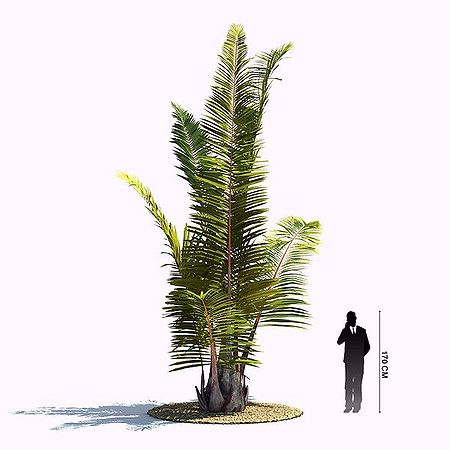
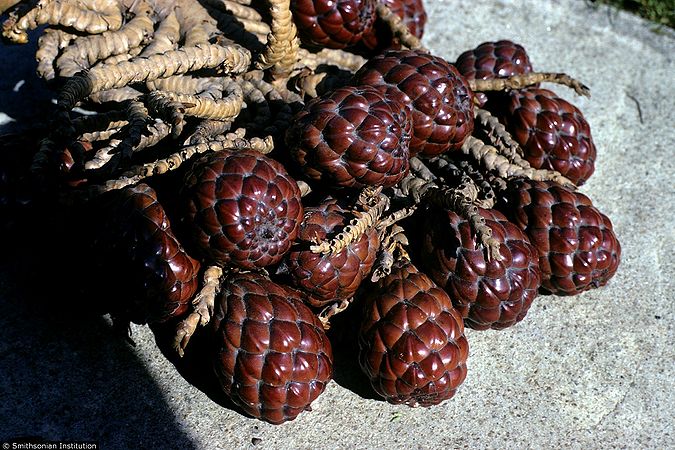
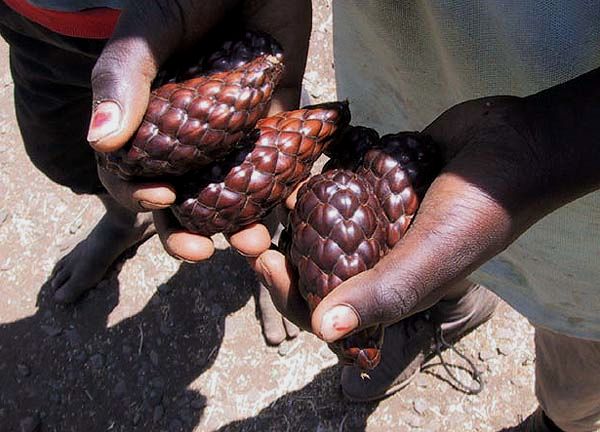
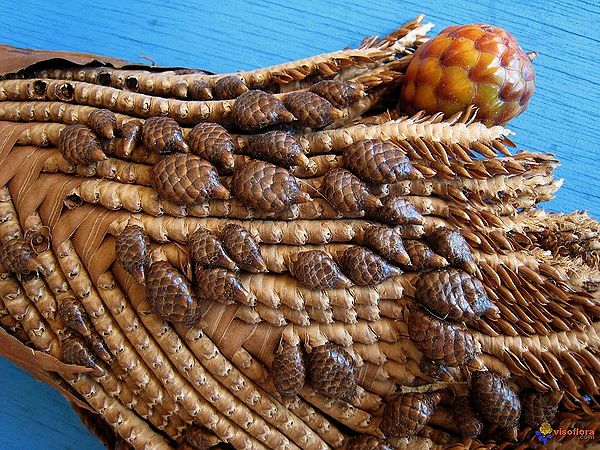
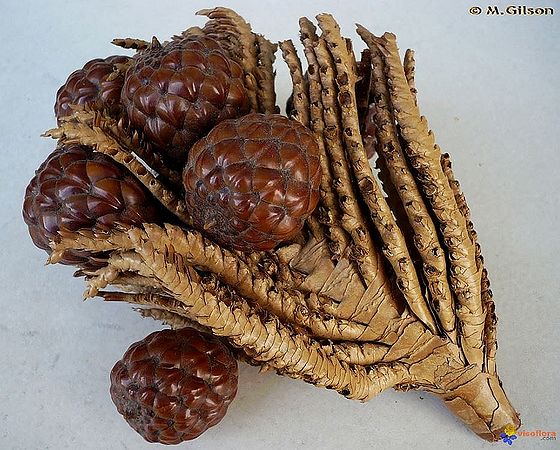
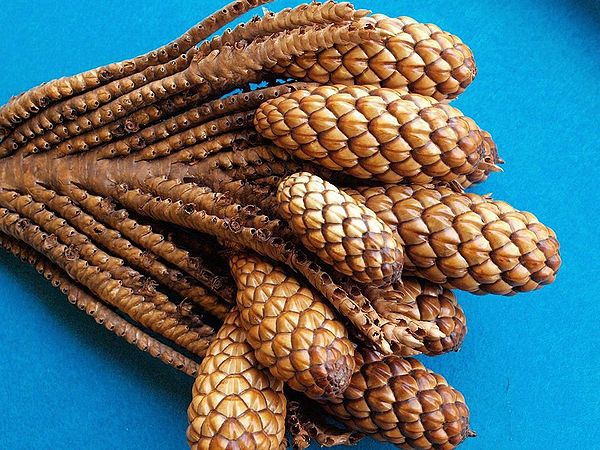
| − | Solitary palm, though clustering in mainland Africa. TRUNK to 10 m high, covered in persistent leaf sheaths. LEAVES about 12 in the crown, porrect, slightly spreading, giving the crown a "shuttle-cock" | + | Solitary palm, though clustering in mainland Africa. TRUNK to 10 m high, covered in persistent leaf sheaths. LEAVES about 12 in the crown, porrect, slightly spreading, giving the crown a "shuttle-cock" appearance, very long, to 20 m; leaf base sheathing, with ragged ligular edge; petiole rounded in section; sheath and petiole about 1.5 m long; rachis several meters long, reddish, distally keeled, proximally to 13 cm wide and decreasing to 1 cm, with scattered scales; leaflets up to 150 on each side of the rachis, inserted in 2 planes and thereby giving the whole leaf a feathery appearance, stiff, attenuate, the median 87-103 x 3.6-3.7 cm, the distal 16-36 x 0.4-1.7 cm, main veins 1, margins with small (1-3 mm long) yellow spines from base to apex of leaflet, midrib adaxially with similar spines to 4 mm, waxy, with many minute reddish scales/glands scattered over the abaxial surface, and sparse ramenta on the midrib. INFLORESCENCE pendulous from the axils of reduced leaves at the stem apex, massive, to 3 m long and 35 cm wide, branched to 2 orders; peduncle distally c. 5.5 x 4.5 cm in diam., glabrous; primary prophyll about 25 x 28 cm; peduncular bract about 18 cm long and 8 cm in diam., tubular for about 11 cm; rachis glabrous; second order prophylls about 9 cm long; first order branches with 13-32 rachillae packed very densely in almost one plane; rachillae 6-13 cm long, about 8 x 5 mm in diam., with dense flowers. STAMINATE FLOWERS with a tubular bract, 7-7.5 x 5-6 mm, broadly ovate, acute; prophyll about 6 mm long and 3 mm in diam.; calyx tubular, 4.5-5 mm high, the lobes < 0.2 mm high, slightly ciliolate; corolla with a tube 2-3 x 1.2-1.5 mm, the lobes 6-6.6 x 2.1-2.5 mm, narrowly ovate and acute, not thickened; stamens 6, inserted at the mouth of the tube, filaments slightly connate, 2-2.8 x 0.5-0.8 mm, anthers 3.2-3.6 x 1.2-1.3 mm, basifixed, locules slightly divergent and sagittate at the base; pistillode not seen. PISTILLATE FLOWERS with a tubular bract about 10 x 9 mm, narrow at the base, widening in the tubular part and then narrowing to an acute apex; prophyll 7.5-8 mm, 2-keeled; bracteole 2.5-3.2 mm; calyx tubular and slightly urceolate, split, 5-6.5 mm high with a truncate apex; corolla tubular for 1-1.3 mm, the lobes narrowly triangular and acute, 2.7-3 x 1.5-1.8 mm; staminodes not seen; ovary about 5.5 x 2.7 mm, covered in fimbriate scales. FRUIT ovoid, 5-6 x 4-4.5 cm with a conical base and a rounded apex with a beak to 5 mm, covered in about 12 rows of reflexed scales, these with a median vertical groove, the largest scales about 16 x 16 mm, chestnut-brown in colour. SEED ovoid, about 3.5 x 3.2 cm; endosperm densely ruminate, the ruminations almost reaching the centre of the seed. (J. Dransfield and H. Beentje. 1995)/Palmweb. Editing by edric. |
{{read more top}} | {{read more top}} | ||
[[Monoecious]], massive, clustering (in Madagascar often solitary) palm, up to 25 m tall; trunk up to 10 m tall and 100 cm in diameter, the lower part with pronounced leaf scars, some remains of rotten leaf sheaths, and adventitious roots, the upper part covered with leaf-bases. Leaves pinnate, erect or slightly spreading, up to 20 m long, sheathing at the base, shiny above, waxy below; sheath unarmed, splitting opposite the petiole, sheath and petiole together c. 1.5 m long; petiole 12–20 cm in diameter, rounded in cross-section, unarmed; rachis unarmed, orange-brown or almost crimson, with 2 lateral grooves near the base; leaflets up to 150 on each side of the rachis, inserted in 2 planes, linear, stiff, up to 200 cm × 8 cm, single-fold, lower surface white waxy, upper surface sparsely waxy, margins and main veins with yellowish spines up to 4 mm long, main veins somewhat reddish. Inflorescence axillary, pendulous, up to 4(–6) m × 35 cm, branched to 2 orders; primary inflorescence bract c. 30 cm × 20 cm, tubular, partly enclosing the first and second order branches, peduncular bract 18 cm × 8 cm, tubular for 11 cm; second order prophylls 9 cm long; first order branches with 13–32 rachillae, up to 30 cm × 2.5 cm; rachilla up to 15 cm × 1.5 cm. Flowers unisexual; male flowers at apex of inflorescence branchlets, female flowers at base; male flowers up to 12 mm × 2 mm, enclosed in a bract, calyx with tube 4–5 mm long and 3 small lobes, corolla with basal tube 2–3 mm long and 3 lobes up to 10 mm × 2.5 mm, with segments slightly thickened near the tip, stamens 6(–9), inserted at the mouth of the corolla tube, filaments 2–3 mm long; female flowers enclosed in 2 bracts, calyx tubular, up to 8 mm long, corolla much shorter than calyx, with basal tube up to 2 mm long and lobes c. 3 mm long, staminodes 6, inconspicuous, ovary superior, 3-celled. Fruit ovoid to ellipsoid, 4.5–11 cm × 3–6 cm, with a beak up to 5 mm long, covered with scales in 12–13 rows, usually 1-seeded; scales convex, reflexed, up to 20 mm × 26 mm, bright orange-brown; mesocarp golden yellow. Seed ovoid to ellipsoid, 3–6 cm × 3–4.5 cm; mesocarp oily; endosperm sparsely to densely ruminate. (PROTA) | [[Monoecious]], massive, clustering (in Madagascar often solitary) palm, up to 25 m tall; trunk up to 10 m tall and 100 cm in diameter, the lower part with pronounced leaf scars, some remains of rotten leaf sheaths, and adventitious roots, the upper part covered with leaf-bases. Leaves pinnate, erect or slightly spreading, up to 20 m long, sheathing at the base, shiny above, waxy below; sheath unarmed, splitting opposite the petiole, sheath and petiole together c. 1.5 m long; petiole 12–20 cm in diameter, rounded in cross-section, unarmed; rachis unarmed, orange-brown or almost crimson, with 2 lateral grooves near the base; leaflets up to 150 on each side of the rachis, inserted in 2 planes, linear, stiff, up to 200 cm × 8 cm, single-fold, lower surface white waxy, upper surface sparsely waxy, margins and main veins with yellowish spines up to 4 mm long, main veins somewhat reddish. Inflorescence axillary, pendulous, up to 4(–6) m × 35 cm, branched to 2 orders; primary inflorescence bract c. 30 cm × 20 cm, tubular, partly enclosing the first and second order branches, peduncular bract 18 cm × 8 cm, tubular for 11 cm; second order prophylls 9 cm long; first order branches with 13–32 rachillae, up to 30 cm × 2.5 cm; rachilla up to 15 cm × 1.5 cm. Flowers unisexual; male flowers at apex of inflorescence branchlets, female flowers at base; male flowers up to 12 mm × 2 mm, enclosed in a bract, calyx with tube 4–5 mm long and 3 small lobes, corolla with basal tube 2–3 mm long and 3 lobes up to 10 mm × 2.5 mm, with segments slightly thickened near the tip, stamens 6(–9), inserted at the mouth of the corolla tube, filaments 2–3 mm long; female flowers enclosed in 2 bracts, calyx tubular, up to 8 mm long, corolla much shorter than calyx, with basal tube up to 2 mm long and lobes c. 3 mm long, staminodes 6, inconspicuous, ovary superior, 3-celled. Fruit ovoid to ellipsoid, 4.5–11 cm × 3–6 cm, with a beak up to 5 mm long, covered with scales in 12–13 rows, usually 1-seeded; scales convex, reflexed, up to 20 mm × 26 mm, bright orange-brown; mesocarp golden yellow. Seed ovoid to ellipsoid, 3–6 cm × 3–4.5 cm; mesocarp oily; endosperm sparsely to densely ruminate. (PROTA) | ||
| Line 32: | Line 33: | ||
{{read more bottom}} | {{read more bottom}} | ||
==Culture== | ==Culture== | ||
| + | A palm of the tropics, it is able to succeed in subtropical areas. Palms succeed in moist tropical climates where temperatures never fall below 10°c, the average annual rainfall is 1,500 mm or more, and the driest month has 25 mm or more rain. Cold Hardiness Zone: 10b | ||
| + | Raphia farinifera is propagated by seed. Germination is slow, unless the outer layers of the seed are removed and the root is exposed. In Madagascar seeds have been reported to germinate after 4–5 months, and to be ready for planting out in the field at 1 year after sowing. Seedlings may also be collected from the wild and raised in a nursery before being planted out in the field. A normal spacing is 12 m × 12 m. Propagation by tissue culture techniques may offer potential for Raphia. (PROTA) | ||
| + | |||
| + | Requires a sunny position in a wet soil. | ||
==Comments and Curiosities== | ==Comments and Curiosities== | ||
{{read more top}} | {{read more top}} | ||
| Line 43: | Line 48: | ||
Properties: Raffia fibre is soft but strong. It is well suited to horticultural purposes, because it is supple and durable and it does not have sharp edges which might damage tender plant parts. The material is easy to prepare to desired widths as it is readily split. It is also easily dyed, making it suitable for the production of fancy articles. The average tensile strength of raffia fibre from Madagascar is 500 N/mm². The rachis is lightweight, easy to cut, strong and durable, making it very suitable for construction and furniture. The fruit pulp contains about 24% oil, the seeds only 1%. The major fatty acids in seed oil from Madagascar are palmitic acid, oleic acid and linoleic acid. The main sterol is β-sitosterol. The fruit pulp has shown antibacterial activity against Staphylococcus aureus, but not against the Gram negative bacteria Escherichia coli, Pseudomonas aeruginosa, Salmonella typhi bacteria; it also had no activity against the fungi Candida albicans and Aspergillus niger. A crude extract of the stem bark caused significant mortality in vitro of adults and microfilariae of Onchocerca volvulus, which causes river blindness. (PROTA) | Properties: Raffia fibre is soft but strong. It is well suited to horticultural purposes, because it is supple and durable and it does not have sharp edges which might damage tender plant parts. The material is easy to prepare to desired widths as it is readily split. It is also easily dyed, making it suitable for the production of fancy articles. The average tensile strength of raffia fibre from Madagascar is 500 N/mm². The rachis is lightweight, easy to cut, strong and durable, making it very suitable for construction and furniture. The fruit pulp contains about 24% oil, the seeds only 1%. The major fatty acids in seed oil from Madagascar are palmitic acid, oleic acid and linoleic acid. The main sterol is β-sitosterol. The fruit pulp has shown antibacterial activity against Staphylococcus aureus, but not against the Gram negative bacteria Escherichia coli, Pseudomonas aeruginosa, Salmonella typhi bacteria; it also had no activity against the fungi Candida albicans and Aspergillus niger. A crude extract of the stem bark caused significant mortality in vitro of adults and microfilariae of Onchocerca volvulus, which causes river blindness. (PROTA) | ||
| + | |||
| + | A very large palm from Madagascar and eastern Africa. Like all Raphia, it grows extremely fast and will produce enormous leaves that can reach an unbelievable 20 m (66 ft) in length. The Raffia Palm likes wet, swampy areas and will thrive in tropical and warm subtropical climates. | ||
| + | |||
| + | The rhinoceros beetle (Oryctes rhinoceros) attacks Raphia farinifera in Mauritius. | ||
{{read more bottom}} | {{read more bottom}} | ||
<br style="clear:both;"/> | <br style="clear:both;"/> | ||
{{#Widget:AdResban}} | {{#Widget:AdResban}} | ||
| − | <center><gallery caption="IMAGE GALLERY" perrow="" widths="" heights=""> | + | <center><gallery caption="IMAGE GALLERY" perrow="4" widths="300px" heights="300px" mode="packed"> |
| − | Image:Raphia farinifera | + | Image:Raphia farinifera leaves.jpg|Leaf Close-up. |
Image:Raphia farinifera leaf base detail.jpg|Leaf Base Detail. | Image:Raphia farinifera leaf base detail.jpg|Leaf Base Detail. | ||
| − | Image:Raphia farinifera leaf | + | Image:Raphia farinifera leaf bases.jpg|Leaf Base Detail. |
| − | Image:Raphia farinifera petiole | + | Image:Raphia farinifera petiole detail.jpg|Petiole Detail. |
| − | image:Raphia farinifera | + | image:Raphia farinifera zoo.jpg|Pana'ewa Rainforest Zoo & Gardens. Hilo, Hawaii. |
Image:RaphiafarIMG 0190.JPG|Fairchild Botanical Garden, FL. | Image:RaphiafarIMG 0190.JPG|Fairchild Botanical Garden, FL. | ||
image:RaphiaFarinifera88.png | image:RaphiaFarinifera88.png | ||
| Line 93: | Line 102: | ||
image:Rf2803.jpg|Montgomery Botanical Centre, Florida. Photo by Dr. William J. Baker, Royal Botanic Gardens, Kew/Palmweb. | image:Rf2803.jpg|Montgomery Botanical Centre, Florida. Photo by Dr. William J. Baker, Royal Botanic Gardens, Kew/Palmweb. | ||
image:Rf3275.jpg|Near Ambinanitelo, Makira Protec, Toamasina, Madagascar. Photo by Dr. William J. Baker, Royal Botanic Gardens, Kew/Palmweb. | image:Rf3275.jpg|Near Ambinanitelo, Makira Protec, Toamasina, Madagascar. Photo by Dr. William J. Baker, Royal Botanic Gardens, Kew/Palmweb. | ||
| + | File:rf3110089675644322.JPG|Malawi, Sani. | ||
| + | File:rf4484431098977.JPG|South Africa, KwaZulu-Natal, Umlalazi Nature Reserve | ||
image:Post-5709-030534400_1335955347.jpg|Mt. Warning Caldera, Nth NSW, Australia. Photo by Pete. | image:Post-5709-030534400_1335955347.jpg|Mt. Warning Caldera, Nth NSW, Australia. Photo by Pete. | ||
image:Post-5709-044841800_1335955557.jpg|Mt. Warning Caldera, Nth NSW, Australia. Photo by Pete. | image:Post-5709-044841800_1335955557.jpg|Mt. Warning Caldera, Nth NSW, Australia. Photo by Pete. | ||
| Line 98: | Line 109: | ||
| + | File:5d2f84.jpg|Thailand. Photo by Geoff Stein. | ||
| + | File:f015de.jpg|Ho'omaluhia Botanical Gardens - Kaneohe, HI. Flowering (top of palm) signaling impending demise of this palm. Photo by Geoff Stein. | ||
| + | File:ef91b0.jpg|Hawaii. Photo by Geoff Stein. | ||
| + | File:af9e3a.jpg|Panaewa Rainforest Zoo and Gardens, Hilo, Hawaii. | ||
| + | File:4060ee.jpg|Hawaii. Photo by Geoff Stein. | ||
| + | File:d7d9d3.jpg|Hawaii. Photo by Geoff Stein. | ||
| + | File:d966ec.jpg|Hawaii. Photo by Geoff Stein. | ||
| + | File:1b11ff.jpg|Hawaii. Photo by Geoff Stein. | ||
| + | File:Raphia farinifera pls MBG Y12008 N044.JPG|Photo: southeastgrowers.com | ||
| + | File:Raphia farinifera pl MBG Y12008 N048.JPG|Photo: southeastgrowers.com | ||
| + | File:Raphia farinifera P30 H8 Y2005 N1531.JPG|Photo: southeastgrowers.com | ||
image:Post-2039-004088500_1335857215.jpg|Democratic Republic of Congo. "I grew from seeds and planted in swampy ground (near the Congo-river)." Photo by Wolfgang Hecht. | image:Post-2039-004088500_1335857215.jpg|Democratic Republic of Congo. "I grew from seeds and planted in swampy ground (near the Congo-river)." Photo by Wolfgang Hecht. | ||
image:Post-2039-056409200_1335857310.jpg|Democratic Republic of Congo. "I grew from seeds and planted in swampy ground (near the Congo-river)." Photo by Wolfgang Hecht. | image:Post-2039-056409200_1335857310.jpg|Democratic Republic of Congo. "I grew from seeds and planted in swampy ground (near the Congo-river)." Photo by Wolfgang Hecht. | ||
File:rfDSCN9371.jpg.7dc53505621bcff517ad838a819baca7.jpg|IPS Direstor Cindy Adair, visit the Satranala reserve, Madagascar. Photo by Cindy Adair. | File:rfDSCN9371.jpg.7dc53505621bcff517ad838a819baca7.jpg|IPS Direstor Cindy Adair, visit the Satranala reserve, Madagascar. Photo by Cindy Adair. | ||
| + | File:49_Raphia farinifera.jpgc8ca0f57-2e36-47e6-906f-cbb3f2a3cf96Larger.jpg | ||
| + | File:RaphiafariniferaBrazil087.jpg | ||
| + | File:Raphia_farinifera_specimen.jpg|Hawaii. Photo by Paul Craft. | ||
| + | File:Raphia_farinifera_specimen2.jpg|Hawaii. Photo by Paul Craft. | ||
| + | File:Raphia_farinifera_naturalized_Brazil.jpg|Hawaii. Photo by Paul Craft. | ||
| + | File:Raphia_farinifera_leafbases.jpg|Hawaii. Photo by Paul Craft. | ||
| + | File:Raphia_farinifera_trunk.jpg|Hawaii. Photo by Paul Craft. | ||
| + | File:Raphia_farinifera_infructescence.jpg|Hawaii. Photo by Paul Craft. | ||
| + | File:Raphia_farinifera_fruit.jpg|Hawaii. Photo by Paul Craft. | ||
| + | File:Raphia_farinifera_seed.jpg|Hawaii. By Paul Craft. Ripe fruit and cleaned seed of Raphia farinifera. Wodyetia bifurcata in upper right is for size comparison. Photo by Cathy Donald. | ||
| + | File:Faye_60_Raphia_farinifera_Congo_1.JPG|Faye Adama 60, Republic of Congo, Feb 2014. Photo by Dr. Adama Faye. | ||
| + | File:Faye_60_Raphia_farinifera_Congo_2.JPG|Faye Adama 60, Republic of Congo, Feb 2014. Photo by Dr. Adama Faye. | ||
| + | File:Faye_60_Raphia_farinifera_Congo_3.JPG|Faye Adama 60, Republic of Congo, Feb 2014. Photo by Dr. Adama Faye. | ||
| + | File:Faye_60_Raphia_farinifera_Congo_4.JPG|Faye Adama 60, Republic of Congo, Feb 2014. Photo by Dr. Adama Faye. | ||
| + | |||
| + | |||
| + | File:rafa5_001_php.jpg | ||
| + | File:farinifera04.jpg | ||
| + | File:raphia-farinifera-visoflora-19370.jpg | ||
| + | File:rf43452218906.JPG | ||
| + | File:thika-nut-twig-763051_960_720.jpg | ||
| + | File:Raffia_Fruechte_natur_bags_9.JPG | ||
| + | File:dried-strips-of-raffia-raphia-farinifera-dyed-green-and-yellow-at-c5fpr3.jpg|Dyed green and yellow. | ||
| + | File:dried-strips-of-raffia-raphia-farinifera-dyed-green-and-yellow-at-c5fptd.jpg|Dyed green and yellow. | ||
| + | File:scot-basket-raffia.jpg | ||
| + | |||
| + | File:111960-5.jpg|Zimbabwe. | ||
| + | File:rf453229980766.JPG|Malawi, Sani. | ||
image:Rf5150.jpg|Fruit with Scales. Photo-Kew. | image:Rf5150.jpg|Fruit with Scales. Photo-Kew. | ||
</gallery></center> | </gallery></center> | ||
| Line 115: | Line 165: | ||
Glossary of Palm Terms; Based on the glossary in Dransfield, J., N.W. Uhl, C.B. Asmussen-Lange, W.J. Baker, M.M. Harley & C.E. Lewis. 2008. Genera Palmarum - Evolution and Classification of the Palms. Royal Botanic Gardens, Kew. All images copyright of the artists and photographers (see images for credits). | Glossary of Palm Terms; Based on the glossary in Dransfield, J., N.W. Uhl, C.B. Asmussen-Lange, W.J. Baker, M.M. Harley & C.E. Lewis. 2008. Genera Palmarum - Evolution and Classification of the Palms. Royal Botanic Gardens, Kew. All images copyright of the artists and photographers (see images for credits). | ||
| + | |||
| + | J. Dransfield & H. Beentje, The Palms of Madagascar. 1995 | ||
{{SpeciesListBackLink}} | {{SpeciesListBackLink}} | ||
[[Category:Palms of Madagascar]] | [[Category:Palms of Madagascar]] | ||
[[Category:RAPHIA|farinifera]] | [[Category:RAPHIA|farinifera]] | ||
Latest revision as of 00:38, 15 November 2016
| Raphia (rahf-EE-ah) farinifera (fahr-ih-nih-FEHR-ah) | |||||||
|---|---|---|---|---|---|---|---|
 Mt. Warning Caldera, Nth NSW, Australia. Photo by Pete. | |||||||
| Scientific Classification | |||||||
| |||||||
| Synonyms | |||||||
|
| |||||||
| Native Continent | |||||||
 | |||||||
| Morphology | |||||||
| |||||||
| Culture | |||||||
|
| |||||||
| Survivability index | |||||||
|
| |||||||
| Common names | |||||||
|
| |||||||
Contents
Habitat and Distribution
Endemic to Mainland Africa; in Madagascar probably introduced. Angola, Benin,
In its natural distribution area, Raphia farinifera is widespread in gallery forest, freshwater swamp-forest and other moist locations, up to 2500 m altitude. In Madagascar it is common near villages at the edge of water courses, at 50–1000 m altitude.
Description
Solitary palm, though clustering in mainland Africa. TRUNK to 10 m high, covered in persistent leaf sheaths. LEAVES about 12 in the crown, porrect, slightly spreading, giving the crown a "shuttle-cock" appearance, very long, to 20 m; leaf base sheathing, with ragged ligular edge; petiole rounded in section; sheath and petiole about 1.5 m long; rachis several meters long, reddish, distally keeled, proximally to 13 cm wide and decreasing to 1 cm, with scattered scales; leaflets up to 150 on each side of the rachis, inserted in 2 planes and thereby giving the whole leaf a feathery appearance, stiff, attenuate, the median 87-103 x 3.6-3.7 cm, the distal 16-36 x 0.4-1.7 cm, main veins 1, margins with small (1-3 mm long) yellow spines from base to apex of leaflet, midrib adaxially with similar spines to 4 mm, waxy, with many minute reddish scales/glands scattered over the abaxial surface, and sparse ramenta on the midrib. INFLORESCENCE pendulous from the axils of reduced leaves at the stem apex, massive, to 3 m long and 35 cm wide, branched to 2 orders; peduncle distally c. 5.5 x 4.5 cm in diam., glabrous; primary prophyll about 25 x 28 cm; peduncular bract about 18 cm long and 8 cm in diam., tubular for about 11 cm; rachis glabrous; second order prophylls about 9 cm long; first order branches with 13-32 rachillae packed very densely in almost one plane; rachillae 6-13 cm long, about 8 x 5 mm in diam., with dense flowers. STAMINATE FLOWERS with a tubular bract, 7-7.5 x 5-6 mm, broadly ovate, acute; prophyll about 6 mm long and 3 mm in diam.; calyx tubular, 4.5-5 mm high, the lobes < 0.2 mm high, slightly ciliolate; corolla with a tube 2-3 x 1.2-1.5 mm, the lobes 6-6.6 x 2.1-2.5 mm, narrowly ovate and acute, not thickened; stamens 6, inserted at the mouth of the tube, filaments slightly connate, 2-2.8 x 0.5-0.8 mm, anthers 3.2-3.6 x 1.2-1.3 mm, basifixed, locules slightly divergent and sagittate at the base; pistillode not seen. PISTILLATE FLOWERS with a tubular bract about 10 x 9 mm, narrow at the base, widening in the tubular part and then narrowing to an acute apex; prophyll 7.5-8 mm, 2-keeled; bracteole 2.5-3.2 mm; calyx tubular and slightly urceolate, split, 5-6.5 mm high with a truncate apex; corolla tubular for 1-1.3 mm, the lobes narrowly triangular and acute, 2.7-3 x 1.5-1.8 mm; staminodes not seen; ovary about 5.5 x 2.7 mm, covered in fimbriate scales. FRUIT ovoid, 5-6 x 4-4.5 cm with a conical base and a rounded apex with a beak to 5 mm, covered in about 12 rows of reflexed scales, these with a median vertical groove, the largest scales about 16 x 16 mm, chestnut-brown in colour. SEED ovoid, about 3.5 x 3.2 cm; endosperm densely ruminate, the ruminations almost reaching the centre of the seed. (J. Dransfield and H. Beentje. 1995)/Palmweb. Editing by edric.
| read more |
|---|
|
Monoecious, massive, clustering (in Madagascar often solitary) palm, up to 25 m tall; trunk up to 10 m tall and 100 cm in diameter, the lower part with pronounced leaf scars, some remains of rotten leaf sheaths, and adventitious roots, the upper part covered with leaf-bases. Leaves pinnate, erect or slightly spreading, up to 20 m long, sheathing at the base, shiny above, waxy below; sheath unarmed, splitting opposite the petiole, sheath and petiole together c. 1.5 m long; petiole 12–20 cm in diameter, rounded in cross-section, unarmed; rachis unarmed, orange-brown or almost crimson, with 2 lateral grooves near the base; leaflets up to 150 on each side of the rachis, inserted in 2 planes, linear, stiff, up to 200 cm × 8 cm, single-fold, lower surface white waxy, upper surface sparsely waxy, margins and main veins with yellowish spines up to 4 mm long, main veins somewhat reddish. Inflorescence axillary, pendulous, up to 4(–6) m × 35 cm, branched to 2 orders; primary inflorescence bract c. 30 cm × 20 cm, tubular, partly enclosing the first and second order branches, peduncular bract 18 cm × 8 cm, tubular for 11 cm; second order prophylls 9 cm long; first order branches with 13–32 rachillae, up to 30 cm × 2.5 cm; rachilla up to 15 cm × 1.5 cm. Flowers unisexual; male flowers at apex of inflorescence branchlets, female flowers at base; male flowers up to 12 mm × 2 mm, enclosed in a bract, calyx with tube 4–5 mm long and 3 small lobes, corolla with basal tube 2–3 mm long and 3 lobes up to 10 mm × 2.5 mm, with segments slightly thickened near the tip, stamens 6(–9), inserted at the mouth of the corolla tube, filaments 2–3 mm long; female flowers enclosed in 2 bracts, calyx tubular, up to 8 mm long, corolla much shorter than calyx, with basal tube up to 2 mm long and lobes c. 3 mm long, staminodes 6, inconspicuous, ovary superior, 3-celled. Fruit ovoid to ellipsoid, 4.5–11 cm × 3–6 cm, with a beak up to 5 mm long, covered with scales in 12–13 rows, usually 1-seeded; scales convex, reflexed, up to 20 mm × 26 mm, bright orange-brown; mesocarp golden yellow. Seed ovoid to ellipsoid, 3–6 cm × 3–4.5 cm; mesocarp oily; endosperm sparsely to densely ruminate. (PROTA) According to Gerard Jean (pers. comm.), plants take 20-25 years from seed to flowering, and 5-6 years from flowering to ripe fruit; all the fruits mature in the same year. Perrier stated that raffia in Madagascar varies quite a bit as regards the length of the fibres, and in the form and size of the fruit. The most striking variety, he said, is one with very large fruits in the Sambirano. No material of this has come to light. (J. Dransfield and H. Beentje. 1995) |
Culture
A palm of the tropics, it is able to succeed in subtropical areas. Palms succeed in moist tropical climates where temperatures never fall below 10°c, the average annual rainfall is 1,500 mm or more, and the driest month has 25 mm or more rain. Cold Hardiness Zone: 10b
Raphia farinifera is propagated by seed. Germination is slow, unless the outer layers of the seed are removed and the root is exposed. In Madagascar seeds have been reported to germinate after 4–5 months, and to be ready for planting out in the field at 1 year after sowing. Seedlings may also be collected from the wild and raised in a nursery before being planted out in the field. A normal spacing is 12 m × 12 m. Propagation by tissue culture techniques may offer potential for Raphia. (PROTA)
Requires a sunny position in a wet soil.
Comments and Curiosities
| read more |
|---|
|
All Raphia palms seen by us were closely associated with human habitation; variation within the Madagascar populations seems to be minimal, especially as regards the fruit; this gives us reason to believe the species has been introduced to the island. This same species is common and widespread in continental Africa. (J. Dransfield and H. Beentje. 1995)/Palmweb. Uses: Fibres from young leaves used for a variety of crafts, including hat-making, fibre-weaving for clothing and basketry; petioles used in hut construction; fruits and hearts edible. Raffia fibre obtained from the upper surface of young leaflets is used worldwide as tying material for horticulture and handicrafts. In tropical Africa it is locally used for tying and for making a wide range of products, including mats, baskets, hats, wallets, shoes, bags, fishing nets, hammocks, curtains and textiles. The leaves are used for thatching, and the leaflets for plaiting. In Madagascar the midveins of the leaflets are used for making fishing nets and a range of articles for domestic use. The petiole and rachis are used for furniture, house construction, fences and ladders, and as poles. The rachis is locally made into sweeping-brushes. In Madagascar the dry petiole is cut into pieces of 40 cm long, which are used as floats for fishing nets. In Uganda strips from the petiole are used for basket weaving. The stems of the palm are a source of starch. The young terminal bud (‘palm cabbage’) is eaten as a vegetable. The palm is tapped for sap to be fermented into palm wine. The wine is also distilled into a strong alcoholic liquor and can also be used as bakers’ yeast. The fruit and seeds are eaten, and the fruit pulp is fermented into an alcoholic drink. Oil from the mesocarp and seed is used as food (‘raphia butter’) and for the production of soap and stearin. The shells of the fruits are made into snuffboxes or buttons, and the fruits and seeds are used for decoration. A wax obtained from the lower surface of the leaflets has been used for floor and shoe polishes and for making candles. Raphia farinifera is planted as a wayside and ornamental tree. In Madagascar the root is used against toothache, fibres from the leaf sheath are used for the treatment of digestive disorders, and a liquor obtained from the inflorescence is a drink as well as a laxative. In Mauritius a decoction of the fruit pulp is used against dysentery, and an infusion of the fruit is said to attenuate haemorrhages. (PROTA) Production and international trade: Most of the raffia of international commerce is produced in Madagascar from Raphia farinifera. In the 1950s c. 5000 t of raffia fibre was annually exported from Madagascar, but in the 1980s and 1990s the average annual exports were only around 2000 t. Oil from the mesocarp has been exported to the European market as ‘bamboo oil'. (PROTA) Properties: Raffia fibre is soft but strong. It is well suited to horticultural purposes, because it is supple and durable and it does not have sharp edges which might damage tender plant parts. The material is easy to prepare to desired widths as it is readily split. It is also easily dyed, making it suitable for the production of fancy articles. The average tensile strength of raffia fibre from Madagascar is 500 N/mm². The rachis is lightweight, easy to cut, strong and durable, making it very suitable for construction and furniture. The fruit pulp contains about 24% oil, the seeds only 1%. The major fatty acids in seed oil from Madagascar are palmitic acid, oleic acid and linoleic acid. The main sterol is β-sitosterol. The fruit pulp has shown antibacterial activity against Staphylococcus aureus, but not against the Gram negative bacteria Escherichia coli, Pseudomonas aeruginosa, Salmonella typhi bacteria; it also had no activity against the fungi Candida albicans and Aspergillus niger. A crude extract of the stem bark caused significant mortality in vitro of adults and microfilariae of Onchocerca volvulus, which causes river blindness. (PROTA) A very large palm from Madagascar and eastern Africa. Like all Raphia, it grows extremely fast and will produce enormous leaves that can reach an unbelievable 20 m (66 ft) in length. The Raffia Palm likes wet, swampy areas and will thrive in tropical and warm subtropical climates. The rhinoceros beetle (Oryctes rhinoceros) attacks Raphia farinifera in Mauritius. |
- IMAGE GALLERY
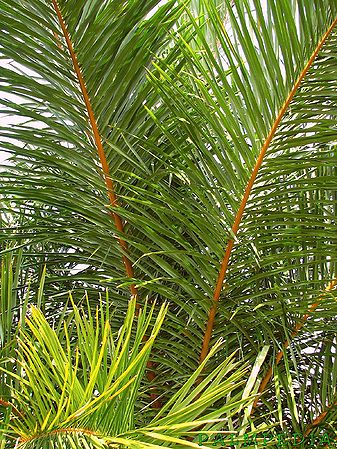
Leaf Close-up.

Leaf Base Detail.

Leaf Base Detail.

Petiole Detail.

Pana'ewa Rainforest Zoo & Gardens. Hilo, Hawaii.

Fairchild Botanical Garden, FL.
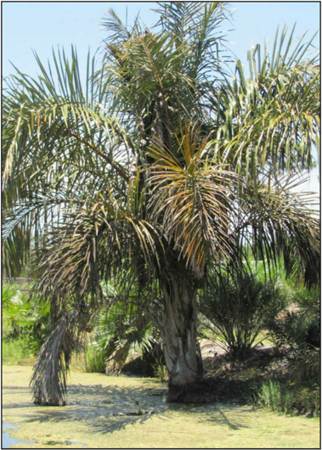

New Caledonia, photo by Ben.

New Caledonia, photo by Ben.
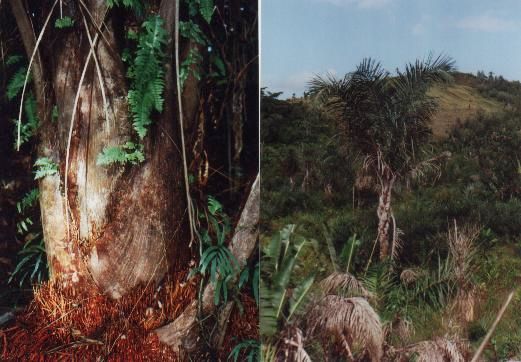
Madagascar. Photo by Jörg Schumann, Thirnax Palms & Cycads, (I got all those fresh Madfox seeds from him).

Photo by Geoff Stein.

Nong Nooch Botanical Garden, Thailand. Photo by Geoff Stein.

Photo by Geoff Stein.

Hawaii. Photo by Geoff Stein.

Sainte marie, Madagascar. Photo by Dr. John Dransfield, Royal Botanic Gardens, Kew/Palmweb.

Anbanizana, Masoala, Madagascar. Photo by Dr. John Dransfield, Royal Botanic Gardens, Kew/Palmweb.

Townsville, Queensland, Australia. Photo by Dr. John Dransfield, Royal Botanic Gardens, Kew/Palmweb.

Near Soni, West Usambara, Tanzania. Photo by Dr. John Dransfield, Royal Botanic Gardens, Kew/Palmweb.

Near Soni, West Usambara, Tanzania. Photo by Dr. John Dransfield, Royal Botanic Gardens, Kew/Palmweb.

Near Soni, West Usambara, Tanzania. Photo by Dr. John Dransfield, Royal Botanic Gardens, Kew/Palmweb.

Tsimbazaza, Madagascar. Photo by Dr. John Dransfield, Royal Botanic Gardens, Kew/Palmweb.

Anbanizana, Masoala, Madagascar. Photo by Dr. John Dransfield, Royal Botanic Gardens, Kew/Palmweb.

Sainte marie, Madagascar. Photo by Dr. John Dransfield, Royal Botanic Gardens, Kew/Palmweb.

Montgomery Botanical Centre, Florida. Photo by Dr. John Dransfield, Royal Botanic Gardens, Kew/Palmweb.

Maroantsetra, Madagascar. Photo by Dr. John Dransfield, Royal Botanic Gardens, Kew/Palmweb.

Sainte Marie, Madagascar. Photo by Dr. John Dransfield, Royal Botanic Gardens, Kew/Palmweb.

Sainte Marie, Madagascar. Photo by Dr. John Dransfield, Royal Botanic Gardens, Kew/Palmweb.

Sainte Marie, Madagascar. Photo by Dr. John Dransfield, Royal Botanic Gardens, Kew/Palmweb.

Anbanizana, Masoala, Madagascar. Photo by Dr. John Dransfield, Royal Botanic Gardens, Kew/Palmweb.

Townsville, Queensland, Australia. Photo by Dr. John Dransfield, Royal Botanic Gardens, Kew/Palmweb.
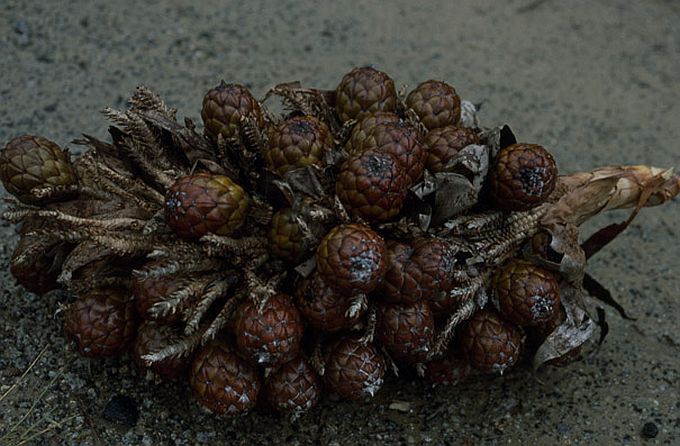
Maroantsetra, Madagascar. Photo by Dr. John Dransfield, Royal Botanic Gardens, Kew/Palmweb.

Montgomery Botanical Centre, Florida. Photo by Dr. William J. Baker, Royal Botanic Gardens, Kew/Palmweb.

Sainte Marie, Madagascar. Photo by Dr. John Dransfield, Royal Botanic Gardens, Kew/Palmweb.

Near Soni, West Usambara, Tanzania. Photo by Dr. John Dransfield, Royal Botanic Gardens, Kew/Palmweb.

Sainte Marie, Madagascar. Photo by Dr. John Dransfield, Royal Botanic Gardens, Kew/Palmweb.

Sainte Marie, Madagascar. Photo by Dr. John Dransfield, Royal Botanic Gardens, Kew/Palmweb.

Sainte Marie, Madagascar. Photo by Dr. John Dransfield, Royal Botanic Gardens, Kew/Palmweb.

Sainte Marie, Madagascar. Photo by Dr. John Dransfield, Royal Botanic Gardens, Kew/Palmweb.

Montgomery Botanical Centre, Florida. Photo by Dr. William J. Baker, Royal Botanic Gardens, Kew/Palmweb.

Near Dar Es Salaam, Tanzania. Photo by Dr. John Dransfield, Royal Botanic Gardens, Kew/Palmweb.

Xishuang, Burma. Photo by Dr. John Dransfield, Royal Botanic Gardens, Kew/Palmweb.

Near Dar Es Salaam, Tanzania. Photo by Dr. John Dransfield, Royal Botanic Gardens, Kew/Palmweb.

Montgomery Botanical Centre, Florida. Photo by Dr. William J. Baker, Royal Botanic Gardens, Kew/Palmweb.

Queensland, Australia. Photo by Dr. William J. Baker, Royal Botanic Gardens, Kew/Palmweb.

Montgomery Botanical Centre, Florida. Photo by Dr. William J. Baker, Royal Botanic Gardens, Kew/Palmweb.

Near Ambinanitelo, Makira Protec, Toamasina, Madagascar. Photo by Dr. William J. Baker, Royal Botanic Gardens, Kew/Palmweb.

Malawi, Sani.

South Africa, KwaZulu-Natal, Umlalazi Nature Reserve

Mt. Warning Caldera, Nth NSW, Australia. Photo by Pete.

Mt. Warning Caldera, Nth NSW, Australia. Photo by Pete.

Mt. Warning Caldera, Nth NSW, Australia. Photo by Pete.

Thailand. Photo by Geoff Stein.

Ho'omaluhia Botanical Gardens - Kaneohe, HI. Flowering (top of palm) signaling impending demise of this palm. Photo by Geoff Stein.

Hawaii. Photo by Geoff Stein.

Panaewa Rainforest Zoo and Gardens, Hilo, Hawaii.

Hawaii. Photo by Geoff Stein.

Hawaii. Photo by Geoff Stein.

Hawaii. Photo by Geoff Stein.

Hawaii. Photo by Geoff Stein.

Photo: southeastgrowers.com

Photo: southeastgrowers.com

Photo: southeastgrowers.com

Democratic Republic of Congo. "I grew from seeds and planted in swampy ground (near the Congo-river)." Photo by Wolfgang Hecht.

Democratic Republic of Congo. "I grew from seeds and planted in swampy ground (near the Congo-river)." Photo by Wolfgang Hecht.

IPS Direstor Cindy Adair, visit the Satranala reserve, Madagascar. Photo by Cindy Adair.
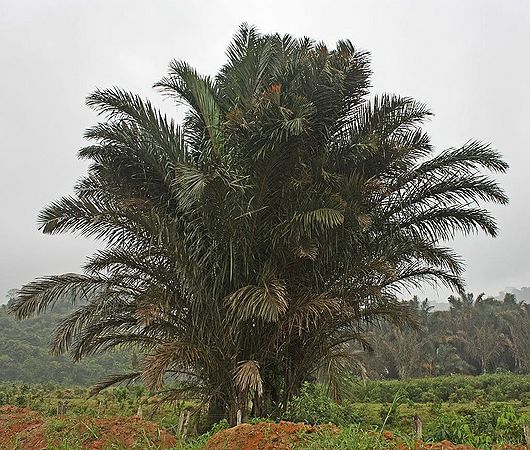

Hawaii. Photo by Paul Craft.
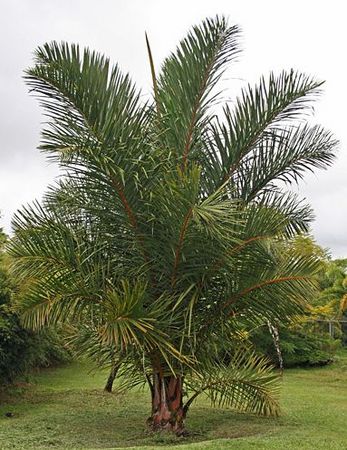
Hawaii. Photo by Paul Craft.

Hawaii. Photo by Paul Craft.

Hawaii. Photo by Paul Craft.

Hawaii. Photo by Paul Craft.

Hawaii. Photo by Paul Craft.

Hawaii. Photo by Paul Craft.

Hawaii. By Paul Craft. Ripe fruit and cleaned seed of Raphia farinifera. Wodyetia bifurcata in upper right is for size comparison. Photo by Cathy Donald.

Faye Adama 60, Republic of Congo, Feb 2014. Photo by Dr. Adama Faye.

Faye Adama 60, Republic of Congo, Feb 2014. Photo by Dr. Adama Faye.

Faye Adama 60, Republic of Congo, Feb 2014. Photo by Dr. Adama Faye.

Faye Adama 60, Republic of Congo, Feb 2014. Photo by Dr. Adama Faye.
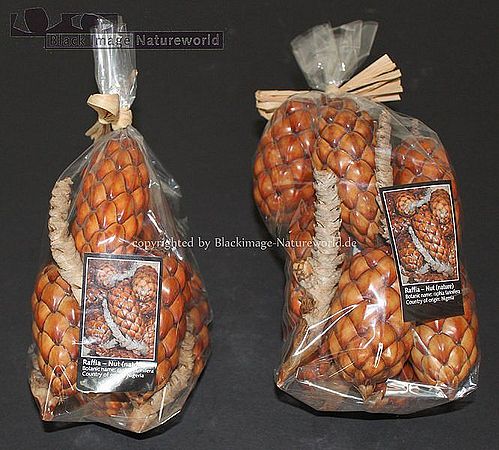

Dyed green and yellow.
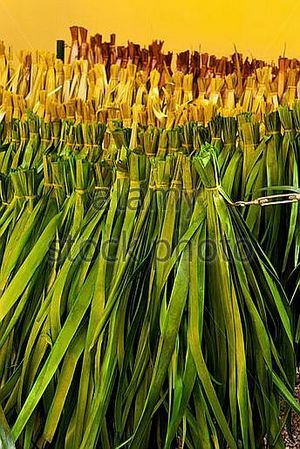
Dyed green and yellow.
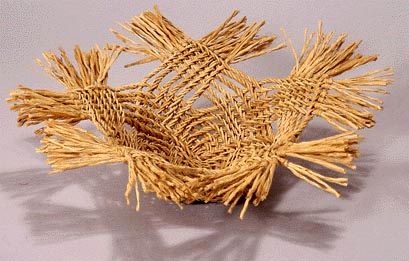

Zimbabwe.

Malawi, Sani.
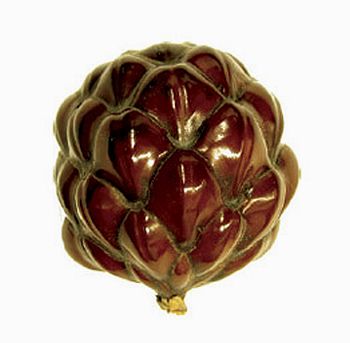
Fruit with Scales. Photo-Kew.


External Links
- Glossary of Palm Terms
- MODERN BOTANICAL LATIN
- "Just To Be Clear"
- http://www.palmbeachpalmcycadsociety.com/palms/documents/RaphiaFarinifera.pdf
References
Special thanks to Geoff Stein, (Palmbob) for his hundreds of photos.
Special thanks to Palmweb.org, Dr. John Dransfield, Dr. Bill Baker & team, for their volumes of information and photos.
Glossary of Palm Terms; Based on the glossary in Dransfield, J., N.W. Uhl, C.B. Asmussen-Lange, W.J. Baker, M.M. Harley & C.E. Lewis. 2008. Genera Palmarum - Evolution and Classification of the Palms. Royal Botanic Gardens, Kew. All images copyright of the artists and photographers (see images for credits).
J. Dransfield & H. Beentje, The Palms of Madagascar. 1995
Many Special Thanks to Ed Vaile for his long hours of tireless editing and numerous contributions.