Difference between revisions of "Attalea crassispatha"
| (20 intermediate revisions by one user not shown) | |||
| Line 1: | Line 1: | ||
__noeditsection__ | __noeditsection__ | ||
{{Palmbox | {{Palmbox | ||
| − | |image= | + | |image=5207577645_66b001028e_o.jpg |
| − | |image_caption= | + | |image_caption=Miami, Florida. Photo by Kyle Wicomb. |
|genus=Attalea (at-tahl-EH-ah) | |genus=Attalea (at-tahl-EH-ah) | ||
|species=<br>crassispatha (krahs-see-SPAH-tah) | |species=<br>crassispatha (krahs-see-SPAH-tah) | ||
| Line 16: | Line 16: | ||
|watering= | |watering= | ||
|soil_type= | |soil_type= | ||
| − | |common_names=Carossier oil palm, | + | |common_names=Carossier oil palm, carroussier, côrossié, petit coco, kawosie, ti koko, kowos, kokowos, kolowosh and kowos etranjè. |
}} | }} | ||
==Habitat and Distribution== | ==Habitat and Distribution== | ||
| − | SW. Haiti. Attalea crassispatha is endemic to the southern peninsula of Haiti, where approximately 25–30 | + | SW. Haiti. Attalea crassispatha is endemic to the southern peninsula of Haiti, [[File:ac0012444.JPG|thumb|left|500px|Photo-evolutionofplants.org]]where approximately 25–30 individual palms are thought to survive. It is the only member of the subtribe Attaleinae native to the Greater Antilles. The species is restricted to four localities within two major watersheds, the Cavaillon and Côtes-de-Fer, where it grows from sea level to 450 m in elevation. (cmsdata.iucn.org) |
| − | individual palms are thought to survive. It is the only member of the subtribe Attaleinae native to the | + | |
| − | Greater Antilles. The species is restricted to four localities within two major watersheds, the Cavaillon | + | |
| − | and Côtes-de-Fer, where it grows from sea level to 450 m in elevation. (cmsdata.iucn.org) | + | |
| − | + | ||
==Description== | ==Description== | ||
Attalea crassispatha (Mart.) Burret is a tall (to 20 m), solitary palm bearing a dense crown of pinnate | Attalea crassispatha (Mart.) Burret is a tall (to 20 m), solitary palm bearing a dense crown of pinnate | ||
| Line 33: | Line 29: | ||
Attalea crassispatha has a single stem which grows up to 20 metres (66 ft) tall. The stem is grey, up to 35 centimetres (14 in) in diameter, and can be columnar, or slightly swollen at the base of the middle of the stem. Individuals bear 15 to 19 pinnately compound leaves—leaves in which rows of leaflets emerge on either side of the axis of the leaf in a feather-like or fern-like pattern—with 127 to 165 pairs of leaflets. Leaves consist of a leaf sheath which wraps around the trunk, a rachis, from which the leaflets emerge, and a petiole, which connects the leaf sheath with the rachis. The leaf sheath is open (it does not wrap completely around the stem); when the leaf is shed, the leaf sheath detached cleanly from the stem. The sheath and petiole combined are 1.3 to 1.35 m (4 ft 3 in to 4 ft 5 in) long, while the rachis is 3.2 to 4 m (10 to 13 ft) long. | Attalea crassispatha has a single stem which grows up to 20 metres (66 ft) tall. The stem is grey, up to 35 centimetres (14 in) in diameter, and can be columnar, or slightly swollen at the base of the middle of the stem. Individuals bear 15 to 19 pinnately compound leaves—leaves in which rows of leaflets emerge on either side of the axis of the leaf in a feather-like or fern-like pattern—with 127 to 165 pairs of leaflets. Leaves consist of a leaf sheath which wraps around the trunk, a rachis, from which the leaflets emerge, and a petiole, which connects the leaf sheath with the rachis. The leaf sheath is open (it does not wrap completely around the stem); when the leaf is shed, the leaf sheath detached cleanly from the stem. The sheath and petiole combined are 1.3 to 1.35 m (4 ft 3 in to 4 ft 5 in) long, while the rachis is 3.2 to 4 m (10 to 13 ft) long. | ||
| − | The inflorescences are born among the leaves. They are either predominantly male, or have a mixture of male and female flowers. The inflorescence consists of a main axis—the peduncle and the rachis—and a series of smaller branches, the rachillae. The rachillae, which bear the flowers, emerge from the rachis. The peduncle is the main stalk, connecting the rachis with the stem. The peduncle, the main stalk of the inflorescence, is no more than 20 cm (7.9 in) long and up to 6 cm (2.4 in) in diameter. The rachis is up to 40 cm (16 in) while the rachillae, which can number in the hundreds, reach a length of about 15 cm (5.9 in). The fruit is reddish when ripe. The seeds, which are about 2 cm (0.79 in) long and 2 cm (0.79 in) in diameter are covered by a 5 millimetres (0.20 in) mesocarp and a 3 mm (0.12 in) endocarp. | + | The inflorescences are born among the leaves. They are either predominantly male, or have a mixture of male and female flowers. The inflorescence consists of a main axis—the peduncle and the rachis—and a series of smaller branches, the rachillae. The rachillae, which bear the flowers, emerge from the rachis. The peduncle is the main stalk, connecting the rachis with the stem. The peduncle, the main stalk of the inflorescence, is no more than 20 cm (7.9 in) long and up to 6 cm (2.4 in) in diameter. The rachis is up to 40 cm (16 in) while the rachillae, which can number in the hundreds, reach a length of about 15 cm (5.9 in). The fruit is reddish when ripe. The seeds, which are about 2 cm (0.79 in) long and 2 cm (0.79 in) in diameter are covered by a 5 millimetres (0.20 in) mesocarp and a 3 mm (0.12 in) endocarp. (Dr.'s Andrew J. Henderson & Michael Balick) |
==Culture== | ==Culture== | ||
Cold Hardiness Zone: 10b | Cold Hardiness Zone: 10b | ||
==Comments and Curiosities== | ==Comments and Curiosities== | ||
{{read more top}} | {{read more top}} | ||
| − | Natural history: | + | Natural history: Charles Plumier visited the island of Hispaniola in 1689 and published a description of the species in 1703. Carl Friedrich Philipp von Martius used Plumier's notes and drawings to give the species a formal Linnaean description in 1884 placing it in the genus Maximiliana. In 1929 Max Burret transferred the species to Attalea. In 1939 O. F. Cook placed the species in a new genus, Bornoa, named for Louis Borno, former President of Haiti. However, Cook did not validly publish it, making the name invalid. Liberty Hyde Bailey kept the species in the genus Attalea. S. F. Glassman considered it close to the genus Orbignya, but suggested that it may represent a new genus. Recent work has favoured maintaining all Attaleinae in a single genus, Attalea. (Dr.'s Andrew J. Henderson & Michael Balick) |
| − | + | ||
| − | + | ||
| − | + | ||
| − | + | ||
| − | + | ||
Threats to survival: Habitat destruction has had a significant impact on this species. It is likely that changes in forest | Threats to survival: Habitat destruction has had a significant impact on this species. It is likely that changes in forest | ||
| Line 63: | Line 54: | ||
seedlings for out-planting. (cmsdata.iucn.org) | seedlings for out-planting. (cmsdata.iucn.org) | ||
| − | Uses: The | + | Uses: The seeds of Attalea crassispatha are edible; the flavour is reported to be similar to that of coconut, but it is richer in fats and denser. The nuts are also a good source of cooking oil. The bract is used as a bowl for feeding pigs. The leaves are used for thatch and weaving, but only when the more common fan palms Sabal causiarum and Coccothrinax argentea are unavailable. It is also used as a source of lumber and as a boundary marker between farmers' fields due to its longevity and ability to survive hurricanes. (Timyan, Joel C.; Samuel F. Reep) |
{{read more bottom}} | {{read more bottom}} | ||
<br style="clear:both;"/> | <br style="clear:both;"/> | ||
| Line 69: | Line 60: | ||
<center><gallery caption="IMAGE GALLERY" perrow="4" widths="300px" heights="300px" mode="packed"> | <center><gallery caption="IMAGE GALLERY" perrow="4" widths="300px" heights="300px" mode="packed"> | ||
File:ac2786198.jpg|Attalea crassispatha growing in an ex situ collection at Fairchild Tropical Botanic Garden, Miami, Florida. Photo by Dr. Scott Zona/Palmweb. | File:ac2786198.jpg|Attalea crassispatha growing in an ex situ collection at Fairchild Tropical Botanic Garden, Miami, Florida. Photo by Dr. Scott Zona/Palmweb. | ||
| + | File:Attalea_crassispatha.jpg|Fairchild Tropical Botanic Garden, Coral Gables, Florida. Photo by Kyle Wicomb. | ||
| + | File:6127987529_79112d2ca8_o.jpg|Fairchild Tropical Botanic Garden, Coral Gables, Florida. Photo by Kyle Wicomb. | ||
| + | File:5207577645_66b001028e_o.jpg|Miami, Florida. Photo by Kyle Wicomb. | ||
| + | File:Cultivated-carossier-palms.jpg|Fairchild Tropical Botanic Garden, Coral Gables, Florida. Photo by Ken Bergman. | ||
| + | File:ac0012444.JPG|Photo-evolutionofplants.org | ||
| + | File:Carossier-palm23.jpg|Haiti. Photo by Bart Colcome. | ||
| + | File:Damaged-trunk-of-carossier-palm.jpg|Haiti. Damaged trunk of carossier palm. Photo by Bart Colcome. | ||
| + | File:5mai.jpg|Photo by Jean-Baptiste G. | ||
| + | File:ac5526915.jpg|Haiti. Photo-southeastgarden.com | ||
| + | File:ac002134.JPG|Montgomery Botanical Center in Miami, Florida. Photo by Paul Craft. | ||
| + | File:ac002155.JPG|Fairchild Tropical Botanic Garden, Coral Gables, Florida. Photo by Paul Craft. | ||
| + | File:ac0014111.JPG|Photo by Paul Craft. | ||
| + | File:Attalea_crassispatha_inflorescence.jpg|Photo by Paul Craft. | ||
| + | File:ac0013211.JPG|Photo by Paul Craft. | ||
| + | File:Attalea_crassispatha_trunk.jpg|Photo by Paul Craft. | ||
| + | File:ac0013222.JPG|Photo by Paul Craft. | ||
| + | File:Attalea_crassispatha_fruit.jpg|Photo by Paul Craft. | ||
File:ac00987.jpg|Image-Dr.'s Andrew J. Henderson & Michael Balick. | File:ac00987.jpg|Image-Dr.'s Andrew J. Henderson & Michael Balick. | ||
File:ac009834.jpg|Image-Dr.'s Andrew J. Henderson & Michael Balick. | File:ac009834.jpg|Image-Dr.'s Andrew J. Henderson & Michael Balick. | ||
| Line 83: | Line 91: | ||
*http://cmsdata.iucn.org/downloads/psg_attalea_crassispatha.pdf | *http://cmsdata.iucn.org/downloads/psg_attalea_crassispatha.pdf | ||
*http://www.virtualherbarium.org/psg/flagship/Attalea_crassispatha.html | *http://www.virtualherbarium.org/psg/flagship/Attalea_crassispatha.html | ||
| + | *http://southeastgarden.com/haiti.html | ||
*http://www.youtube.com/watch?v=0XzVQyMKiCQ | *http://www.youtube.com/watch?v=0XzVQyMKiCQ | ||
==References== | ==References== | ||
Latest revision as of 09:33, 23 April 2016
| Attalea (at-tahl-EH-ah) crassispatha (krahs-see-SPAH-tah) | |||||||
|---|---|---|---|---|---|---|---|
 Miami, Florida. Photo by Kyle Wicomb. | |||||||
| Scientific Classification | |||||||
| |||||||
| Synonyms | |||||||
|
| |||||||
| Native Continent | |||||||
 | |||||||
| Morphology | |||||||
| |||||||
| Culture | |||||||
|
| |||||||
| Survivability index | |||||||
|
| |||||||
| Common names | |||||||
|
| |||||||
Contents
Habitat and Distribution
SW. Haiti. Attalea crassispatha is endemic to the southern peninsula of Haiti,
Description
Attalea crassispatha (Mart.) Burret is a tall (to 20 m), solitary palm bearing a dense crown of pinnate leaves, each leaf up to 5 m long and bearing up to 165 pairs of leaflets. Overall, the palm can resemble a robust coconut palm. The inflorescence bears a thick, woody, furrowed peduncular bract. The staminate flowers bear three lance-shaped petals that are not fused together at their bases and eight or nine stamens. The anthers are curled and shorter than the petals. The fruits are egg-shaped, about 3 cm long. Each fruit has a hard stone (endocarp) enclosing a single seed. (cmsdata.iucn.org) Editing by edric.
Attalea crassispatha has a single stem which grows up to 20 metres (66 ft) tall. The stem is grey, up to 35 centimetres (14 in) in diameter, and can be columnar, or slightly swollen at the base of the middle of the stem. Individuals bear 15 to 19 pinnately compound leaves—leaves in which rows of leaflets emerge on either side of the axis of the leaf in a feather-like or fern-like pattern—with 127 to 165 pairs of leaflets. Leaves consist of a leaf sheath which wraps around the trunk, a rachis, from which the leaflets emerge, and a petiole, which connects the leaf sheath with the rachis. The leaf sheath is open (it does not wrap completely around the stem); when the leaf is shed, the leaf sheath detached cleanly from the stem. The sheath and petiole combined are 1.3 to 1.35 m (4 ft 3 in to 4 ft 5 in) long, while the rachis is 3.2 to 4 m (10 to 13 ft) long. The inflorescences are born among the leaves. They are either predominantly male, or have a mixture of male and female flowers. The inflorescence consists of a main axis—the peduncle and the rachis—and a series of smaller branches, the rachillae. The rachillae, which bear the flowers, emerge from the rachis. The peduncle is the main stalk, connecting the rachis with the stem. The peduncle, the main stalk of the inflorescence, is no more than 20 cm (7.9 in) long and up to 6 cm (2.4 in) in diameter. The rachis is up to 40 cm (16 in) while the rachillae, which can number in the hundreds, reach a length of about 15 cm (5.9 in). The fruit is reddish when ripe. The seeds, which are about 2 cm (0.79 in) long and 2 cm (0.79 in) in diameter are covered by a 5 millimetres (0.20 in) mesocarp and a 3 mm (0.12 in) endocarp. (Dr.'s Andrew J. Henderson & Michael Balick)
Culture
Cold Hardiness Zone: 10b
Comments and Curiosities
| read more |
|---|
|
Natural history: Charles Plumier visited the island of Hispaniola in 1689 and published a description of the species in 1703. Carl Friedrich Philipp von Martius used Plumier's notes and drawings to give the species a formal Linnaean description in 1884 placing it in the genus Maximiliana. In 1929 Max Burret transferred the species to Attalea. In 1939 O. F. Cook placed the species in a new genus, Bornoa, named for Louis Borno, former President of Haiti. However, Cook did not validly publish it, making the name invalid. Liberty Hyde Bailey kept the species in the genus Attalea. S. F. Glassman considered it close to the genus Orbignya, but suggested that it may represent a new genus. Recent work has favoured maintaining all Attaleinae in a single genus, Attalea. (Dr.'s Andrew J. Henderson & Michael Balick) Threats to survival: Habitat destruction has had a significant impact on this species. It is likely that changes in forest cover, soil structure and moisture, fire regime, and abundance of native seed dispersal agents have had a negative effect on the natural reproduction of this palm. Regeneration is prevented by livestock grazing on fruits and seedlings and by people, who harvest immature seeds as snacks. Periodic hurricanes, to which the area is prone, are also a threat to the remaining adult palms of this species. A mature individual was toppled by Hurricane Georges in 1998. Confined to the south-west peninsula of Haiti. In 1996, fewer than 30 individuals were found in two adjacent river valleys. (cmsdata.iucn.org) Current Conservation Measures: IUCN Redlist; Critically Endangered: A large ex situ population of Attalea crassispatha is maintained at Fairchild Tropical Botanic Garden, Miami, Florida, USA. It is probably the largest collection of the species in the world. Most of the palms are still too young to flower or fruit. Seeds were also distributed to other botanical gardens in the USA, Central America, and elsewhere. In Haiti, seedlings of Attalea crassispatha were planted on the grounds of public buildings and private residences in 1990, in an effort to develop in-country ex situ collections. Additionally, families with Attalea crassispatha growing on their land were paid to preserve the palm. It is not known if the payments have been sustained. A local NGO, the Fondation Botanique d'Haiti is undertaking a two-year project to investigate the distribution, ecology and conservation status of Attalea crassispatha, with support from Flora & Fauna International. The project will conduct public awareness activities, propagate and distribute of seedlings for out-planting. (cmsdata.iucn.org) Uses: The seeds of Attalea crassispatha are edible; the flavour is reported to be similar to that of coconut, but it is richer in fats and denser. The nuts are also a good source of cooking oil. The bract is used as a bowl for feeding pigs. The leaves are used for thatch and weaving, but only when the more common fan palms Sabal causiarum and Coccothrinax argentea are unavailable. It is also used as a source of lumber and as a boundary marker between farmers' fields due to its longevity and ability to survive hurricanes. (Timyan, Joel C.; Samuel F. Reep) |
- IMAGE GALLERY

Attalea crassispatha growing in an ex situ collection at Fairchild Tropical Botanic Garden, Miami, Florida. Photo by Dr. Scott Zona/Palmweb.

Fairchild Tropical Botanic Garden, Coral Gables, Florida. Photo by Kyle Wicomb.

Fairchild Tropical Botanic Garden, Coral Gables, Florida. Photo by Kyle Wicomb.

Miami, Florida. Photo by Kyle Wicomb.

Fairchild Tropical Botanic Garden, Coral Gables, Florida. Photo by Ken Bergman.
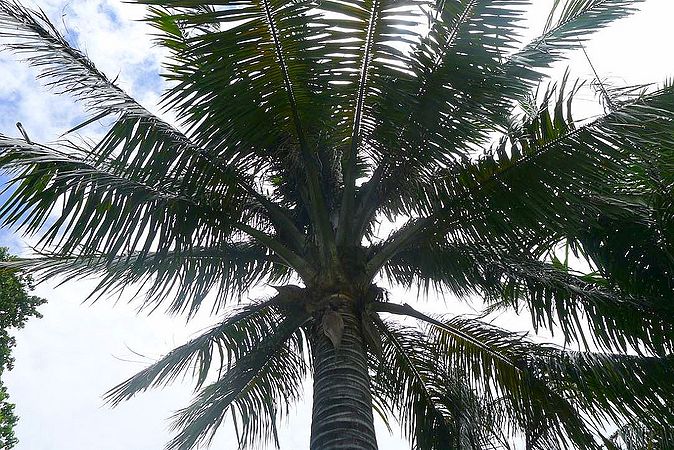
Photo-evolutionofplants.org

Haiti. Photo by Bart Colcome.
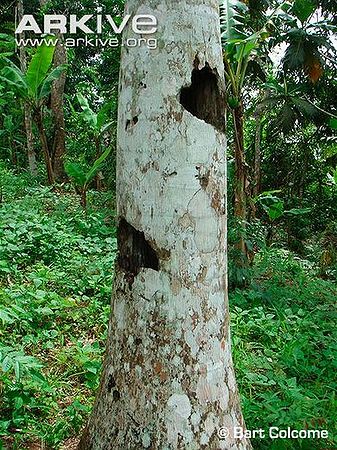
Haiti. Damaged trunk of carossier palm. Photo by Bart Colcome.
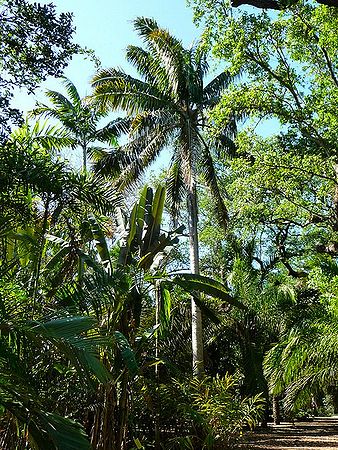
Photo by Jean-Baptiste G.
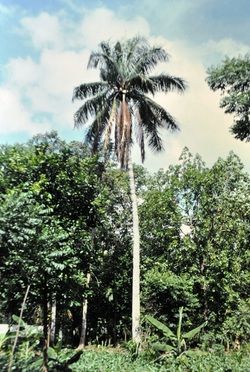
Haiti. Photo-southeastgarden.com

Montgomery Botanical Center in Miami, Florida. Photo by Paul Craft.

Fairchild Tropical Botanic Garden, Coral Gables, Florida. Photo by Paul Craft.

Photo by Paul Craft.

Photo by Paul Craft.

Photo by Paul Craft.

Photo by Paul Craft.

Photo by Paul Craft.

Photo by Paul Craft.

Image-Dr.'s Andrew J. Henderson & Michael Balick.

Image-Dr.'s Andrew J. Henderson & Michael Balick.


External Links
- Glossary of Palm Terms
- MODERN BOTANICAL LATIN
- "Just To Be Clear"
- http://www.conservationevidence.com/individual-study/1648
- http://cmsdata.iucn.org/downloads/psg_attalea_crassispatha.pdf
- http://www.virtualherbarium.org/psg/flagship/Attalea_crassispatha.html
- http://southeastgarden.com/haiti.html
- http://www.youtube.com/watch?v=0XzVQyMKiCQ
References
Phonetic spelling of Latin names by edric.
Special thanks to Geoff Stein, (Palmbob) for his hundreds of photos.
Special thanks to Palmweb.org, Dr. John Dransfield, Dr. Bill Baker & team, for their volumes of information and photos.
Glossary of Palm Terms; Based on the glossary in Dransfield, J., N.W. Uhl, C.B. Asmussen-Lange, W.J. Baker, M.M. Harley & C.E. Lewis. 2008. Genera Palmarum - Evolution and Classification of the Palms. Royal Botanic Gardens, Kew. All images copyright of the artists and photographers (see images for credits).
Henderson, A. & M. Balik. 1991. Attalea crassispatha, a rare and endemic Haitian palm. Brittonia 43: 189–194.
Many Special Thanks to Ed Vaile for his long hours of tireless editing and numerous contributions.