Difference between revisions of "Ceratolobus discolor"
| (One intermediate revision by one user not shown) | |||
| Line 19: | Line 19: | ||
}} | }} | ||
==Habitat and Distribution== | ==Habitat and Distribution== | ||
| − | Borneo, and Sumatra. Widespread but rather local, possibly overlooked, in Sarawak, West and South Kalimantan, and Sabah, and one population in West Sumatra. Confined to lowland Mixed-Dipterocarp forest, sometimes on seasonally flooded alluvial flats. | + | Borneo, and Sumatra. Widespread but rather local, possibly overlooked, in Sarawak, [[File:cdDSCF0072_1726_wai-seperaa(1).jpg|thumb|left|450px|Eastern Penan, Sarawak.]]West and South Kalimantan, and Sabah, and one population in West Sumatra. Confined to lowland Mixed-Dipterocarp forest, sometimes on seasonally flooded alluvial flats. |
| − | + | ||
==Description== | ==Description== | ||
Moderate-sized clustering rattan rarely exceeding 15 m in length. Stems closely clustering by short suckers, 6-11 mm in diam. without sheaths, to 30 mm with sheaths; internodes 20-35 cm long, occasionally still longer in juvenile plants. Leaf sheath pinky-grey-green when fresh and newly emerged, dull grey-green when fresh and old, dark grey-brown when dry, densely covered with caducous scurfy grey indumentum (dark brown scales rather rare), and armed with groups and partial whorls of easily detached dark brown, spiculate spines to 9 cm long, borne on pale yellowish-green bulbous bases, these last remaining long after the spiculae have become detached; occa- sionally with broad, thin, almost papery, straw-coloured spines to 3.7 x 0.3 m long in groups among the spiculae, very rarely these spines abundant and spiculae almost absent; geniculus prominent, either armed with spiculae or, in forms with broad papery spines, almost inerm; ocrea to 1.5 cm, brown, tattering. Leaf 1.5-2.5 m long in adult; petiole 10-35 cm long, occasionally longer in juvenile leaves, to 10 mm wide and 7 mm thick, rounded abaxially, flattened or slightly grooved adaxially, armed with scattered spiculae below, and groups of 2-4 more robust, not easily-detached yellow-green spines to 1.1 cm long, especially along the margins, and scattered smaller spines on the adaxial face; minute papillae and caducous grey-white indumentum between the spines; petiole decreasing in width and armature above; rachis armed as the petiole but in upper part, spines tending to be confined to abaxial face and grouped in grapnels of 3.5; cirrus to 1.5 m long, with grapnel spine groups 5 cm distant below, decreasing above, and scattered grey-white indumentum and few chocolate-coloured scales. {{read more top}}Leaflets 7-8 on each side of the rachis in mature leaf, the middle ones larger than the others, the largest broadly cuneate-rhomboid, to 35 x 16 cm at about 20 cm from the insertion on the rachis; lowermost leaflets on either side about 28 x 6 cm, upper- most to 32 x 10 cm; upper leaflet margins praemorse with rather rounded lobes, armed with small black bristles, the central lobe often prominent; whole leaflet markedly plicate with up to 15 plications, dull mid-green above, gleaming grey-white indumentose below, scattered dark-grey indumentum and brown pseudoparenchymatous scales along the main ribs on the upper surface and along margins exposed in bud; transverse veinlets rather obscure; emerging leaflets pink, turning dull brown then green. Staminate and pistillate inflorescences superficially similar, sessile, erect, very robust, the pistillate to 80 x 9 cm; base of inflorescence at point of insertion on leaf sheath about 15 mm wide by 5 mm through. Prophyll pale pinky-green at first emergence from sheaths, then drying to dull brown, very stiff, almost woody in texture, with dense caducous chocolate-coloured indumentum on both surfaces but especially on the abaxial surface; beak to 8 cm long by 2 cm wide at base and 0-5 cm wide at tip. Axis branching to 2 orders with up to 8 first-order branches 8 cm long; first-order bracts tightly sheathing, to 8 mm long, with apiculus to 12 mm long. Staminate flowers solitary, borne on an alveolus about 0.75 mm in diam.; calyx with shallowly triangular lobes to 0.75 mm long; corolla about 4.5 mm long split ? to the base into 3 lobes 2.25 mm wide near the base, tapering to bluntly triangular tips; stamens 6; filaments about 1 mm long; anthers 1.75 x 0.2 mm; pollen yellow; pistillode trifid, minute. Pistillate flower borne with sterile staminate flower in a pair on an alveolus about 1.25 mm in diam.; calyx with 3 triangular lobes about 1 mm high; corolla split to I into 3 broadly triangular lobes 4.5 x 3 mm; staminodes 6, with broad triangular bases and empty anthers about 1.5 mm long; ovary about 2.75 mm in diam., rounded, tipped with 3 sinuous stigmas to 1-5 mm long. Sterile staminate flower to 6.5 mm long; calyx 1 mm long, shallowly lobed; corolla split for 4.5 mm; staminodes with filaments 1.75 mm long and anthers 1.5 x 0.2 mm. Mature fruit bursting the enclosing inflorescence bract, and tending to hang out, rounded, to 1.5 cm in diam, tipped by stigma remains and covered with 12 vertical rows of pale orange-brown scales with darker brown margins; seed rounded about 1.2 cm in diam., covered in a thin sarcotesta; endosperm shallowly ruminate; embryo basal. Germination adjacent- ligular; eophyll not known. (J. Dransfield, A monograph of Ceratolobus (Palmae). 1979)/Palmweb. Editing by edric. | Moderate-sized clustering rattan rarely exceeding 15 m in length. Stems closely clustering by short suckers, 6-11 mm in diam. without sheaths, to 30 mm with sheaths; internodes 20-35 cm long, occasionally still longer in juvenile plants. Leaf sheath pinky-grey-green when fresh and newly emerged, dull grey-green when fresh and old, dark grey-brown when dry, densely covered with caducous scurfy grey indumentum (dark brown scales rather rare), and armed with groups and partial whorls of easily detached dark brown, spiculate spines to 9 cm long, borne on pale yellowish-green bulbous bases, these last remaining long after the spiculae have become detached; occa- sionally with broad, thin, almost papery, straw-coloured spines to 3.7 x 0.3 m long in groups among the spiculae, very rarely these spines abundant and spiculae almost absent; geniculus prominent, either armed with spiculae or, in forms with broad papery spines, almost inerm; ocrea to 1.5 cm, brown, tattering. Leaf 1.5-2.5 m long in adult; petiole 10-35 cm long, occasionally longer in juvenile leaves, to 10 mm wide and 7 mm thick, rounded abaxially, flattened or slightly grooved adaxially, armed with scattered spiculae below, and groups of 2-4 more robust, not easily-detached yellow-green spines to 1.1 cm long, especially along the margins, and scattered smaller spines on the adaxial face; minute papillae and caducous grey-white indumentum between the spines; petiole decreasing in width and armature above; rachis armed as the petiole but in upper part, spines tending to be confined to abaxial face and grouped in grapnels of 3.5; cirrus to 1.5 m long, with grapnel spine groups 5 cm distant below, decreasing above, and scattered grey-white indumentum and few chocolate-coloured scales. {{read more top}}Leaflets 7-8 on each side of the rachis in mature leaf, the middle ones larger than the others, the largest broadly cuneate-rhomboid, to 35 x 16 cm at about 20 cm from the insertion on the rachis; lowermost leaflets on either side about 28 x 6 cm, upper- most to 32 x 10 cm; upper leaflet margins praemorse with rather rounded lobes, armed with small black bristles, the central lobe often prominent; whole leaflet markedly plicate with up to 15 plications, dull mid-green above, gleaming grey-white indumentose below, scattered dark-grey indumentum and brown pseudoparenchymatous scales along the main ribs on the upper surface and along margins exposed in bud; transverse veinlets rather obscure; emerging leaflets pink, turning dull brown then green. Staminate and pistillate inflorescences superficially similar, sessile, erect, very robust, the pistillate to 80 x 9 cm; base of inflorescence at point of insertion on leaf sheath about 15 mm wide by 5 mm through. Prophyll pale pinky-green at first emergence from sheaths, then drying to dull brown, very stiff, almost woody in texture, with dense caducous chocolate-coloured indumentum on both surfaces but especially on the abaxial surface; beak to 8 cm long by 2 cm wide at base and 0-5 cm wide at tip. Axis branching to 2 orders with up to 8 first-order branches 8 cm long; first-order bracts tightly sheathing, to 8 mm long, with apiculus to 12 mm long. Staminate flowers solitary, borne on an alveolus about 0.75 mm in diam.; calyx with shallowly triangular lobes to 0.75 mm long; corolla about 4.5 mm long split ? to the base into 3 lobes 2.25 mm wide near the base, tapering to bluntly triangular tips; stamens 6; filaments about 1 mm long; anthers 1.75 x 0.2 mm; pollen yellow; pistillode trifid, minute. Pistillate flower borne with sterile staminate flower in a pair on an alveolus about 1.25 mm in diam.; calyx with 3 triangular lobes about 1 mm high; corolla split to I into 3 broadly triangular lobes 4.5 x 3 mm; staminodes 6, with broad triangular bases and empty anthers about 1.5 mm long; ovary about 2.75 mm in diam., rounded, tipped with 3 sinuous stigmas to 1-5 mm long. Sterile staminate flower to 6.5 mm long; calyx 1 mm long, shallowly lobed; corolla split for 4.5 mm; staminodes with filaments 1.75 mm long and anthers 1.5 x 0.2 mm. Mature fruit bursting the enclosing inflorescence bract, and tending to hang out, rounded, to 1.5 cm in diam, tipped by stigma remains and covered with 12 vertical rows of pale orange-brown scales with darker brown margins; seed rounded about 1.2 cm in diam., covered in a thin sarcotesta; endosperm shallowly ruminate; embryo basal. Germination adjacent- ligular; eophyll not known. (J. Dransfield, A monograph of Ceratolobus (Palmae). 1979)/Palmweb. Editing by edric. | ||
| Line 27: | Line 26: | ||
{{read more bottom}} | {{read more bottom}} | ||
==Culture== | ==Culture== | ||
| − | + | Cold Hardiness Zone: 11 | |
==Comments and Curiosities== | ==Comments and Curiosities== | ||
Latest revision as of 09:02, 10 January 2016
| Ceratolobus (sehr-ah-toh-LOH-buhs) discolor (dihs-cohl'-ohr) | |||||||
|---|---|---|---|---|---|---|---|
.jpg) Eastern Penan, Sarawak. | |||||||
| Scientific Classification | |||||||
| |||||||
| Synonyms | |||||||
|
| |||||||
| Native Continent | |||||||
 | |||||||
| Morphology | |||||||
| |||||||
| Culture | |||||||
|
| |||||||
| Survivability index | |||||||
|
| |||||||
| Common names | |||||||
|
| |||||||
Contents
Habitat and Distribution
Borneo, and Sumatra. Widespread but rather local, possibly overlooked, in Sarawak, Description
Moderate-sized clustering rattan rarely exceeding 15 m in length. Stems closely clustering by short suckers, 6-11 mm in diam. without sheaths, to 30 mm with sheaths; internodes 20-35 cm long, occasionally still longer in juvenile plants. Leaf sheath pinky-grey-green when fresh and newly emerged, dull grey-green when fresh and old, dark grey-brown when dry, densely covered with caducous scurfy grey indumentum (dark brown scales rather rare), and armed with groups and partial whorls of easily detached dark brown, spiculate spines to 9 cm long, borne on pale yellowish-green bulbous bases, these last remaining long after the spiculae have become detached; occa- sionally with broad, thin, almost papery, straw-coloured spines to 3.7 x 0.3 m long in groups among the spiculae, very rarely these spines abundant and spiculae almost absent; geniculus prominent, either armed with spiculae or, in forms with broad papery spines, almost inerm; ocrea to 1.5 cm, brown, tattering. Leaf 1.5-2.5 m long in adult; petiole 10-35 cm long, occasionally longer in juvenile leaves, to 10 mm wide and 7 mm thick, rounded abaxially, flattened or slightly grooved adaxially, armed with scattered spiculae below, and groups of 2-4 more robust, not easily-detached yellow-green spines to 1.1 cm long, especially along the margins, and scattered smaller spines on the adaxial face; minute papillae and caducous grey-white indumentum between the spines; petiole decreasing in width and armature above; rachis armed as the petiole but in upper part, spines tending to be confined to abaxial face and grouped in grapnels of 3.5; cirrus to 1.5 m long, with grapnel spine groups 5 cm distant below, decreasing above, and scattered grey-white indumentum and few chocolate-coloured scales.| read more |
|---|
| Leaflets 7-8 on each side of the rachis in mature leaf, the middle ones larger than the others, the largest broadly cuneate-rhomboid, to 35 x 16 cm at about 20 cm from the insertion on the rachis; lowermost leaflets on either side about 28 x 6 cm, upper- most to 32 x 10 cm; upper leaflet margins praemorse with rather rounded lobes, armed with small black bristles, the central lobe often prominent; whole leaflet markedly plicate with up to 15 plications, dull mid-green above, gleaming grey-white indumentose below, scattered dark-grey indumentum and brown pseudoparenchymatous scales along the main ribs on the upper surface and along margins exposed in bud; transverse veinlets rather obscure; emerging leaflets pink, turning dull brown then green. Staminate and pistillate inflorescences superficially similar, sessile, erect, very robust, the pistillate to 80 x 9 cm; base of inflorescence at point of insertion on leaf sheath about 15 mm wide by 5 mm through. Prophyll pale pinky-green at first emergence from sheaths, then drying to dull brown, very stiff, almost woody in texture, with dense caducous chocolate-coloured indumentum on both surfaces but especially on the abaxial surface; beak to 8 cm long by 2 cm wide at base and 0-5 cm wide at tip. Axis branching to 2 orders with up to 8 first-order branches 8 cm long; first-order bracts tightly sheathing, to 8 mm long, with apiculus to 12 mm long. Staminate flowers solitary, borne on an alveolus about 0.75 mm in diam.; calyx with shallowly triangular lobes to 0.75 mm long; corolla about 4.5 mm long split ? to the base into 3 lobes 2.25 mm wide near the base, tapering to bluntly triangular tips; stamens 6; filaments about 1 mm long; anthers 1.75 x 0.2 mm; pollen yellow; pistillode trifid, minute. Pistillate flower borne with sterile staminate flower in a pair on an alveolus about 1.25 mm in diam.; calyx with 3 triangular lobes about 1 mm high; corolla split to I into 3 broadly triangular lobes 4.5 x 3 mm; staminodes 6, with broad triangular bases and empty anthers about 1.5 mm long; ovary about 2.75 mm in diam., rounded, tipped with 3 sinuous stigmas to 1-5 mm long. Sterile staminate flower to 6.5 mm long; calyx 1 mm long, shallowly lobed; corolla split for 4.5 mm; staminodes with filaments 1.75 mm long and anthers 1.5 x 0.2 mm. Mature fruit bursting the enclosing inflorescence bract, and tending to hang out, rounded, to 1.5 cm in diam, tipped by stigma remains and covered with 12 vertical rows of pale orange-brown scales with darker brown margins; seed rounded about 1.2 cm in diam., covered in a thin sarcotesta; endosperm shallowly ruminate; embryo basal. Germination adjacent- ligular; eophyll not known. (J. Dransfield, A monograph of Ceratolobus (Palmae). 1979)/Palmweb. Editing by edric.
This is a spectacular rattan when found with inflorescences. The inflorescences are massive, erect, and the prophylls have an almost woody texture. Old inflorescences are frequently ant-infested. Observations in Sarawak suggest that the massive structure of the mature plant or stem is built up only gradually and that seedlings may be very slender. It is not known whether subsequent growth involves successive internodes increasing in diameter until the mature size is reached, or if the mature size is reached by develop- ment of more massively constructed stems by basal suckering-individual internodes cannot, of course, increase in diameter as secondary thickening does not occur. The presence of slender juvenile forms along with massively- constructed adults can lead to confusion-is one dealing with one or two species ? The slender juveniles differ only in size, do not bear inflorescences, and are found intermingled with the adults and this seems to be strong cir- cumstantial evidence that they represent different stages of the same species. The population in West Sumatra consisted of one large clump of several stems bearing massive pistillate inflorescences reminiscent of the Sarawak populations and several slender individuals one of which had a single old, well-rotted staminate inflorescence, about one third the size of the pistillate inflorescences. That this much smaller plant would seem to represent a neotenous individual of Ceratolobus discolor, rather than being another species, is suggested by the close similarity between it and the massive clump nearby in all features except sex and size. The much larger size of staminate inflorescences in Bornean populations suggests that this is only a chance instance of sexual dimorphism. It is on the basis of these observations that specimens regarded by Beccari as representing a distinct species, C. rostratus are here merged into C. discolor (see below under C. rostratus). Furthermore the presence of laminate spines, smaller lowermost leaflets and dense white indumentum on the lower leaflet surface are all features of C. discolor, and further suggest that inclusion of these Ceratolobus specimens, formerly included in C. rostratus, in C. discolor is correct. (J. Dransfield, A monograph of Ceratolobus (Palmae). 1979)/Palmweb. |
Culture
Cold Hardiness Zone: 11
Comments and Curiosities
- IMAGE GALLERY
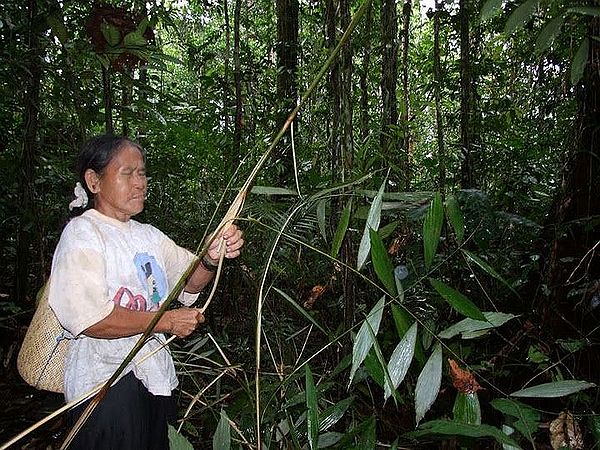
Eastern Penan, Sarawak.
External Links
References
Phonetic spelling of Latin names by edric.
Special thanks to Geoff Stein, (Palmbob) for his hundreds of photos.
Special thanks to Palmweb.org, Dr. John Dransfield, Dr. Bill Baker & team, for their volumes of information and photos.
Glossary of Palm Terms; Based on the glossary in Dransfield, J., N.W. Uhl, C.B. Asmussen-Lange, W.J. Baker, M.M. Harley & C.E. Lewis. 2008. Genera Palmarum - Evolution and Classification of the Palms. Royal Botanic Gardens, Kew. All images copyright of the artists and photographers (see images for credits).
J. Dransfield, A monograph of Ceratolobus (Palmae). 1979
Many Special Thanks to Ed Vaile for his long hours of tireless editing and numerous contributions.