Difference between revisions of "Chrysalidocarpus robustus"
| Line 59: | Line 59: | ||
Image:Potted_004.jpg|potted 2009. | Image:Potted_004.jpg|potted 2009. | ||
Image:Potted_003.jpg|potted 2009. | Image:Potted_003.jpg|potted 2009. | ||
| − | File:post-844-1210137233.jpg|Ranomafana Arboretum, Madagascar. Photo by Bill B. | + | File:post-844-1210137233.jpg|Ranomafana Arboretum, Madagascar. Bruno Leroy giving scale. Photo by Bill B. |
Image:robusta.jpg|Trunk detail, Courtesy Daryl O'Connor, Brisbane, Queensland. | Image:robusta.jpg|Trunk detail, Courtesy Daryl O'Connor, Brisbane, Queensland. | ||
File:post-42-0-66470900-1431244418.jpg|Wollongong Botanical Gardens Palm Collection, 90 minute drive south of Sydney. Photo by Daryl O'Connor. | File:post-42-0-66470900-1431244418.jpg|Wollongong Botanical Gardens Palm Collection, 90 minute drive south of Sydney. Photo by Daryl O'Connor. | ||
Revision as of 08:29, 1 January 2016
| Dypsis (DIP-sis) robusta (roh-BOOS-tah) | |||||||
|---|---|---|---|---|---|---|---|
 Brisbane Botanic Gardens Mt Coot-tha, Queenland, Australia. Photo by Paul Latzias. | |||||||
| Scientific Classification | |||||||
| |||||||
| Synonyms | |||||||
|
| |||||||
| Native Continent | |||||||
 | |||||||
| Morphology | |||||||
| |||||||
| Culture | |||||||
|
| |||||||
| Survivability index | |||||||
|
| |||||||
| Common names | |||||||
|
| |||||||
Contents
Habitat and Distribution
Endemic to Madagascar.

Description
A solitary, robust palm. Trunk 1.4 m tall, 36.4 cm. in diam. (l m above ground), flaring to 64 cm. in diam. at ground level; internodes 5-6.5 cm, dark green covered with white waxy indumentum, aging to brownish gray with vertical fissures; leaf scars 3.8 cm wide. Leaves about 14 in the crown, pinnate, ascending; base massive, 95 cm long, 25 cm wide adaxially and 40 cm wide abaxially at pinnae, flaring out to 115 cm wide in proximal 35 cm, thick, + woody, 12 cm think at pinnae, 3-4 cm thick midsheath, 1.5 cm thick at proximal margins, 3-5 mm thick at distal margins, orange-brown adaxially, densely covered with white waxy indumentum densely punctuated with ragged, branched, lacerate, fringed, reddish brown scales 2-2.5 mm high, sometimes with auricles to 8 cm high on either side of rachis; rachis to 4.6 m long, distally twisting nearly 180°, 25 cm wide and broadly channeled adaxially at sheath, 40 cm wide and broadly rounded abaxially at sheath, both surfaces green and densely covered with white waxy indumentum and reddish brown tomentum, adaxial channel to 4 cm deep but gradually narrowing and becoming shallower until at mid-blade a flattopped ridge and then 40 cm distally of midblade into a narrow sharply angled ridge 1.5 cm high, gradually dissipating near tip, rachis 4 cm wide midblade and 3 mm wide at tip, rounded abaxially and covered with white waxy indumentum, freshly cut surfaces with pinkish tinge; pinnae 135-140 per side, regularly arranged but twisting rachis and ascending pinnae with drooping tips imparting the appearance of being irregularly arranged and lending a somewhat plumose effect to the blade, most proximal 63 x 1.3 cm, at 1-2 m distally of sheath 120 x 4.5 cm, at 3 m distally of sheath 80 x 5 cm, most distal 18 x 0.5 cm, thick, coriaceous, dark glossy green adaxially with prominently raised light green midrib and thickened marginal nerves, 5-6 inconspicuous nerves between midrib and each margin, green with distinct glaucous bloom abaxially and prominently raised midrib, scattered light brown to tan, ragged, lacerate, medifixed ramenta 4-10 mm long on midrib abaxially and these most common in mid-blade and in proximal 30 cm of each pinna, pinnae 4-7 cm apart in proximal meter, 3-4 cm apart mid-blade to tip, forward pointing, spreading and flat with slightly drooping tips in proximal 1 m, at mid-blade ascending off rachis and blade + V-shaped, tips drooping, pinnae flat in distal 1 m. Inflorescences protandrous, interfoliar, branched to 4 orders, most proximal branches of first three orders of branching the largest and most complex and progressively becoming smaller and less complex distally until most distal represented by simple rachillae; peduncle 1 m long, 9 cm wide, 5 cm thick, arcuate, green, covered with patchy reddish brown tomentum; only tip of prophyll or 1st peduncular bract seen,| read more |
|---|
| this portion 18 cm long, green, stiff, coriaceous, flattened, 2- keeled, sparsely covered with reddish brown tomentum; 3 rudimentary peduncular bracts present, most distal 10 cm below most proximal branch, 1.5 cm high, next lowest 20 cm proximal below most proximal branch, 2.5 cm high, most proximal 38 cm below most proximal branch, 18 cm long; rachis 1.7m long, green with some reddish brown tomentum, 43 1st order branches; most proximal 1st order branch with sub-peduncle 18 cm long, 4.5-5.7 cm wide, flattened, 2.3 cm thick, sub-rachis 97 cm long with 32 2nd order branches; most proximal 2nd order branch with sub-peduncle 12.5 cm long, 1.2-1.9 cm wide, flattened, 1 cm thick, subrachis 30.5 cm long with 15 3rd order branches; most proximal 3rd order branch with subpeduncle 2.5 cm long and branched into 2-3 rachillae; all branches and rachillae of all orders subtended by bracteoles; rachillae (12-)20-25 cm long, 4 mm. in diam., spreading, ± stiff but drooping and yellow-green in fruit. Flowers (fresh flowers at anthesis not seen) borne in triads in cleft-like pits 1.5 mm high, 3 mm wide, 1 mm deep, proximal lip of pit cliff-like, slightly mucronate, triads 3-5 mm apart proximally, 2-3 mm apart distally; each staminate flower subtended by a small, thin, crescent-shaped, nearly transparent bracteole 0.2 mm high on outer side; pistillate flower subtended by 2, thin, light green, nearly transparent, imbricate bracteoles 0.5 mm high. Fruits 14 x 12 mm, very broadly ellipsoid, orange, stigmatic remains basal, just above perianth; mesocarp mucilaginous, 1 mm thick. Fruiting perianth 6.5 mm wide; sepals imbricate in basal 1/5, very briefly connate, broadly rounded apically, 2 x 3 mm; petals imbricate in basal 1/3-1/2, very briefly connate, 3 x 4-5 mm, rounded-triangular; staminodes 6, triangular, 0.8-1 mm high. Seeds 1 1 x 9 mm, obovoid-ellipsoid; endosperm homogeneous; embryo slightly distal of middle. (D. Hodel, J. Marcus and J. Dransfield. 2005)/Palmweb. Editing by edric.
Measurements for the description were taken from non-dried, fresh material Marcus had collected and sent to Hodel. Dried rachillae are more slender, floral pits more prominent, and proximal lip of floral pit sharper, thinner and more knife-like than in fresh rachillae. Dypsis robusta keys to couplet F21, Key 6 in The Palms of Madagascar but has homogeneous endosperm like D. ifanadianae and D. tsaravoasira. It differs from the former in the larger trunk diameter (36.4 vs. 18 cm), larger and different colored leaf base (95 vs. 72 cm, waxy white with reddish brown tomentum vs. green), longer rachis (4.6 vs. 3 m) with more pinnae per side (130 vs. 55), and inflorescence branched to 4 rather than 3 orders. It differs from the latter in the spirally vs. tristichously arranged leaves, different colored leaf base (waxy white with reddish brown tomentum vs. green), longer rachis (4.6 vs. 3.5 m), and larger (1.8 vs. 0.6 m) and interfoliar rather than infrafoliar inflorescence branched to 4 rather than 3 orders. Dypsis robusta has somewhat similar leaf bases to those of D. hovomantsina but differs in the wider (to 5 vs. to 4 cm), regularly arranged rather than irregularly arranged pinnae, longer rachis (4.6 vs. 3.5 m) with more pinnae per side (130 vs. 96), larger (1.7 vs. 0.48 m), interfoliar rather than infrafoliar inflorescence branched to 4 rather than 3 orders, and homogeneous rather than deeply ruminate endosperm. Marcus originally obtained several small plants of Dypsis robusta from the late Maria Walford- Huggins Boggs of Australia in 1991 or 1992. Boggs, who did not say where the plants originated, called the species Chrysalidocarpns 'Stumpy' (not to be confused with Dypsis 'Stumpy,' which was later named and described as D. carlsmithii). Few large or mature plants of this species are known in cultivation. Marcus gave one plant to Florida nurseryman George Zammas, but its fate is unknown. Arden Dearden and Clayton York in Australia have plants, but they have not yet flowered. Kampon Tansacha has one plant in his Nong Nooch Tropical Garden in Thailand that has recently flowered (Michael Ferrero, per. comm.). Marcus has erroneously referred to this palm in the past as D. prestoniana although more recently he has distributed it as Dypsis 'Maria's Stumpy.' Clayton York (per. comm.) reported that this species may have originally been introduced erroneously as D. caniculata . Dypsis robusta would make a fine ornamental for parks, public areas, and large gardens in the tropics and warm subtropics. Its suitability for more temperate areas, such as regions with a Mediterranean climate, is unknown. The type plant in the Marcus nursery in Hilo, Hawaii has a short but robust trunk about 1.5 m tall, is 6 m tall overall, and has been flowering for about a year. The twisting rachis and ascending pinnae with drooping tips impart the appearance of being irregularly arranged and lend a somewhat plumose effect to the blade although pinnae are regularly arranged in one plane. (D. Hodel, J. Marcus and J. Dransfield. 2005)/Palmweb. |
Culture
Cold Hardiness Zone: 10a

Comments and Curiosities
| read more |
|---|
|
Since publication of The Palms of Madagascar (Dransfield and Beentje 1995), several new species of Dypsis have been discovered, described and named. Jeff Marcus, an ardent collector and commerical palm grower, discovered two of these new Dypsis cultivated in Hawaii, one in his own nursery near Hilo. Marcus and others widely distributed seeds and seedling of these new Dypsis, and they were subsequently described and named as D. carlsmithii and D. albofarinosa (Dransfield and Marcues 2002 and Hodel and Marcus 2004). Now Marcus has discovered a third new Dypsis in his nursery, and because he has been distributing seedlings, it is approrpiate to describe and name this large, robust new species. (D. Hodel, J. Marcus and J. Dransfield. 2005)/Palmweb. So as not to be confused, notice how juvenile pinnae start out fat, but once mature, wind up rather skinny, morphing of this nature is typical of Dypsis species, this species was previously known as Dypsis sp. 'white stem' Here is a page to both inform and "search for" possibly the rarest Dypsis out there. An unknown, large, tristichtous, palm that while it looks similar to other Dypsis, it 99.99% of the time, is sadly not the palm here. Dypsis Dean has owned and killed a few and it currently is only known to exist in 3 collections in Southern California. Originally located and collected by Mardy Darian in Madagascar, he has said and many have agreed that at one time he had "hundreds" of seedlings, and thought he could go back to get more. Upon his return, the area was cleared. A large thread was started in Palmtalk, you may want to read. HERE |
This is a tillering palm, it exhibits saxophone style root growth (it has a heel), keep top third of heel above soil elevation!
- IMAGE GALLERY

Marcus Garden, Hawaii.

Marcus Garden, Hawaii.

Hawaii.

Hawaii.
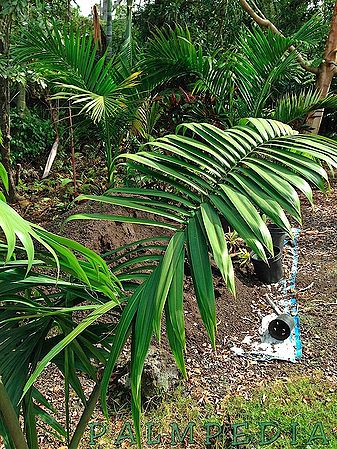
Hawaii.

Vista - Cuesta Linda.

Vista - Cuesta Linda.
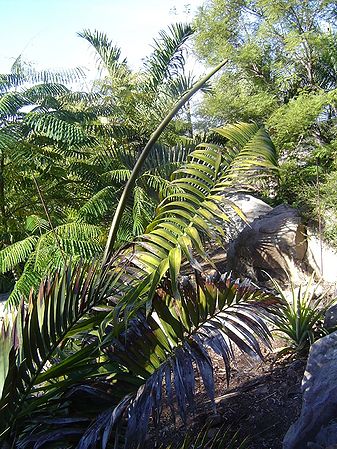
Vista - 12/27/09.

Vista - 12/27/09.

Vista - 12/27/09.

potted 2009.

potted 2009.

Ranomafana Arboretum, Madagascar. Bruno Leroy giving scale. Photo by Bill B.

Trunk detail, Courtesy Daryl O'Connor, Brisbane, Queensland.

Wollongong Botanical Gardens Palm Collection, 90 minute drive south of Sydney. Photo by Daryl O'Connor.

Photographed it in a botanic garden in Madgascar. Photo by Kim

Photographed it in a botanic garden in Madgascar. Photo by Kim

Photographed it in a botanic garden in Madgascar. Photo by Kim

growing in a 7gal pot

Old Beach, Tasmania, Australia. Photo by Troy Donovan

Brisbane Botanical gardens, Australia. Troy giving scale. Photo by Troy Donovan

Utopia Palms & Cycads, QLD. Australia. Photo by Troy Donovan

Brisbane Botanic Gardens Mt Coot-tha, Queenland, Australia. Stuart giving scale. Photo by Paul Latzias.

Brisbane Botanic Gardens Mt Coot-tha, Queenland, Australia. Photo by Paul Latzias.
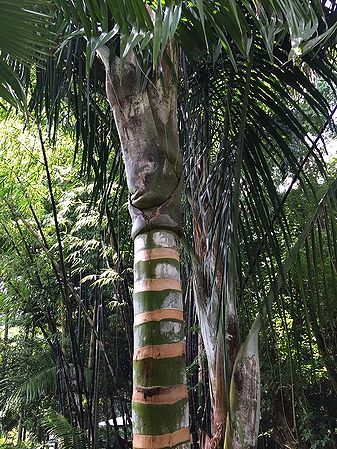
Brisbane Botanic Gardens Mt Coot-tha, Queenland, Australia. Photo by Paul Latzias.

Jeff Marcus for scale. Floribunda, Hawaii. Photo-Rare Palm Seeds.com
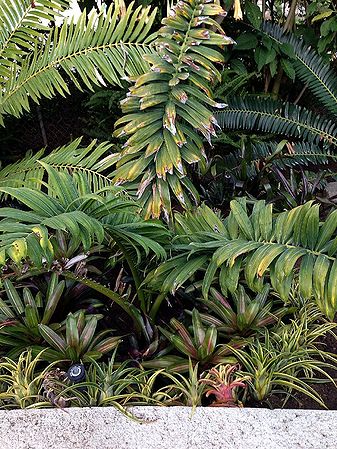
Vista, CA. Photo by Jeffry Brusseau
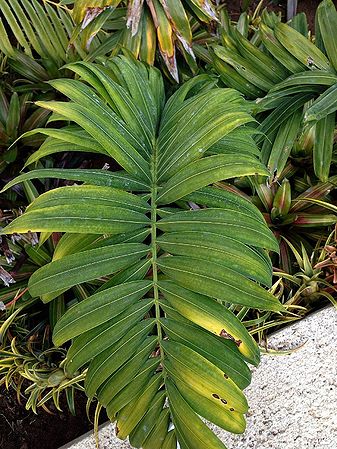
Vista, CA. Photo by Jeffry Brusseau

Hawaii. Bill Austin's place. Photo by Paul Latzias.

Brisbane Botanic Gardens, Mount Coot-tha, Brisbane, Australia. Photo by Paul Latzias.

Brisbane Botanic Gardens, Mount Coot-tha, Brisbane, Australia. Photo by Paul Latzias.


External Links
- Glossary of Palm Terms
- MODERN BOTANICAL LATIN
- "Just To Be Clear"
- THE SAXOPHONE STYLE ROOT GROWTH (HEEL)
- Dypsis robusta Found in the Wild
References
Phonetic spelling of Latin names by edric.
Special thanks to Geoff Stein, (Palmbob) for his hundreds of photos.
Special thanks to Palmweb.org, Dr. John Dransfield, Dr. Bill Baker & team, for their volumes of information and photos.
Glossary of Palm Terms; Based on the glossary in Dransfield, J., N.W. Uhl, C.B. Asmussen-Lange, W.J. Baker, M.M. Harley & C.E. Lewis. 2008. Genera Palmarum - Evolution and Classification of the Palms. Royal Botanic Gardens, Kew. All images copyright of the artists and photographers (see images for credits).
Hodel, D. , Marcus, J. & Dransfield, J. 2005. Dypsis robusta, a large new palm from cultivation. Palms 49(3): 128-130.
Many Special Thanks to Ed Vaile for his long hours of tireless editing and numerous contributions.