Difference between revisions of "Calamus diepenhorstii"
| Line 23: | Line 23: | ||
==Description== | ==Description== | ||
A moderately large, clustering and variable rattan, widespread in lowland rainforests on Borneo, the Malay Peninsula, Sumatra and in the Philippines below 800 m (2600 ft.), with slender stems to 3 cm (1 in.) in diameter including the leafsheath and 20 m (67 ft.) long. The arching leaves are finely pinnate and do not carry a cirrus, but the leafsheath holds a spiny flagellum to 2 m (7 ft.) or more long. In cultivation it is best adapted to a tropical climate. The cane has a good quality and is widely used. (RPS.com) | A moderately large, clustering and variable rattan, widespread in lowland rainforests on Borneo, the Malay Peninsula, Sumatra and in the Philippines below 800 m (2600 ft.), with slender stems to 3 cm (1 in.) in diameter including the leafsheath and 20 m (67 ft.) long. The arching leaves are finely pinnate and do not carry a cirrus, but the leafsheath holds a spiny flagellum to 2 m (7 ft.) or more long. In cultivation it is best adapted to a tropical climate. The cane has a good quality and is widely used. (RPS.com) | ||
| + | |||
| + | |||
| + | |||
| + | |||
Revision as of 23:57, 21 January 2015
| Calamus (KAL-ah-muhs) diepenhorstii (dee-eh-pehn-HOHRS-tee) | |||||||
|---|---|---|---|---|---|---|---|
 Photo-Malaysian Biological Diversity. | |||||||
| Scientific Classification | |||||||
| |||||||
| Synonyms | |||||||
|
| |||||||
| Native Continent | |||||||
|
| |||||||
| Morphology | |||||||
| |||||||
| Culture | |||||||
|
| |||||||
| Survivability index | |||||||
|
| |||||||
| Common names | |||||||
|
| |||||||
Contents
Habitat and Distribution
Borneo, Malaya, Philippines, Sumatera, and Thailand.

Description
A moderately large, clustering and variable rattan, widespread in lowland rainforests on Borneo, the Malay Peninsula, Sumatra and in the Philippines below 800 m (2600 ft.), with slender stems to 3 cm (1 in.) in diameter including the leafsheath and 20 m (67 ft.) long. The arching leaves are finely pinnate and do not carry a cirrus, but the leafsheath holds a spiny flagellum to 2 m (7 ft.) or more long. In cultivation it is best adapted to a tropical climate. The cane has a good quality and is widely used. (RPS.com)
| Detailed Scientific Description |
|---|
|
I have referred to C. diepenhorstii two rather different forms in Sarawak. One occurs in kerangas at the foot of G Pueh; it more nearly approaches typical C. diepenhorstii than the other except in the sheath spines which have conspicuous swollen bases. The other was collected on the summit ridge of G Buri along the border of the 1st and 2nd Divisions; it possesses more numerous, smaller leaflets which are densely covered with bristles on the lower surface, and the leaf sheath is densely armed with long spines. There are only two collections of each form and so I am reluctant to commit myself as to whether they deserve varietal status within C. diepenhorstii. (Dransfield, J. 1992. The Rattans of Sarawak. Forest Department Sarawak, Malaysia and Royal Botanic Gardens, Kew, UK)/Palmweb. Editing by edric. |
Culture
Comments and Curiosities
Etymology: H. Diepenhorst, 1811-1860, Assistant Resident in W Sumatra.
| read more |
|---|
|
There are three subspecies: 1.) Calamus diepenhorstii var. diepenhorstii; Known from two collections in Ulu Ingei. Elsewhere in Sabah (as var. major J. Dransf.), Sarawak, widespread in Peninsular Malaysia and Sumatra, in Philippines as a distinct variety. C. diepenhorstii var. diepenhorstii occurs in kerangas on ridge tops in the Ulu Ingei. It is a common rattan in Peninsular Malaysia, where it is used extensively (as rotan kerai), but it appears to be too rare in Brunei and elsewhere in Borneo, to be of any significance in the rattan trade. Clustering rattan climbing to 20 m; stem without sheaths to about 15 mm in diam., with sheaths to 30 mm in diam., internodes to about 15 cm. Sheaths dull, often brownish-green, drying brown, armed with long black flattened spines to 40 mm, usually less, sometimes with conspicuous swollen bases, brown scales abundant between the spines; knee conspicuous; ocrea poorly developed. Flagellum to 2 m long. Leaf ecirrate, curved, to 1.2 m long including the petiole 20-40 cm long; leaflets c. 15-30 on each side of the rachis, regularly arranged, curved, linear, the longest (in one form) to 35 × 1.4 cm, or (in another form) to 50 × 2 cm, bristly on main vein on upper surface, armed with 3 rows of bristles or densely covered with bristles on the lower surface. Inflorescence to 4 m with about 5 very distant, partial inflorescences, long pendulous; male rachillae about 50 × 2 mm; female rachillae about 70 × 3 mm. Mature fruit rounded, about 22 mm in diam., briefly beaked and covered in 16-21 vertical rows of brown scales. Seed rounded; endosperm ruminate. Seedling leaf bifid. 2.) Calamus diepenhorstii var. exulans; Philippines. 3.) Calamus diepenhorstii var. major; Borneo. (J. Dransfield, The Rattans of Brunei Darussalam. 1997)/Palmweb. |
- IMAGE GALLERY

Photo-Malaysian Biological Diversity.
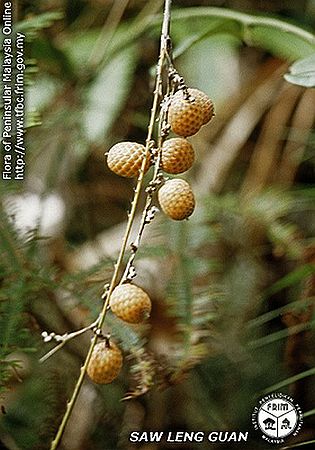
Photo-Malaysian Biological Diversity.

Kuantan, Pahang, Malaysia. Photo by Dr. John Dransfield, Royal Botanic Gardens, Kew/Palmweb.

Photo-Rare Palm Seeds.com

Photo-Rare Palm Seeds.com
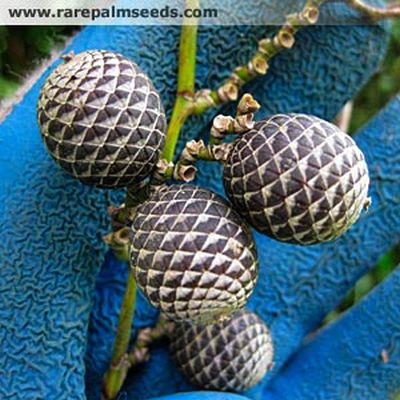
Photo-Rare Palm Seeds.com


External Links
References
Phonetic spelling of Latin names by edric.
Special thanks to Geoff Stein, (Palmbob) for his hundreds of photos.
Special thanks to Palmweb.org, Dr. John Dransfield, Dr. Bill Baker & team, for their volumes of information and photos.
Glossary of Palm Terms; Based on the glossary in Dransfield, J., N.W. Uhl, C.B. Asmussen-Lange, W.J. Baker, M.M. Harley & C.E. Lewis. 2008. Genera Palmarum - Evolution and Classification of the Palms. Royal Botanic Gardens, Kew. All images copyright of the artists and photographers (see images for credits).
Dransfield, J. 1992. The Rattans of Sarawak. Forest Department Sarawak, Malaysia and Royal Botanic Gardens, Kew, UK
J. Dransfield, The Rattans of Brunei Darussalam. 1997
Many Special Thanks to Ed Vaile for his long hours of tireless editing and numerous contributions.