Difference between revisions of "Wodyetia bifurcata"
Geoff Stein - Author & Editor
| Line 4: | Line 4: | ||
</center> | </center> | ||
'''''Wodyetia bifurcata''''' was a very rare and endangered palm in the late 1900s, yet now it is universally grown and is even becoming somewhat 'common' in California landscapes. It is an exotic and highly ornamental Australian native that has shown some remarkable versatility in terms of climate tolerance (though still not a great palm for areas with substantial frost)- even growing in the hot inland deserts if protected from full sun. There are second and probably third generation palms growing in California. Leaves are highly plumose and somewhat resemble a foxes tail. | '''''Wodyetia bifurcata''''' was a very rare and endangered palm in the late 1900s, yet now it is universally grown and is even becoming somewhat 'common' in California landscapes. It is an exotic and highly ornamental Australian native that has shown some remarkable versatility in terms of climate tolerance (though still not a great palm for areas with substantial frost)- even growing in the hot inland deserts if protected from full sun. There are second and probably third generation palms growing in California. Leaves are highly plumose and somewhat resemble a foxes tail. | ||
| − | + | <center> | |
{| colspan="2" style="background: #FCFCFC; border: 1px solid black; vertical-align: top;" | | {| colspan="2" style="background: #FCFCFC; border: 1px solid black; vertical-align: top;" | | ||
| style="width: 50%; background: #f8e8df; border: 1px solid black; vertical-align: top;" | | | style="width: 50%; background: #f8e8df; border: 1px solid black; vertical-align: top;" | | ||
| Line 36: | Line 36: | ||
*'''Availability''': relatively common (even at garden outlet stores) | *'''Availability''': relatively common (even at garden outlet stores) | ||
|} | |} | ||
| + | {{#Widget:AdResBan}} | ||
<gallery> | <gallery> | ||
File:Wodyetia better K.jpg|Huntington Beach, California | File:Wodyetia better K.jpg|Huntington Beach, California | ||
Revision as of 22:39, 12 August 2015
Common Name: Foxtail Palm
Wodyetia bifurcata was a very rare and endangered palm in the late 1900s, yet now it is universally grown and is even becoming somewhat 'common' in California landscapes. It is an exotic and highly ornamental Australian native that has shown some remarkable versatility in terms of climate tolerance (though still not a great palm for areas with substantial frost)- even growing in the hot inland deserts if protected from full sun. There are second and probably third generation palms growing in California. Leaves are highly plumose and somewhat resemble a foxes tail.
|
Appearance and Biology
|
Horticultural Characteristics
|

Huntington Beach, California

Ventura, California

Orange county, California

Orange county, California

Orange county

Santa Barbara, California

Seal Beach, California

Ventura, California

Ventura

Huntington Beach, California

San Fernando valley, 10 year old palm in very marginal climate, California

a bit nutrient deficient, California

Palm Desert, Californa

Palm Desert, Living Desert botanical garden, California

Thailand

Hawaii

Hawaii

Hawaii, University of Hawaii

Hilo Zoo, Hawaii

Hawaii

Hawaii

Hawaii

Hawaii

Hawaii
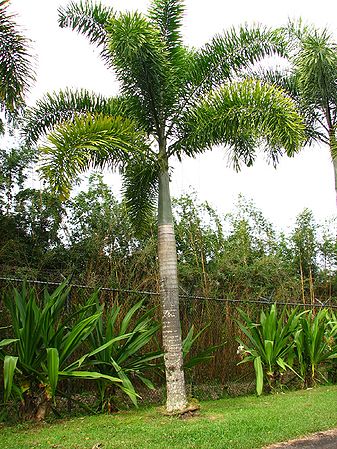
Hilo Zoo, Hawaii

Hawaii

Los Angeles arboretum

Los Angeles arboretum

juvenile leaf detail

trunk in California

flowering palm, Los Angeles arboretum

inflorescence, California

various stages of fruiting, Hawaii


trees in fruit, Hawaii


weird bud illness, California


