Difference between revisions of "Bismarckia Nobilis"
Geoff Stein - Author & Editor
| Line 9: | Line 9: | ||
<div style="background: #e5a178; border: 1px solid black; padding: 5px; margin: 3px; font-weight: bold; text-align: center; font-size: 120%;">Morphology (Identification)</div> | <div style="background: #e5a178; border: 1px solid black; padding: 5px; margin: 3px; font-weight: bold; text-align: center; font-size: 120%;">Morphology (Identification)</div> | ||
<div style="padding-left: 1em;"> | <div style="padding-left: 1em;"> | ||
| − | *'''Habit''': solitary | + | *'''Habit''': solitary with huge crown of up to 2 dozen leaves |
*'''Height''': 30 feet | *'''Height''': 30 feet | ||
*'''Spread''': 14'-16' | *'''Spread''': 14'-16' | ||
| − | *'''Trunk''': | + | *'''Trunk''': 16"-24" and clean except for a few dead leaves near top of trunk |
| − | *'''Leaf Shape''': palmate to mildly costapalmate, very stiff and often with a waxy coating | + | *'''Leaf Shape and Color''': palmate to mildly costapalmate, very stiff and often with a waxy coating; color ranges from green (to lime green if struggling) to the more hardy colors of grey, grey-green, blue-green to silver blue |
*'''Petiole''': no teeth but extremely sharp | *'''Petiole''': no teeth but extremely sharp | ||
| − | |||
*'''Reproduction''': dioecious | *'''Reproduction''': dioecious | ||
*'''Inflorescence''': stiff, rope-like and branched | *'''Inflorescence''': stiff, rope-like and branched | ||
| Line 24: | Line 23: | ||
<div style="padding-left: 1em;"> | <div style="padding-left: 1em;"> | ||
*'''Minimum Temperature''': Green form- 28F; Blue or Grey forms- 22F (improves with maturity) | *'''Minimum Temperature''': Green form- 28F; Blue or Grey forms- 22F (improves with maturity) | ||
| − | *'''Drought Tolerance''': moderate to good with maturity | + | *'''Drought Tolerance''': moderate to good with maturity but still likes a lot of water |
*'''Heat Tolerance''': excellent | *'''Heat Tolerance''': excellent | ||
*'''Wind Tolerance''': fair to good (blue forms more tolerant than green) | *'''Wind Tolerance''': fair to good (blue forms more tolerant than green) | ||
| Line 32: | Line 31: | ||
*'''Growth Rate''': slow to moderate, becoming moderately fast with maturity | *'''Growth Rate''': slow to moderate, becoming moderately fast with maturity | ||
*'''Human Hazards''': very sharp petiole blades (easy to injure oneself if pruning without gloves) | *'''Human Hazards''': very sharp petiole blades (easy to injure oneself if pruning without gloves) | ||
| − | *'''Disease Problems''': few in California | + | *'''Disease Problems''': few in California |
| + | *'''Transplanting?''': very difficult to transplant once forming a trunk- best to plant where you want it forever | ||
| + | *'''Indoor?''': poor choice for indoors due to extremely high light requirements, no to mention size | ||
| + | *'''Availability''': commonly available now even from garden outlet nurseries, at least in California | ||
|} | |} | ||
<gallery> | <gallery> | ||
Revision as of 22:09, 29 July 2014
Common Name: Bismarck Palm
Bismarckia nobilis is a large, solitary Madagascan palm with immense mildly costapalmate, stiff leaves of either dull green or various shades of waxy blue or grey. It is widely considered one of the most ornamental and majestic palms one can grow in southern California. Green forms of this palm grow rapidly in the tropics, but are rather marginal in most areas of southern California, only managing to grow to adulthood in the most ideal climates (frost-free coastal, or nearly frost free inland low deserts). However, the blue, grey and white forms are much hardier and faster growing in a Mediterranean climate and perform excellently along the coast as well as far inland as the low deserts. Damage to young plants during moderate to severe frosts often results in complete defoliation, but surprisingly many still recover. Plant this one where you want it (remembering it gets enormous) because it is a very hard palm to transplant successfully (root trauma often results in the death of the palm). Available from single leaf seedling to large boxes nowadays. Very commonly available, even at large home garden centers sometimes.
|
Morphology (Identification)
|
Horticultural Characteristics
|

Bismarckias of various sizes for sale, California

Balboa Park trees

mature specimen in Palm Desert

very rapidly growing grey plant in Ventura county, only 10 years old

mature palm in Orange county, California

maturing palm in Palm Desert
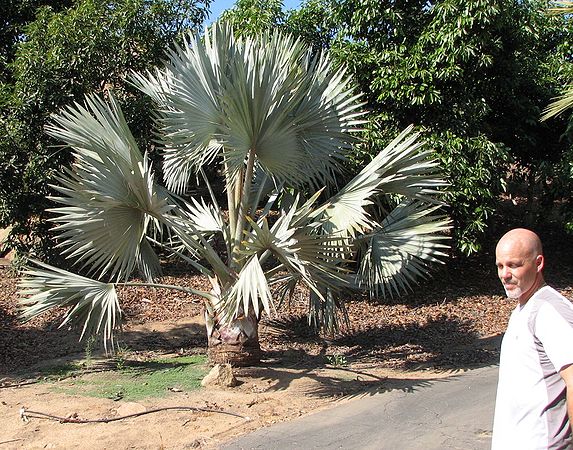
blue form near Vista, California

palm in coastal California mountains

Los Angeles arboretum

silver form, Vista, California

white form, Hawaii

pale blue form, Hawaii

blue form, Orlando, Florida
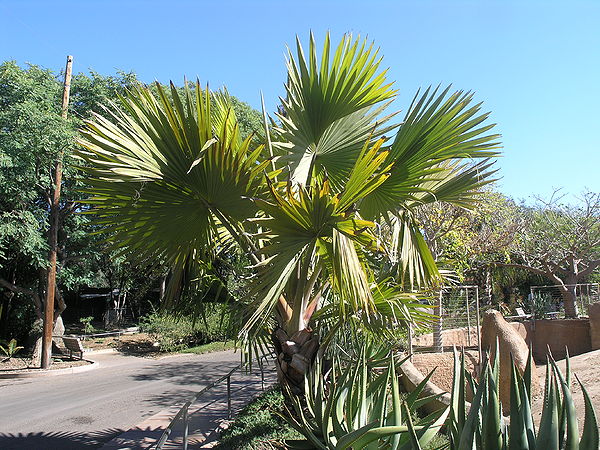
green form San Diego Zoo

mature, healthy green form in Palm Desert

struggling green palm in California (eventually died)

tall green palm Singapore
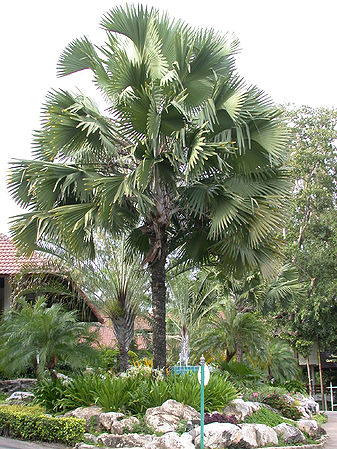
nice fast growing green palm Thailand
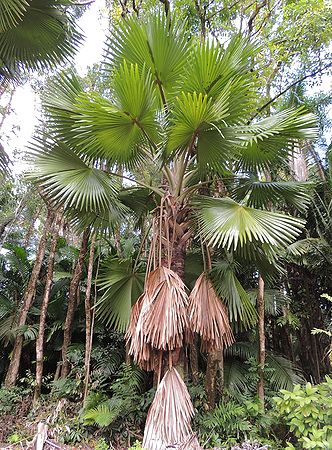
green palm in Hawaii

another healthy green palm in Hawaii

green palms in Hawaii
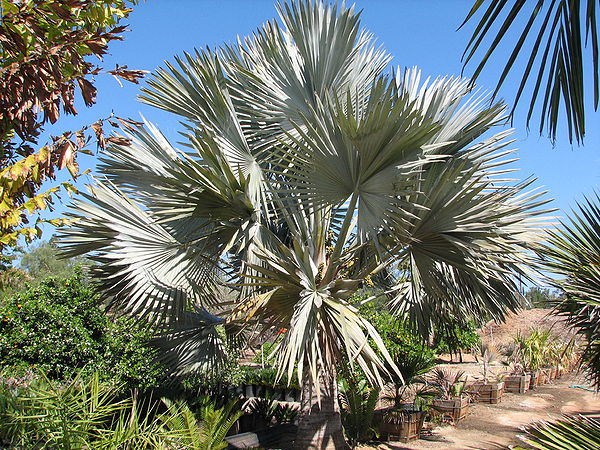
fruiting female in Fallbrook, California

female fruits, Hawaii

male in flower, Hawaii
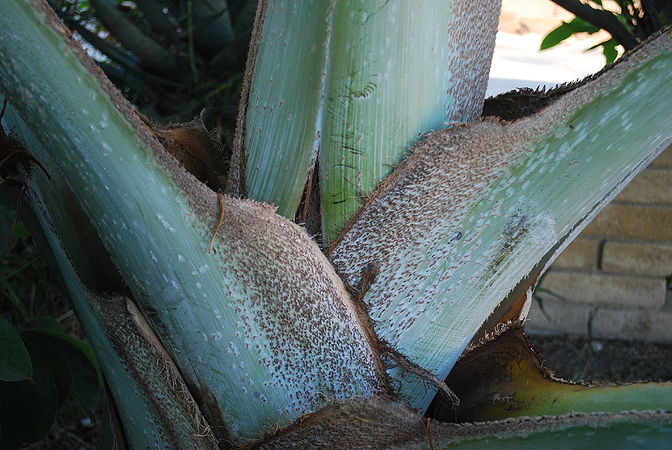
leaf bases
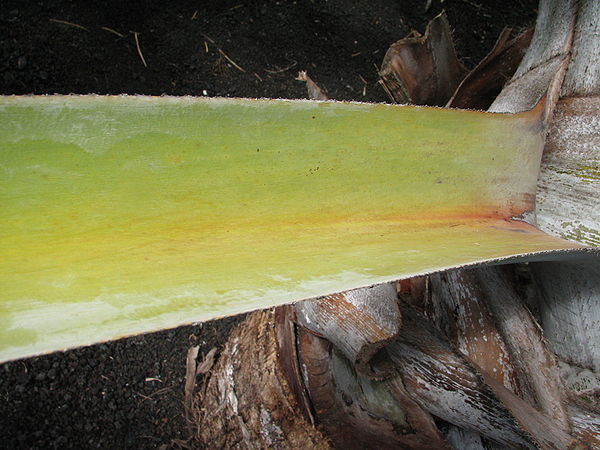
very sharp petiole blades


