Difference between revisions of "Lanonia dasyantha"
Geoff Stein - Author & Editor
(Created page with "<center>'''Pronunciation''': lah-NO-nee-uh dah-zee-AN-thuh <br/> '''Common Name''': Vietnamese Paradise Palm </center> '''''Lanonia dasyantha''''' was, until the early 2000s...") |
|||
| (3 intermediate revisions by one user not shown) | |||
| Line 3: | Line 3: | ||
'''Common Name''': Vietnamese Paradise Palm | '''Common Name''': Vietnamese Paradise Palm | ||
</center> | </center> | ||
| − | '''''Lanonia dasyantha''''' was, until the early 2000s, known as Licuala radula and many will still know at such. It is the only mottled Licuala-like palm that can survive outdoors in California (so far) and some enthusiasts of had success with this palm in their gardens here. | + | '''''Lanonia dasyantha''''' was, until the early 2000s, known as ''Licuala radula'' and many will still know at such. It is the only mottled Licuala-like palm that can survive outdoors in California (so far) and some enthusiasts of had success with this palm in their gardens here. There was a lot of excitement about this palm in the late 1990s, but it has turned out to a bit tougher to keep happy than was at first thought. But it still exists in some gardens, though it is unlikely any will produce viable flowers |
| + | Synonym: ''Licuala radula'' | ||
| + | <center> | ||
{| colspan="2" style="background: #FCFCFC; border: 1px solid black; vertical-align: top;" | | {| colspan="2" style="background: #FCFCFC; border: 1px solid black; vertical-align: top;" | | ||
| style="width: 50%; background: #f8e8df; border: 1px solid black; vertical-align: top;" | | | style="width: 50%; background: #f8e8df; border: 1px solid black; vertical-align: top;" | | ||
<div style="background: #e5a178; border: 1px solid black; padding: 5px; margin: 3px; font-weight: bold; text-align: center; font-size: 120%;">Appearance and Biology</div> | <div style="background: #e5a178; border: 1px solid black; padding: 5px; margin: 3px; font-weight: bold; text-align: center; font-size: 120%;">Appearance and Biology</div> | ||
<div style="padding-left: 1em;"> | <div style="padding-left: 1em;"> | ||
| − | *'''Habit''': | + | *'''Habit''': clustering or solitary with a crown of 3-6 fan leaves |
| − | *'''Height''': | + | *'''Height''': 3' overall (stemless or nearly so- 1' maximum height estimate) |
| − | *'''Trunk''': | + | *'''Trunk''': non-existant or single/multiple stems up to 1' (estimate); 1" thick; retained leaf bases on stems |
| − | *'''Crownshaft''': | + | *'''Crownshaft''': none |
| − | *'''Spread''': | + | *'''Spread''': 3'-5' |
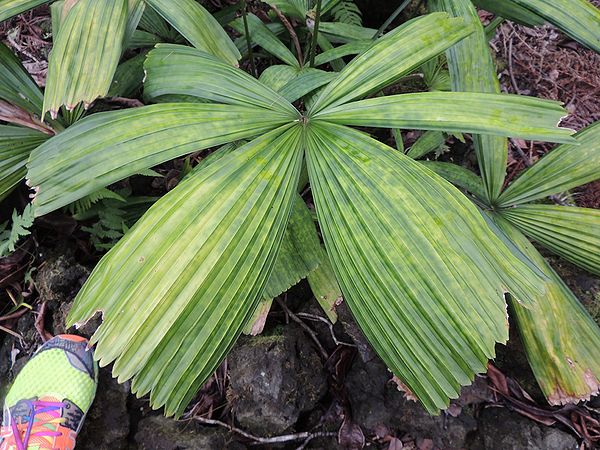
| − | *'''Leaf Description''': | + | *'''Leaf Description''': palmate; deeply divided (to the petiole); 3/4 circle to nearly circular; 2'-3' long; deep green with mottling of pale green |
| − | *'''Petiole/Leaf bases''': | + | *'''Petiole/Leaf bases''': bright green; flattish; arching; un-split and retained on stem, if any; unarmed or with very short, widely spaced teeth |
| − | *'''Reproduction''': | + | *'''Reproduction''': dioecious |
| − | *'''Inflorescence''': | + | *'''Inflorescence''': |
| − | *'''Fruit''': | + | *'''Fruit''': 1/3" in diameter; globoid; red when ripe |
| style="width: 50%; background: #f8e8df; border: 1px solid black; vertical-align: top;" | | | style="width: 50%; background: #f8e8df; border: 1px solid black; vertical-align: top;" | | ||
<div style="background: #e5a178; border: 1px solid black; padding: 5px; margin: 3px; font-weight: bold; text-align: center; font-size: 120%;">Horticultural Characteristics</div> | <div style="background: #e5a178; border: 1px solid black; padding: 5px; margin: 3px; font-weight: bold; text-align: center; font-size: 120%;">Horticultural Characteristics</div> | ||
<div style="padding-left: 1em;"> | <div style="padding-left: 1em;"> | ||
| − | *'''Minimum Temp''': | + | *'''Minimum Temp''': 30F |
| − | *'''Drought Tolerance''': | + | *'''Drought Tolerance''': low |
| − | *'''Dry Heat Tolerance''': | + | *'''Dry Heat Tolerance''': low |
| − | *'''Cool Tolerance''': | + | *'''Cool Tolerance''': low |
| − | *'''Wind Tolerance''': | + | *'''Wind Tolerance''': low |
| − | *'''Salt Tolerance''': | + | *'''Salt Tolerance''': unknown |
| − | *'''Growth Rate''': | + | *'''Growth Rate''': very slow |
| − | *'''Soil Preference''': | + | *'''Soil Preference''': moist |
| − | *'''Light Requirement''': | + | *'''Light Requirement''': shade to filtered light |
| − | *'''Human Hazards''': | + | *'''Human Hazards''': virtually none |
| − | *'''Disease or Horticultural Problems''': | + | *'''Disease or Horticultural Problems''': none |
| − | *'''Transplants?''': | + | *'''Transplants?''': unknown |
| − | *'''Indoor?''': | + | *'''Indoor?''': likely a good candidate |
| − | *'''Availability''': | + | *'''Availability''': very rare |
|} | |} | ||
| + | {{#Widget:AdResBan}} | ||
<gallery> | <gallery> | ||
| − | + | File:Licuala radula 2.jpg|all photos from Hawaii, unless labeled otherwise | |
| + | File:Licuala radula again maybe DO side shot.jpg| | ||
| + | File:Licuala radula again.jpg| | ||
| + | File:Licuala radula clumpagain DO.jpg| | ||
| + | File:Licuala radula DO shot.jpg| | ||
| + | File:Licuala radula farther.jpg| | ||
| + | File:Licuala radula NN.jpg|Nong Nooth Tropical gardens, Thailand | ||
| + | File:Licuala radula one more time.jpg| | ||
| + | File:Licuala radula P.jpg|Pauleen Sullivan estate, Hawaii | ||
| + | File:Licuala radula Piercy.jpg|PIercy garden | ||
| + | File:Licuala radula plant 2.jpg| | ||
| + | File:Licuala radula shot 5 DO.jpg| | ||
| + | File:Licuala radula.jpg| | ||
| + | File:licuala radulas more.jpg| | ||
| + | File:Licuala radulat DO shot 2.jpg| | ||
| + | File:Licuala radulat leaf P.jpg| | ||
| + | File:Licuala radulat leaf shot.jpg| | ||
| + | File:Licuala radulla pflm leaves.jpg| | ||
| + | File:Licuala radula flowering.jpg| | ||
</gallery> | </gallery> | ||
[[Category: Lanonia]] | [[Category: Lanonia]] | ||
Latest revision as of 12:15, 18 August 2015
Common Name: Vietnamese Paradise Palm
Lanonia dasyantha was, until the early 2000s, known as Licuala radula and many will still know at such. It is the only mottled Licuala-like palm that can survive outdoors in California (so far) and some enthusiasts of had success with this palm in their gardens here. There was a lot of excitement about this palm in the late 1990s, but it has turned out to a bit tougher to keep happy than was at first thought. But it still exists in some gardens, though it is unlikely any will produce viable flowers
Synonym: Licuala radula
|
Appearance and Biology
|
Horticultural Characteristics
|

all photos from Hawaii, unless labeled otherwise


Nong Nooth Tropical gardens, Thailand


Pauleen Sullivan estate, Hawaii

PIercy garden