Difference between revisions of "Washingtonia filifera"
Geoff Stein - Author & Editor
| (2 intermediate revisions by 2 users not shown) | |||
| Line 4: | Line 4: | ||
</center> | </center> | ||
'''''Washingtonia filifera''''' is California's only native palm. Though fairly commonly grown, mature specimens make excellent specimens and still a different look from the overly common ''Washingtonia robusta'' (Mexican Fan Palm) which is grown everywhere one looks. These palms do best inland away from ocean influence, which tends to make their crowns sparse and anemic looking. This is an excellent desert palm, which is where they are native to. This species has one of the thickest of all the palm trunks on earth. Hybrids between this and the Mexican Fan Palm are commonly seen in landscapes around southern California. | '''''Washingtonia filifera''''' is California's only native palm. Though fairly commonly grown, mature specimens make excellent specimens and still a different look from the overly common ''Washingtonia robusta'' (Mexican Fan Palm) which is grown everywhere one looks. These palms do best inland away from ocean influence, which tends to make their crowns sparse and anemic looking. This is an excellent desert palm, which is where they are native to. This species has one of the thickest of all the palm trunks on earth. Hybrids between this and the Mexican Fan Palm are commonly seen in landscapes around southern California. | ||
| − | + | <center> | |
{| colspan="2" style="background: #FCFCFC; border: 1px solid black; vertical-align: top;" | | {| colspan="2" style="background: #FCFCFC; border: 1px solid black; vertical-align: top;" | | ||
| style="width: 50%; background: #f8e8df; border: 1px solid black; vertical-align: top;" | | | style="width: 50%; background: #f8e8df; border: 1px solid black; vertical-align: top;" | | ||
| Line 37: | Line 37: | ||
*'''Availability''': common but not always easy to tell if this or the other species when young, and rarely do nurseries identify which is which | *'''Availability''': common but not always easy to tell if this or the other species when young, and rarely do nurseries identify which is which | ||
|} | |} | ||
| + | {{#Widget:AdResBan}} | ||
<gallery> | <gallery> | ||
File:Washingtonia oasis.JPG|native palms in Palm Desert, California | File:Washingtonia oasis.JPG|native palms in Palm Desert, California | ||
| Line 59: | Line 60: | ||
File:Washingtonia filifera crown.JPG|crown shot | File:Washingtonia filifera crown.JPG|crown shot | ||
File:Washingtonia filifera half crown.JPG|partial crown shot | File:Washingtonia filifera half crown.JPG|partial crown shot | ||
| + | File:Washingtonia filifera petioles and dove I think.jpg|petiole shot | ||
File:Washingtonia filifera filiferous seedling.JPG|juvenile volunteer | File:Washingtonia filifera filiferous seedling.JPG|juvenile volunteer | ||
File:Washingtonia filifera juvenile LD.jpg|young palm in desert | File:Washingtonia filifera juvenile LD.jpg|young palm in desert | ||
File:Washingtonia filiferas with missing landscape tree H.jpg|old palms in Huntington gardens | File:Washingtonia filiferas with missing landscape tree H.jpg|old palms in Huntington gardens | ||
File:Washingtonia filifera.JPG|underwatered palm showing sparse crown | File:Washingtonia filifera.JPG|underwatered palm showing sparse crown | ||
| + | File:Washingtonia filifera trunk rings LD.jpg|ringed trunk | ||
File:Washingtonia filiferi.JPG|juvenile palm | File:Washingtonia filiferi.JPG|juvenile palm | ||
File:Washingtonia filifera dead.JPG|dead palm | File:Washingtonia filifera dead.JPG|dead palm | ||
File:Washingtonia topless.JPG|another suddenly dead palm | File:Washingtonia topless.JPG|another suddenly dead palm | ||
| + | File:Washingtonia filifera infructescence and skirt.jpg|infructescence | ||
| + | File:Washingtonia filifera fruits shot LD.jpg|fruits | ||
| + | File:Washingtonia filifera fruits and finch nice shot.jpg|fruits and finch | ||
File:Washingtonia filifera and robusta larb again.jpg|''Washingtonia filifera'' (shorter thick trunk) and ''robusta'' (tall, thin and bent trunk) | File:Washingtonia filifera and robusta larb again.jpg|''Washingtonia filifera'' (shorter thick trunk) and ''robusta'' (tall, thin and bent trunk) | ||
File:Washingtonia filifera nd 1 robusta.JPG|''Washingtonia filiferas" and a single "Washingtonia robusta" on the left | File:Washingtonia filifera nd 1 robusta.JPG|''Washingtonia filiferas" and a single "Washingtonia robusta" on the left | ||
File:Washingtonia filifera and robusta trunk.JPG|''Washingtonia filifera'' and a ''Washingtonia robusta'' trunk | File:Washingtonia filifera and robusta trunk.JPG|''Washingtonia filifera'' and a ''Washingtonia robusta'' trunk | ||
</gallery> | </gallery> | ||
| + | [[Category:Washingtonia]] | ||
Latest revision as of 22:17, 12 August 2015
Common Name: California Fan Palm, Petticoat Palm, Cotton Palm
Washingtonia filifera is California's only native palm. Though fairly commonly grown, mature specimens make excellent specimens and still a different look from the overly common Washingtonia robusta (Mexican Fan Palm) which is grown everywhere one looks. These palms do best inland away from ocean influence, which tends to make their crowns sparse and anemic looking. This is an excellent desert palm, which is where they are native to. This species has one of the thickest of all the palm trunks on earth. Hybrids between this and the Mexican Fan Palm are commonly seen in landscapes around southern California.
|
Appearance and Biology
|
Horticultural Characteristics
|

native palms in Palm Desert, California

Palm Desert, California

Palm Desert, California

row of trimmed palms, Ventura county, California

Los Angeles very old, tall palm

Huntington gardens in cactus area, California

Living Desert arboretum, Palm Desert, California
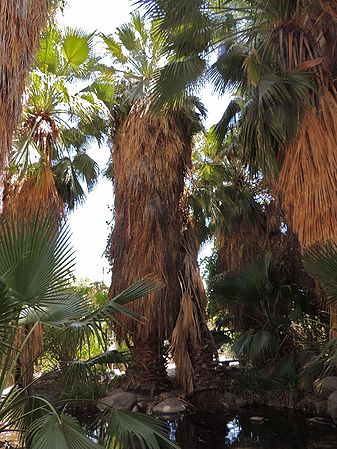
Living Desert arboretum, California
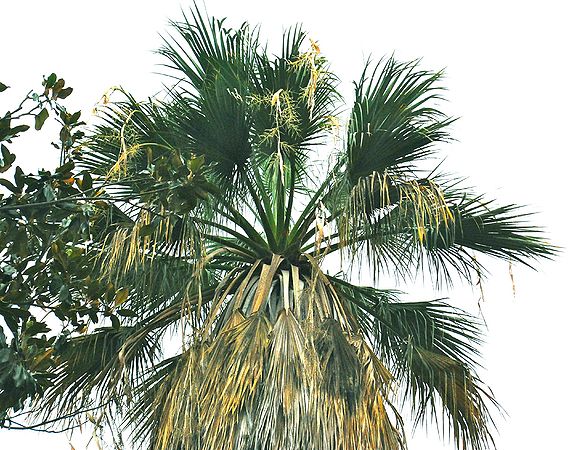
San Fernando valley, California

Antelope Valley, California

Huntington gardens, California
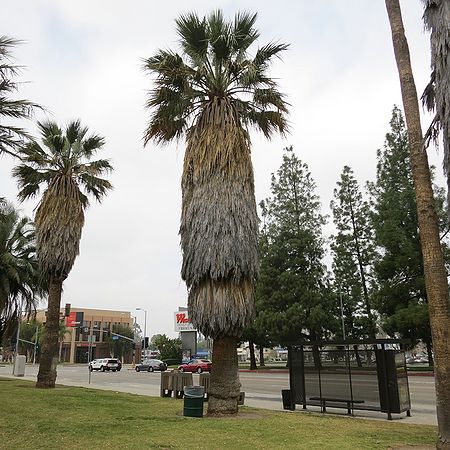
petticoat

San Fernando valley, California
palms with petticoats

native plant garden California

showing skirts

over-trimmed palms in Palm Desert, California

crown

close up of crown

crown shot
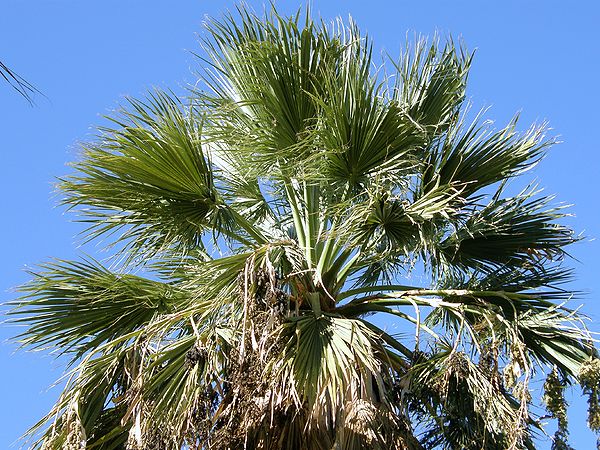
partial crown shot

petiole shot

juvenile volunteer

young palm in desert

old palms in Huntington gardens

underwatered palm showing sparse crown

ringed trunk

juvenile palm

dead palm

another suddenly dead palm

infructescence

fruits

fruits and finch

Washingtonia filifera (shorter thick trunk) and robusta (tall, thin and bent trunk)

Washingtonia filiferas" and a single "Washingtonia robusta" on the left

Washingtonia filifera and a Washingtonia robusta trunk


