Pinanga coronata
Geoff Stein - Author & Editor
Common Name: Ivory Cane Palm
Pinanga coronata is just one of over 90 species of Pinanga that have been described, but easily one of the most cold hardy of the lot and one of the few that can be grown easily in many of the milder climates in California. This is surprising if you consider these are from the South Pacific Islands- a very tropical origin. Pinangas are among the most colorful and ornamental of the palms, and Pinanga coronata is no exception, though it is not one of the most colorful of the genus. It is a suckering, tropical looking species with variably pinnate leaves
Synonym: Pinanga kuhlii
|
Appearance and Biology
|
Horticultural Characteristics
|
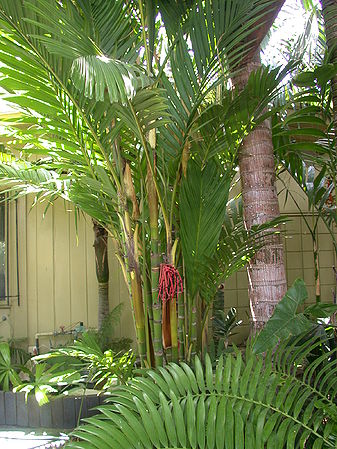
garden of Ralph Velez, Orange County, California

Velez palm

San Diego county, California

garden of Matt Bradford, San Diego county, California- two varieties

garden of Jim Denz, northern California


estate of Pauleen Sullivan, Hawaii


garden of Matt Bradford, San Diego county

Bradford collection

new leaf, California

Bradford plant, San Diego county


Zoo in Hilo, Hawaii

Floribunda Palms, Hawaii

flowers on palm in Ventura, California


Pauleen Sullivan palm flowers in Ventura


carpet of seedlings in Lundkvist estate, HAwaii


